the Creative Commons Attribution 4.0 License.
the Creative Commons Attribution 4.0 License.
 | 16 Feb 2026
The menhir: aesthetic politics of radioactive waste disposal in northern Switzerland
Rony Emmenegger
Federico Luisetti
Geological disposal projects rest on the assumption that radioactive waste can be safely managed through its spatio-temporal separation from human life at the surface. This paper examines how a local farmer in the Zürcher Weinland – one of the regions considered for nuclear waste disposal – disrupted this assumption by rendering the radioactive hazard perceptible through a series of landscape interventions. Drawing on interviews, participatory observations, and document analysis, we show how these interventions – banners, barrels, and, most notably, a 30 t protest boulder, the menhir – provoked controversy over humanity's relationship with radioactive waste and its implications for the continuation of rural life. In dialogue with Jacques Rancière's work on aesthetics and politics, we argue that these interventions can unsettle the region's consensual political landscape and reveal how human and non-human actors can emerge as political subjects.
- Article
(10449 KB) - Full-text XML
- BibTeX
- EndNote


Politics is a paradoxical form of action. (Rancière, 2010:29)
Nuclear waste authorities and organizations promote deep geological disposal as the ultimate solution for the long-term management of radioactive waste. This approach rests on the premise that radioactive waste can be safely contained within a suitable geological stratum, eliminating the need for active human care in the long term (Schröder, 2016; Uggla, 2004). Although publicly presented as a consensual technoscientific endeavor, disposal projects also rely on the vision that nuclear waste can be separated from human life at the surface (Kearnes and Rickards, 2017; Schröder, 2016). In public and policy discourse, this vision is reinforced through an imaginary divide between the surface and the subsurface (Emmenegger, 2025; Gregson, 2012) – as realms marked by fundamentally different properties and temporalities (Pinkus, 2023). Envisioning geological disposal within a so-called “host rock” ultimately serves to disconnect hazardous waste from human life, spatially and temporally, to ensure the long-term protection of humans and the environment at the surface.
In this paper, we show how a local farmer in the Zürcher Weinland disrupted the unilateral vision that human life and hazardous waste can be kept apart through geological disposal. The region located in northern Switzerland has been the focus of the Swiss National Cooperative for the Disposal of Radioactive Waste (Nagra) – the organization mandated to manage nuclear waste on behalf of the nuclear industry – as a potential site for geological disposal since the 1990s (Hadermann et al., 2014). Following the redesign of the nuclear waste siting process in line with a broader “participatory turn” (Kuppler, 2012; Bergmans et al., 2015), the region regained significance in 2011 as one of six potential disposal sites identified for further investigation (SFOE, 2008). As in the other regions, a so-called “regional conference” secured local participatory involvement and local consent in the subsequent stepwise decision-making process (Emmenegger, 2026a).
For Jürg Rasi, the local farmer at the center of this article, neither Nagra's initial exploration nor the begin of the participatory process in the region was of concern. This changed in 2013, when he learned that Nagra was considering his land as a potential site for a surface facility providing access to a subsurface geological repository. The selection of the surface site was an outcome of the participatory process and testified to the regional conference's decisive role in surface planning and decision-making (see also Emmenegger, 2026a). However, it put Rasi's farmland at risk and prompted him to establish a rural interest group, which he later transformed into the Ländliche Interessengemeinschaft Kein Endlager im Weinland (LiKE) association. Rasi chose not to participate in the siting process through the established local institution of the regional conference. Instead, he pursued an activist path, expressed through a series of material-aesthetic interventions in the landscape surrounding his farm.
In this paper, we trace Rasi's unconventional opposition to geological disposal plans in the Zürcher Weinland – from its inception to its conclusion in 2022, when Nagra selected another region, Nördlich Lägern, as its preferred site for geological disposal (see Emmenegger, 2025). Drawing on ethnographic research, as well as document and media analysis (see Appendix A), we examine LiKE's activist struggle and its formation as an assemblage of humans and non-humans (see also Bickerstaff and Agyeman, 2009) within an emerging political landscape. As we demonstrate, this struggle unfolded through a series of landscape interventions and included the placement of protest banners and barrels, through which Rasi symbolically staged the radioactive hazard at the surface. Most spectacularly, in 2018, it advanced through the placement of a 30 t boulder – the menhir – as a memorial protesting the plans for radioactive waste disposal on his land. While such interventions indeed appear to be rather unconventional in the context of institutionalized participatory governance processes (Hietala and Geysmans, 2022), anti-nuclear activism elsewhere reveals that they are not (see, e.g., Marila, 2024).
To capture the political nature of these material-aesthetic interventions in the landscape, we draw on Jacques Rancière's (2004, 2009) work on aesthetics and politics. In human and political geography, Rancière has gained prominence for his dissensual political thinking, which places disagreement and antagonism “at the heart of political change” (Blakey, 2021a:3; see also Bassett, 2014; Blakey, 2021b; Dikeç, 2005; Grayson, 2017). Contributing to a post-politics scholarly tradition (see also Mouffe, 2005; Wilson and Swyngedouw, 2014; Žižek, 1999), Rancière suggests that political order is not merely constituted through laws, regulations, and institutions, but through consensual regimes of the sensible – captured by his notion of aesthetics. If consensus is, as he argues, “a certain regime of the perceptible”, then politics, too, must operate at this foundational level. At the core of an aesthetic politics lies the staging of dissensus, which disrupts a consolidated “regime of the sensible” (Rancière, 2010).
Inspired by Rancière's aesthetic mode of political thinking (see also Blakey, 2021a; Moze and Spiegel, 2022), we examine Rasi's rural activism as a “paradoxical form of action” (Rancière, 2010:29) as follows: in Sect. 2, we introduce and extend Rancière's theory of aesthetic dissensus to demonstrate its potential for human geographers to conceptualize “the political” in relation to landscapes. In Sect. 3, we trace the formation of Rasi's farmer protest and show how he staged his dissensus with Nagra's geological disposal plans outside the institutionalized participatory governance framework designed to build consensus. In Sect. 4, we discuss how the placement of the menhir disrupted the landscape and how the stone emerged as a political subject. In Sect. 5, we illustrate how Rasi's landscape interventions challenged the techno-scientific vision of disposal – both spatially and temporally – by rendering radioactive waste perceptible at the surface. Finally, in Sect. 6, we conclude by reconstructing the constitutive role of landscape interventions in the formation of LiKE as an activist assemblage of human and non-human subjects and by underlining the potential of aesthetic politics to advance human geographers' understanding of political landscapes.
For human geographers, landscapes are not passive backdrops to politics but are inherently political. Yet, what constitutes “the political” in relation to landscapes has been subject to debate. Human geography scholarship has been profoundly shaped by Denis Cosgrove's (1985) seminal work on landscapes as a “way of seeing”. In a radical departure from the classical understanding of the “aesthetic” landscape as an object of scenic appreciation for its beauty and sublimity, Cosgrove argued that landscape is a structuring or ordering of the world and thus infused with power and authority. While this departure from a narrowly “aesthetic” understanding marked an important step for human geography, some have cautioned against “throwing the baby out with the bathwater” (Benediktsson, 2007:209). Among these critics, landscape scholars have argued that landscapes offer a “sensory appearance of the political” (Salwa, 2022:83), as they are shaped by politics and, in turn, evoke “deep emotional feelings” and “moral sentiments of care” (Benediktsson, 2007:213). As this literature suggests, aesthetics must take center stage in order to understand how power operates and can be contested in and through landscapes.
Bringing aesthetics back in, we argue that Rancière's work can help unpack the political nature of landscapes as a contested stage of the sensory world. For Rancière, the domain of aesthetics does not refer to “a theory of the beautiful” but rather to a political arrangement of the sensible – both perception and meaning.1 He captures this dual nature of the aesthetic field through the concept of the distribution of the sensible: “I call the distribution of the sensible the system of self-evident fact of sense perception that simultaneously discloses the existence of something in common and the delimitations that define the respective parts and positions within it” (Rancière, 2004:13). Aesthetics, in this sense, simultaneously inscribes the “consensus” about the common world and defines who belongs where, who gets to speak or act, and who does not (Rancière, 1999:51–53). Rancière captures this simultaneity eloquently in his original French concept le parage du sensible, which denotes both partaking and partitioning (Dikeç, 2005).
For Rancière, aesthetics is inherently political. In his 2009 article, he proposes approaching the relationship between aesthetics and politics in two ways: first, as an aesthetic of politics, which captures the specific configuration of a sensible texture that orders, and second, as a politics of aesthetics, which captures the ways in which sensible experience becomes disrupted through aesthetic means. At the core of aesthetic politics lies the “staging of a dissensus – of a conflict of sensory worlds” (Rancière, 2009:11). Importantly, for Rancière, the staging of dissensus is not primarily about introducing concerns into the political realm but about initiating the political subjectivation of those who act. The notion of political subjectivation is analytically significant, as it highlights that subjects do not pre-exist politics but emerge from political practice once they question the existing social hierarchies and their roles and places assigned to them within a consensual regime of the sensible (Rancière, 2010:91–96). Politics is thereby paradoxical as it involves acting from a position that does not (yet) exist within the consensual world.
Against this backdrop, we argue that Rancière's theory of aesthetic dissensus holds significant potential for human geographers seeking to grasp “the political” in relation to landscapes. In a recent work on landscape painting, Rancière (2023:67) – commenting on Edmund Burke's philosophy of place – notes that “a landscape is the reflection of a social and political order” and that “a social and political order can be described as a landscape”. Here, Rancière explores the emergence of landscape in painting and traces its connection to the “upheaval” of the French Revolution and the emergence of new forms of sensible experience at the time (Rancière, 2023:x). Yet, in this work, Rancière considers landscape only as a specific configuration of experience in the arts that helped the West reorganize its relation to nature and social order. His theory of political action – grounded in the concept of the distribution of the sensible and dissensus – has evolved in parallel but has left largely unexplored how politics, as a paradoxical form of action, plays out in practices and processes that shape landscapes.
To fill this gap, we argue that Rancière's dissensual thinking can significantly enrich human geographers' understanding of political landscapes along two lines. First, it allows an exploration of how a political order can materially consolidate as a sensible configuration and how such an order can be contested through material-aesthetic interventions (see also Di Stefano et al., 2022). Examining the aesthetic constitution of a political landscape in this way is not a material-semiotic move that gives meaning and authority – or knowledge and power – a material form (cf. Moore, 2005; Duineveld et al., 2017). Rather, it aligns with Rancière's principle that “the essential work of politics is the configuration of its own space” and “to make the world of its subjects and its operations seen” (Rancière, 2010:38). Second, Rancière's work inspires an understanding of landscapes not simply as products of politics but as constitutive of political action and subject formation. Instrumental to this is his notion of political subjectivation, through which subjects emerge from political practice once they question existing social hierarchies and the roles and places assigned within them. Political subjectivation is not merely an effect of the struggle over being in the world (cf. Haraway, 2008; Imoberdorf and Emmenegger, 2020) but concerns the process of making one's role and place perceptible within it.
Rancière's dissensual thinking, we suggest, provides a lens for understanding the aesthetic politics that shapes or disrupts landscapes and determines who and what can emerge as a political subject within them. However, capturing political landscapes along these lines also requires moving beyond Rancière's exclusive focus on human and speaking subjects. Federico Luisetti (2023) has recently suggested that political subjectivation can also occur for non-humans. Building on the work of Marisol De la Cadena (2015), he proposes that non-humans may emerge as political subjects when their presence disrupts a specific socio-natural configuration of the sensible. Rather than presupposing the existence of an inherent political agency of non-humans (e.g. Bennett, 2010) or its emergence as a relational property (e.g. Latour, 1993), Luisetti (2023:44) argues that non-humans such as “geobodies” and “earth-beings” acquire political significance through events – such as natural catastrophes or social insurgences – that unsettle perception and, with it, a particular aesthetic configuration of the socio-natural order. As we demonstrate in the following sections, such a reading holds significant potential for understanding the formation of LiKE as an activist assemblage of human and non-human subjects and, more broadly, for thematizing forms of politics that mobilize non-human entities as allies in political struggles (see also Quintana, 2020).
3.1 Building consensus
Already in the late 1990s, Nagra intensified its geological investigations in the Zürcher Weinland due to the presence of an Opalinus clay substrate with favorable properties for the deep geological disposal of high-level radioactive waste in Switzerland. Most significantly, Nagra's investigation in the municipality of Benken – neighboring Marthalen where Jürg Rasi resides – proved instrumental for the so-called disposal proof as techno-legal foundation for the continuation of the disposal project and the search for a suitable site (Nagra, 2002). However, local resistance also emerged within the green and left-wing milieus, initially organized by two activist groups that later merged into KLAR! Schweiz (Kein Leben mit atomaren Risiken). Site selection became more complicated as political resistance emerged elsewhere in central Switzerland around Nagra's small- and mid-level waste disposal project and its subsequent failure. This failure ultimately forced government authorities to abolish the local veto right and redesign nuclear waste governance processes along participatory lines (NEA, 2003; SFOE, 2008; see also Krütli et al., 2010; Kuppler, 2017).
The Zürcher Weinland – subsequently referred to as Zurich North East (ZNO) – regained attention with the start of the sectoral plan process, when Nagra listed it as one of six potential disposal regions for further investigation. KLAR! also joined the newly established regional conference as one of the local stakeholders in 2011 (see Adler, 2023; Emmenegger, 2026b). At that time, Rasi was hardly concerned about the region's renewed nomination as a potential disposal site. This changed in 2013, when he received a letter from Nagra informing him that his farmland was under consideration as the location for a surface access facility to a future repository. Rasi's land had come into focus after the conference had rejected Nagra's initial proposals for potential surface sites – among other reasons, due to their location above groundwater protection areas (D1, 2014:27; see Nagra, 2011). The conference had concluded that “no suitable site for a surface facility” could be identified within the proposed perimeter (D1, 2014:1). Nevertheless, it had left open the possibility for Nagra to conduct further investigations at the site deemed the “least unsuitable”, should the geological assessment across the three regions “lead to the conclusion that a deep geological repository can only be realized in the ZNO region for safety reasons” (D1, 2014:38). For the conference, this openness was a strategic move to secure its continued participatory involvement in the siting process and to prevent Nagra from proceeding independently and in a top-down manner (D1, 2014:39).
In late January 2014, the regional conference approved the proposal to further evaluate the suitability of Rasi's land around Isebuck – the site now labeled ZNO-6b. Ahead of the next meeting in mid-May, the conference board invited Rasi to speak at a panel discussion, where he voiced strong concerns about the proposal, which affected not only his farm but also “most of his property” (D2, 2014:5). At the time, Rasi appeared to have only a limited understanding of the complex nuclear waste governance structure, particularly the decisive role of the regional conference in the participatory process and in siting the surface facility on his land. He expressed a clear sense of powerlessness in the face of what he perceived as Nagra's top-down decision-making approach and the conference's lack of critical engagement. Rasi's subsequent call for a “right of co-determination and veto” (D2, 2014:5), however, was countered by the cantonal building director equally invited to the panel. The director asked rhetorically, “If the geologists' investigations [across the different regions] conclude that, unfortunately, it now affects your property, Mr. Rasi, how would you react?” (D2, 2014:5). The question was rhetorical: the right-wing politician had just emphasized that “safety, and only safety, is decisive” as the criterion for selecting a disposal region – implicitly making clear that this collective aim should not be jeopardized by the individual interests of a single farmer (D2, 2014:5). Rasi's immediate response avoided any NIMBY-like reasoning. Instead, he underscored that, if this were the case, “for better or worse”, he would have to accept the decision, as “the people of Weinland have always taken responsibility and have never shirked their responsibilities” (D2, 2014:6). Yet, he also voiced procedural concerns about the rather technocratic way Nagra had justified the feasibility of surface facility – despite its location above groundwater.
Despite Rasi's intervention, the regional conference's surface committee continued to evaluate the potential facility at site ZNO-6b in accordance with its institutional mandate. Yet, increasing doubts about the site's suitability also began to emerge among committee and conference members, largely due to limited knowledge about the actual boundaries and flows of the groundwater aquifers and the corresponding safety implications of a surface facility for drinking water. These uncertainties had prompted the conference as early as 2013 to commission Nagra to conduct further investigations (D1, 2014:85; D3, 2016:49), with findings subsequently presented in conference meetings (Nagra, 2017). Nagra's new insights into groundwater flows at the site ultimately led the conference to call for an “opening up” and a renewed consideration of potential surface sites comparable to ZNO-6b years later, in April 2020. By December 2021, attention had shifted to a comparable site in the neighboring municipality of Benken (ZNO-21) – a location not far from Rasi's farmland but reportedly not in conflict with groundwater use (D4, 2021).
By then, however, Rasi's struggle was no longer merely about his own land: it had evolved into a broader contestation of the inherent threat that radioactive waste disposal posed to the continuation of agricultural life in the region. As part of this struggle, Rasi later admitted that he had indeed followed the conference's proceedings, occasionally attending meetings to stay informed and take part in discussions. Nevertheless, he regarded the conference as a largely apolitical institution – an impression, in his view, reinforced by its lack of transparency, minimal public engagement, and the delegation of communication efforts to Nagra. Viewing local participation merely as an “alibi” to “justify” decisions made elsewhere (I1, 2021), Rasi had deliberately chosen to organize his resistance outside the institutionalized participatory framework. Instead, he advanced it through a series of aesthetic interventions in the landscape, as the remainder of this paper illustrates.2
3.2 Staging dissensus
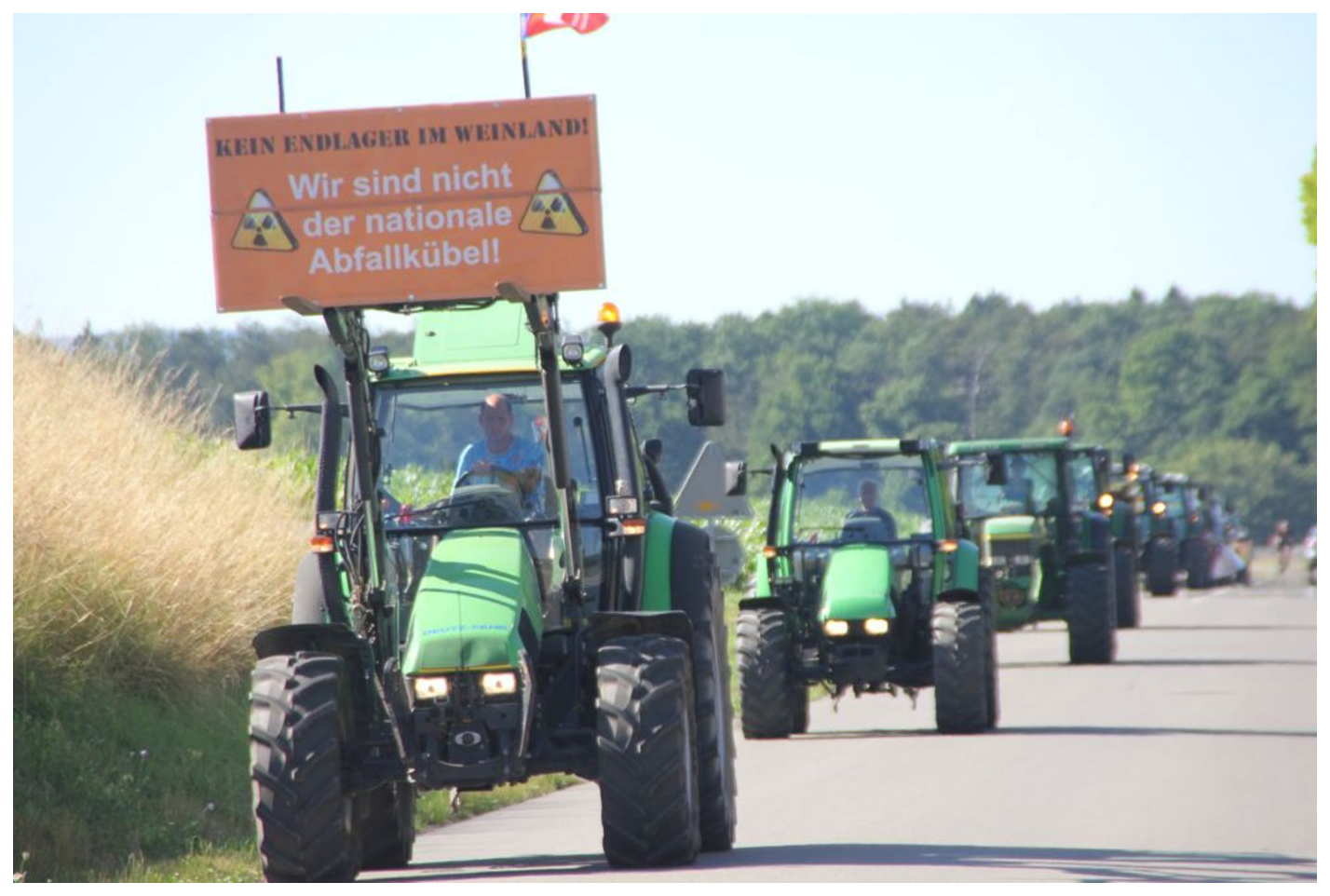
Figure 1Farmer protest in Marthalen (N16, 2014; see also N17, 2015).
The prospect of nuclear waste being disposed of on his farmland represented for Rasi a fundamental threat to his future as a farmer and compelled him to act in a paradoxical way. In 2014, he led a convoy of tractors to the municipal center to disrupt an event organized by the Department of Energy – the government authority leading the sectoral plan process – where the news about the site proposal was to be officially announced (N1, 2019:7). The action proved effective in mobilizing other farmers and laid the groundwork for collective action. Rasi focused his efforts on the rural community, thereby distinguishing his movement from KLAR!, a local association rooted in the green-left and anti-nuclear milieu (Adler, 2023; Emmenegger, 2026b). In 2015, this mobilization culminated in the creation of a community of interest (interessengemeinschaft, IG) to advocate for rural interests in the siting process and to oppose Nagra's repository plans. His campaign included a series of high-visibility protests using agricultural machinery adorned with bright banners bearing slogans such as “we are not the national waste basket” (see Fig. 1). In less spectacular but equally symbolic acts, Rasi also placed signs along the road crossing his land to raise awareness of rural concerns and the importance of preserving the agricultural landscape.
Rasi decided to consolidate and revitalize local mobilization towards the end of the second stage of the sectoral plan process, when the federal government was about to confirm the Zürcher Weinland as one of three potential disposal regions. In August 2018, he transformed his community of interest into a formal association with the stated objective “to preserve our natural, rural living and working spaces for future generations, to critically assess the construction of a potential nuclear repository, and to oppose it if necessary” (D5, 2020, emphasis added). The new name, LiKE (Ländliche Interessengemeinschaft Kein Endlager im Weinland), maintained a reference to the previous initiative while emphasizing the group's firm opposition to repository plans in the region (N2, 2018). The positively connoted abbreviation “LiKE” further reinforced the group's “local-patriotic” stance – particularly through the “L”, which, as Rasi explained, expresses a strong “love” for the “land” (N2, 2018).
The reconstitution of LiKE was not merely a matter of rebranding but part of a strategic effort to expand the struggle beyond the rural milieu. As Rasi emphasized, the notion that opposition to nuclear power is voiced only by the political left or the greens is “a cliché” (N2, 2018). He countered, “You don't have to be left-wing or green to oppose the destruction of nature and our homeland!” (N3, 2018). However, LiKE's blurring of political boundaries sparked tensions that came to the fore during a panel discussion organized for the association's founding event (N3, 2018): one of the invited speakers, the president of the Zurich Farmers' Association, used the platform to clarify his organization's position, emphasizing the need to set aside local self-interests and to place trust in scientific expertise and science-based site selection. In response, the other speaker – a prominent KLAR! board member – challenged this stance, questioning why the Farmers' Association, which routinely opposes environmental and infrastructural projects to defend cultivated land, remained silent in the face of radioactive waste disposal. The debate highlighted the underlying tension between the tendency of right-wing politicians in Switzerland to support pro-nuclear arguments, while disregarding the potentially negative consequences for the rural constituency they claim to represent. The tension, however, remained unresolved at the end of the event.

Figure 2LiKE foundation in Marthalen (N2, 2018).
Rasi's activism not only destabilized established political relations – both between and within political parties – but also disrupted the prevailing vision of geological disposal. Central to this disruption were not only rhetoric arguments but also the visual language through which he made radioactive waste and its potential harm perceptible at the surface. At the association's foundational event, LiKE's members ceremonially removed the old banner from a tractor, revealing a new green one underneath (see Fig. 2). The new banner continued to convey the hazard of radioactive waste through the association's name, displayed in yellow lettering – aligning with the visual language of (trans-)national anti-nuclear movements (see Kirchhof and Meyer, 2014), including KLAR! The name appeared against a green background symbolizing the rural environment that LiKE sought to defend. This green field was bisected by a horizontal line that visually introduced a vertical connection between the subsurface and the surface. Along this line, a small plant was depicted growing upward.
This image of a plant rooted in radioactive waste was evocative. On the one hand, it made visible the danger of radioactive waste stored underground; on the other hand, it mirrored the trifoliate form of the international radiation warning symbol (often referred to as a “trifold”) with its three-bladed shape. The plant thus suggested an imminent threat to life on the surface from radioactive waste buried below, blurring the boundary between life and death, in line with Rasi's characterization of radioactive waste as a “cancer in nature” (N2, 2018). In effect, the plant rendered the looming threat perceptible, unsettling the aesthetic of the cultivated landscape that underpinned and sustained agricultural life at the surface. Moreover, the image disrupted the strict division between the surface and the subsurface – and, with it, the technoscientific vision of geological disposal that assumes radioactive waste and human life can be kept strictly apart.
4.1 Landscape disruption
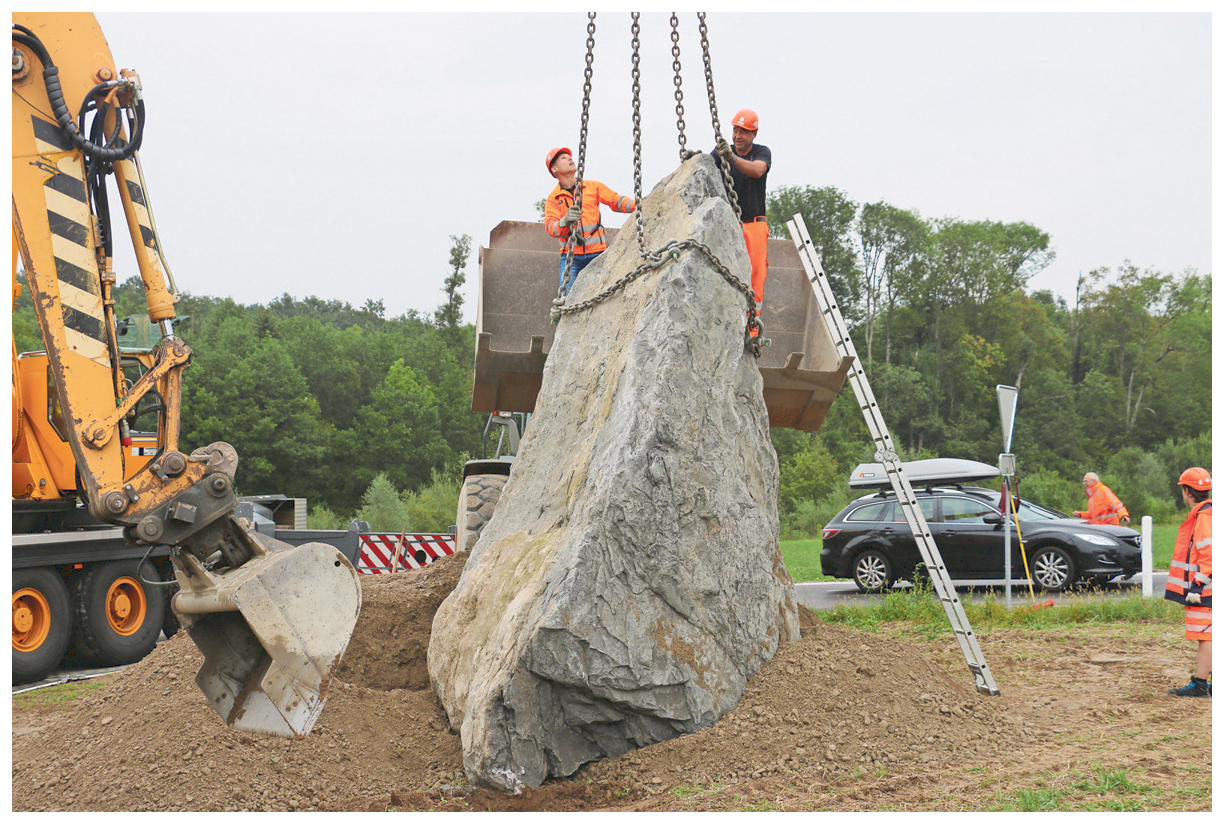
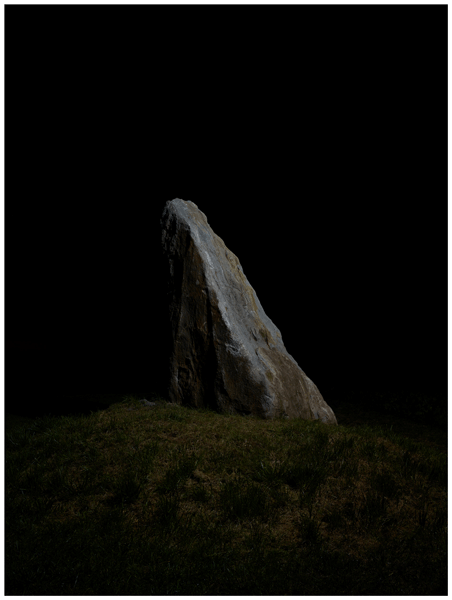
Figure 3The menhir of Marthalen (N5, 2018).
Already during the founding meeting, Jürg Rasi had announced the upcoming launch of LiKE's “first, highly visible action” (N3, 2018). A few days later, on a morning at the end of August 2018, a heavy transporter stopped at the crossroads between the municipalities of Benken and Marthalen, next to Rasi's farm, to unload a 30 t boulder. Several of LiKE's members and volunteers assisted with the placement of the sandstone after its arrival at around 09:00 LT, completing the installation by approximately 11:00. LiKE strategically positioned the 4.5 m high stone on Rasi's land as a memorial protesting the proposed construction of a deep geological repository for radioactive waste. Shortly afterward, the association's green banner was added to the site, disrupting the rural scenery by staging the looming radioactive threat (see Fig. 3). As Rasi (I1, 2021) later explained, it was crucial to make a visible and perceptible statement, since the geological disposal plans were otherwise largely invisible.
LiKE's action attracted immediate local media attention and gave new momentum to its struggle. Yet, LiKE did not act alone when placing the stone: long before, Rasi had approached KLAR! after concluding that resistance against the advancing disposal plans lacked a symbolic presence that could render it both visible and memorable. A KLAR! board member subsequently proposed the idea after spotting the sandstone in a quarry in the canton of Schwyz. This collaboration between the two activist groups – both rooted in the same region but embedded in distinct socio-political milieus – was kept secret. In media commentary, Rasi therefore referred only to an anonymous “generous benefactor” who had made the installation possible (N4, 2018). In fact, KLAR! had covered the transportation costs, and the stone soon became a key site of reference for its members as well. Nevertheless, KLAR! never publicly acknowledged or questioned the stone's symbolic association with the “Rasi family” (D6, 2019).
Despite its political–economic entanglement, the stone emerged as a constitutive site for LiKE's political struggle and identity. Originally named the “Devil's Stone” (D5, 2020), LiKE had adopted a KLAR! member's proposal to name the sandstone in reference to a well-known Swiss myth: the story of humans making a pact with the devil to build a bridge across the Schöllenen Gorge in the Swiss Alps, on the condition that the devil would claim the first soul to cross it. Echoing the original tale, the repository's Devil's Stone offered a mythical critique of human hybris and of geological disposal as yet another megalomaniac technoscientific project. Notably, LiKE's version of the story remained silent about the myth's ending – where humans, instead of sacrificing a human soul, tricked the devil by sending a billy goat across the bridge, thereby fulfilling the pact while enraging the devil. Nevertheless, the mythical reference vested the sandstone with agency, unsettling perception and reconfiguring sensible socio-natural order at the site.
And yet, the name did not last long. As Rasi explained in 2021, he had never been fully comfortable with it, finding it too negative and academic to truly reflect his concerns. He was therefore quite pleased when, immediately following the stone's placement, a local journalist gave it a new political identity: the menhir of Marthalen (N5, 2018). In her report, the journalist drew a comparison between LiKE's struggle against the repository project and the resistance of the Gauls against Rome, with the menhir serving as a quintessential symbol of strength and perseverance (N4, 2018). Rasi embraced this more positive and popular association. Beyond its value for rural mobilization and representation, he welcomed the new name because it depicted the imbalance of power between his local resistance and the national disposal project, which, he was convinced, Nagra advanced in a top-down manner. He later said, “We can learn from their [the Gauls'] local patriotism, no matter how powerful the opponent is. Be it the Devil's Stone or the menhir, it should be a sign to think about – a memorial for all those who sell our region, our homeland for money, and for those who want to abuse our Weinland to get rid of dangerous nuclear waste” (D7, 2019).
With the placement of the menhir, Rasi had staged dissensus. In the regional conference meeting 2 weeks later, the cantonal building director – the same individual who had shared the podium with Rasi during the 2014 panel debate – criticized the intervention in Rasi's absence: “We don't need a menhir; rather, we need to support those who want to work creatively on solutions” (D8, 2018:5). He once more emphasized the pioneering character of the participatory process and the importance of thinking about the region's future beyond opportunistic or oppositional interests. For Rasi, however, the existence of the menhir proved instrumental. He used the site as his preferred place to meet with journalists and, at times, to debate with Nagra representatives. Strategically located at the crossroads, the gathering point offered an open view over the surrounding landscape shaped by forestry and agriculture, including Rasi's farm and farmland. During our interview at the site in 2021, this scenery allowed Rasi to describe the agricultural landscape and land use, recall his family's history on the land, and project a vision of a future nuclear facility onto it as a looming threat. His concern with the planned facility was related not only to its size and significant land use impact but also to the hazards and risks it posed to his farmland and agricultural life more broadly.
4.2 Political subjectivation
The placement of the menhir disrupted not only the techno-scientific vision of disposal projected onto Rasi's land but also the consensual political landscape at the site. It immediately prompted a response from municipal authorities. Because the menhir had been erected in an agricultural zone without a permit, the municipal council concluded that a subsequent building application was required. The municipal mayor therefore contacted Rasi to express concern and request that he apply for the permit retrospectively. Rasi considered the demand unjustified and refused. As he later claimed, he had evaluated potential restrictions on the plot and road safety regulations prior to the placement and had deliberately chosen not to apply for approval (N6, 2019). In mid-October 2018, the municipal council consequently formalized its demand for a permit in an official order, citing the need to assess the menhir's zoning conformity. Although such an assessment would require further investigation, Rasi's chance of receiving a permit appeared rather “unlikely”, and he therefore lodged an appeal (D5, 2020).
His appeal triggered a legal dispute between Rasi and the municipal council, resulting in a case before the Building Appeals Court. To determine whether authorization was required, the court had to assess the sandstone's status as “installation”, which would require a permit in an agricultural zone. The municipality considered the stone an artificial installation with a “visible and permanent” impact on “space and the environment”, claiming that approval was necessary in the “public interest” (D9, 2018). Rasi, in contrast, argued that the menhir was simply a “landscape element” and therefore did not require approval (D10, 2019:4). The appeals court sided with the municipality, stating that “the stone” could be subsumed under the federal legal concept of an installation – an “artificially created, permanent facility firmly attached to the ground”, for which a permit is required (N6, 2019; see also N7, 2019). It concluded that “the menhir was erected without prior planning permission in the agricultural zone and serves no agricultural purpose” (D10, 2019:5). The court also acknowledged that there is “considerable scope for discretion” to waive permission for an installation if there is no “public interest” – but not in the case of doubt. The menhir constituted such a case: first, due to its placement at the intersection of two state roads and, second, because it was erected on farmland designated for agriculture.
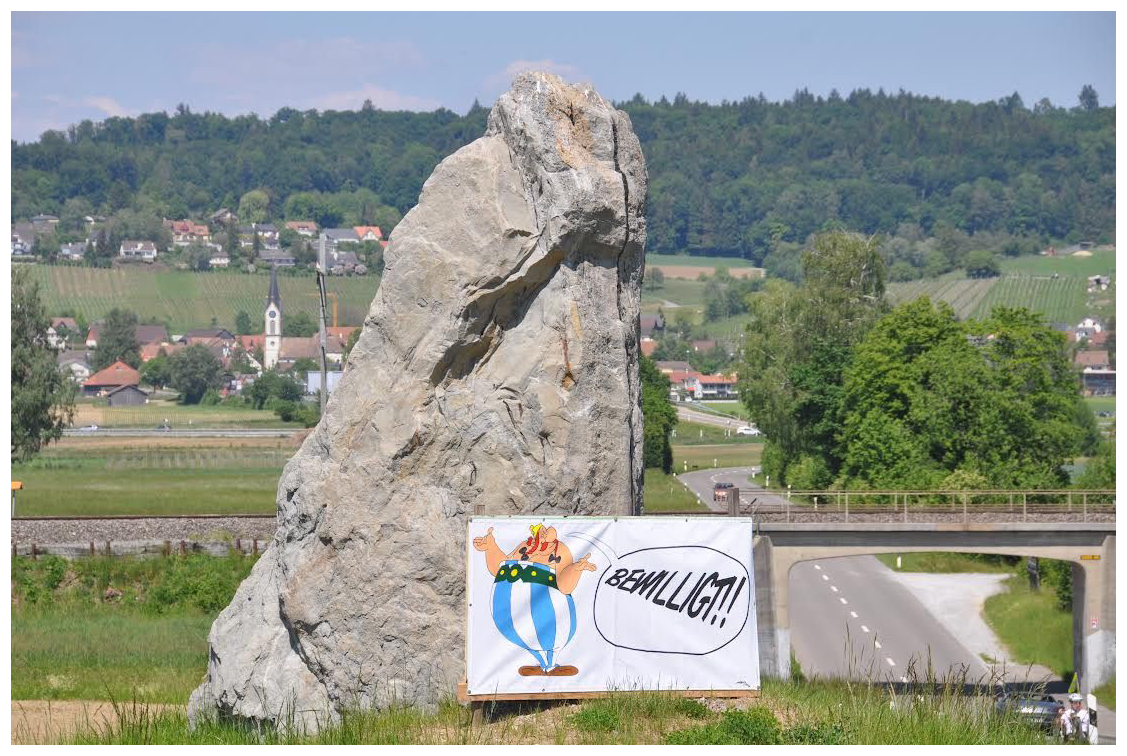
Figure 4The menhir of Marthalen (N18, 2020; see also N19, 2020).
The appeals court rejected Rasi's appeal, ruling that the requirements for approval must be assessed more precisely in a subsequent procedure by the Building Department. This decision weakened Rasi's legal position, requiring him to cover the appeal costs and leaving open the possibility that the menhir could be removed. Displeased with the ruling, Rasi again appealed to the cantonal Administrative Court. Despite his renewed effort, the higher court also rejected his complaint, ruling that a municipal building application was necessary and instructing Rasi to submit one. Like the lower court, the higher court considered the “spatial significance of [the] project as a whole” a determining factor (D10, 2019:5). During the legal proceedings, however, the stone's nature within the landscape had become increasingly ambiguous. Even at the lower level, the municipality had objected to the menhir's use as a platform for political messaging, arguing that such a “protest object” does not serve an agricultural purpose (D9, 2018:5). Rasi himself had emphasized the political character of the sandstone, describing it as a “silent and non-toxic memorial” opposing geological disposal at the site (D11, 2019:4). Building on this debate, the higher court acknowledged that the menhir's “source material and natural surface” did not, in itself, render it a “recognizable man-made object” (D11, 2019:5). Nevertheless, it concluded that the menhir's “height” and “dimensions” emphasized its function as a memorial, making it a “monument”, “sculpture”, or “statue”, all of which require a permit due to their “spatial impact” (D11, 2019b:5).
Against this backdrop, the cantonal Administrative Court did not simply reject Rasi's appeal but also acknowledged the menhir's political nature in its verdict. It called for a “neutral and unbiased” examination of the permit application to safeguard “freedom of opinion” (D11, 2019:7). The Building Department was thus requested to process the building application, which Rasi finally submitted, and concluded that an exceptional permit could be granted. To justify this decision, the department emphasized that the memorial draws attention to the potential impairment of Rasi's agricultural land due to the disposal project, rendering it “positively site-specific” and “no longer possible elsewhere in this way” (D12, 2020:3). The department thus recognized the menhir as a “borderline case”, where both its location in the agricultural zone and its role in exercising “freedom of expression” were decisive (D12, 2020:3). In granting the permit, it referred to its consistent practice of allowing “election and voting posters in the run-up to elections and votes … outside the building zone without a permit” (D12, 2020:6). The department did not, however, accept Rasi's argument that the menhir was “a stone and not a statue” (N7, 2019). Rather, it treated the stone as an “oversized poster stand”, justified in the context of a protest against the potential impairment of “site-specific” land use (D12, 2020:3).
The department finally concluded that “democratic opinion-forming must not be hindered without necessity … all the more as regional participation in the search for a [geological disposal] site is enshrined in the Nuclear Energy Act” (D12, 2020:3; see NEA, 2003). It further declared, “The fact that political participation in the Sectoral Plan procedure for a deep geological repository leaves its mark on the landscape must be accepted in a democratic society, provided that legal limits are respected” (D12, 2020:4). In-mid April 2020, the Municipal Council also approved the Building Department's decision at its meeting. As Rasi had argued during the case, he would have preferred an informal resolution with the municipality (N6, 2019). In the end, however, he was pleased with the legal dispute, as it had proven even more effective in securing media attention and keeping the menhir in the “political consciousness” (I1, 2021). Furthermore, the case was successful as it finally transformed the sandstone boulder into a political subject and an integral part of LiKE's activist assemblage. Yet, its political entitlement remained temporary. Even though the Building Department concluded that “the natural sandstone blends in aesthetically … well into its surrounding” (D12, 2020:4), the exceptional permit was time-bound: it was valid “until the end of the search for a site” through the sectoral plan in the region, after which “the sandstone must … be removed and the original condition restored” (D12, 2020:4).
5.1 Uncertain underground
The legal approval of the menhir finally gave Jürg Rasi reason to celebrate and inspired his family to create an Obelix poster simply “out of joy” the same night (N8, 2020; see Fig. 4). He considered the event “a silver lining on the horizon” (N9, 2020) and an important “political statement by the Canton” – now under the leadership of a new building director with a Green Party affiliation – which encouraged citizens to voice opposition and adopt a more critical attitude towards the geological disposal project (N9, 2020). He elaborated, “We are pleased about the Building Department's and the Municipal Council's rethinking. It's not enough just to talk about groundwater and technical safety. We need to consider in good time how badly people in the region will be affected by the huge construction project and the repository” (N8, 2020, emphasis added). In this vein, Rasi once again articulated the need to protect agricultural life and the region from the potentially harmful impact of a geological repository. This was not to suggest that discussions about rural life at the surface are more important than those about subsurface safety but rather that the two must be considered in relation to one another.
In his struggle to safeguard agricultural life at the surface, Rasi had long engaged in debates about subsurface dynamics and groundwater flows. LiKE's homepage stated, “Safe and clean groundwater is of eminent importance for agriculture and the rest of the population” (D5, 2020). In line with the regional conference's earlier call for further investigations of the actual aquifer boundaries and dynamics around ZNO-6b (see Sect. 3.1), LiKE had emphasized that “the groundwater area (so-called groundwater protection area Au) must be independently investigated, and it must be shown in a comprehensible manner how this area can be generously avoided” (D5, 2020) as a geological repository site. However, Rasi was not pleased when cantonal authorities subsequently proposed establishing a groundwater protection zone but suggested locating it beyond the surface perimeter designated for the repository, ZNO-6b (N10, 2019). Following the according information event in September 2019, LiKE submitted an open letter to the responsible building director, criticizing the cantonal authorities' uncritical stance in the debate and questionable planning proposal (N11, 2019). Reflecting a certain hope in the new building director, the letter was an unequivocal call not to “sacrifice” but to “stand up for” the affected rural population – who, as LiKE argued, should not also have to bear the costs associated with groundwater protection on top of those already associated with geological disposal (N10, 2019).
Rasi's relationship with the cantonal authorities remained tense as the controversy unfolded. In his view, the problem lay not only in the horizontal boundaries on the canton's groundwater protection map, but also in its rather “selective” (N10, 2019) focus on groundwater close to the surface. For Rasi, this approach to protection was problematic because it overlooked – or “deliberately ignored” – the significance of groundwater at greater depths as a resource and discouraged its further investigation (N10, 2019). In 2021, the cantonal government reaffirmed the importance of groundwater protection in accordance with the precautionary principle in an official statement (D13, 2021). In line with the regional conference (see Sect. 3.1), the canton also called for a surface facility without a so-called “hot cell”, where radioactive waste would be repackaged for final disposal, in order to reduce risks and ensure a fair distribution among the cantons. Unlike the conference, however, the cantonal government maintained Rasi's land as a potential surface facility site (D14, 2021:68), stating that “the ZNO-6b site is located outside the strategic area of interest for drinking water supply” (D15, 2021:13).
According to Rasi, the controversy finally escalated in January 2022, when the new building director publicly declared deep groundwater was not suitable for drinking water (N12, 2022; N13, 2022). This time, the director's focus was no longer on near-surface groundwater flows – the main point of contention in previous debates over surface planning – but on groundwater several hundred meters below ground. His shift in attention followed an interpellation submitted by a coalition of green-left cantonal councilors, who had argued that geological disposal would undermine potential future uses of deep groundwater as a resource (for example, for geothermal energy) and therefore required further investigation (D16, 2021). The building director, however, dismissed these concerns, countering that the deep groundwater was “mineral, i.e., salty” and therefore not of “drinking water quality” (N12, 2022; N13, 2022). Unsurprisingly, Rasi expressed little understanding for this reasoning, given the persistent uncertainties surrounding deep groundwater and his more dynamic understanding of the subsurface – one in which groundwater flows and agricultural life were ultimately connected (see also Aschwanden, 2020). He maintained that “some future generation will need it”, if not for drinking, then for irrigating crops (N13, 2022). Most importantly, he understood the canton's position as a clear sign that the repository project had moved beyond the realm of “facts” and firmly into that of “politics” (N13, 2022).
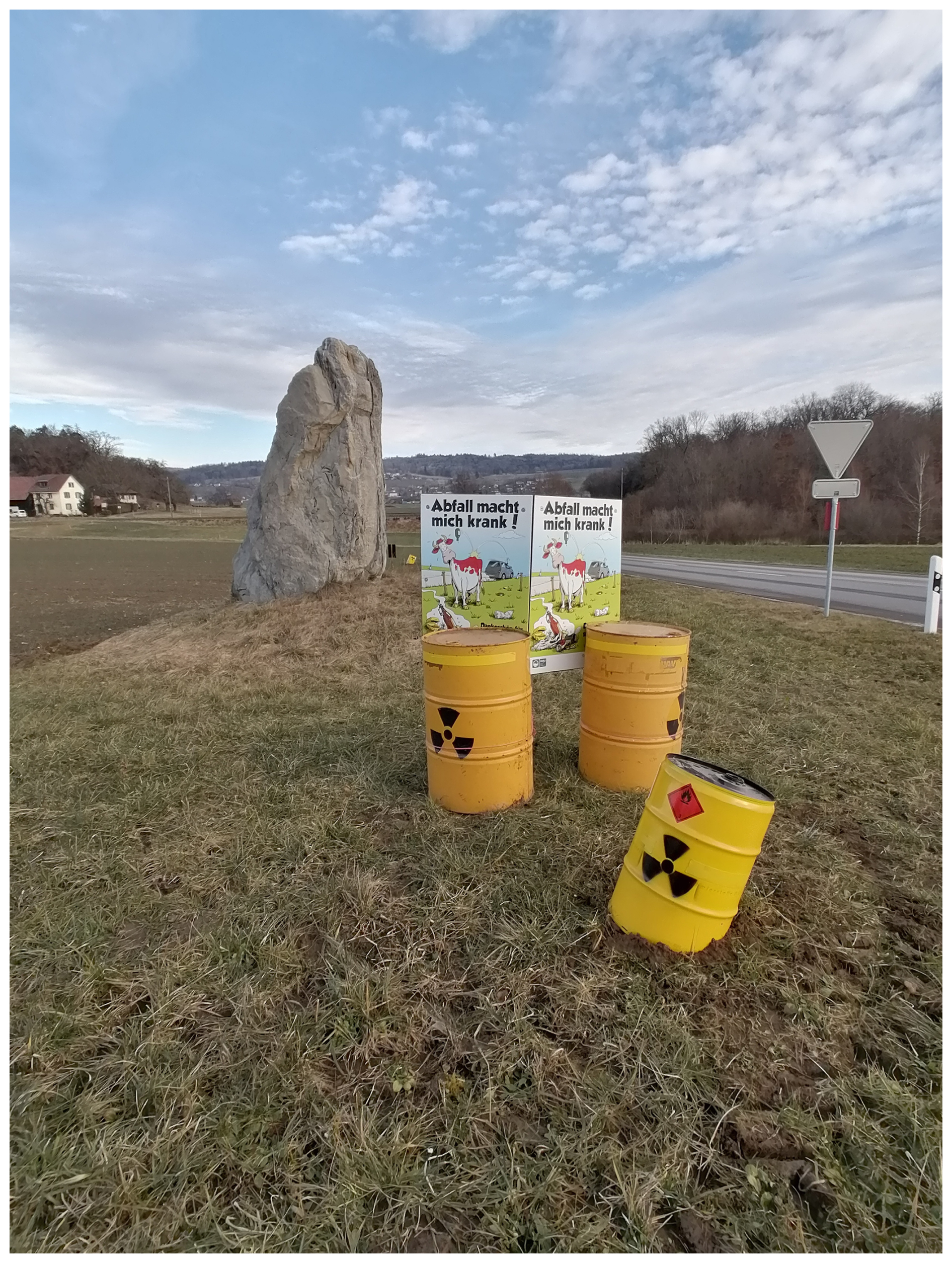
Given his disappointment with how the groundwater controversy had unfolded, Rasi once again intervened in the landscape (N13, 2022). In early 2022, he joined a campaign initiated by FAIE, propelled by the slogan “Waste makes you ill!”. The campaign aimed to draw attention to the environmental consequences of littering and garnered broad support in the rural milieu, including the Farmers' Association and farming households throughout Switzerland. By joining the campaign, Rasi displayed the banner next to the menhir and positioned several yellow barrels beside it (see Fig. 5). In doing so, he significantly expanded the notion of waste that the campaign had originally invoked – transforming his farmland into what a journalist had once described as the “atomic field” (N14, 2018). Placed as a warning signal around the menhir, this banner and barrels further disrupted the landscape. Indeed, the banner reflected a rather common means of drawing attention to rural concerns on agricultural land, and its presence therefore did not unsettle perception. The barrels, in contrast, did so by once again bringing to the surface the threat of radioactive contamination, which Rasi perceived as endangering the cultivated landscape he was determined to protect. Moreover, the barrels – marked with the three-bladed radiation warning symbol – served to question the ongoing governance process, which, as Rasi explained, placed him and his family under immense strain and was making them “slowly sick” (N13, 2022). While the barrels thus allowed Rasi to stage a dissensus regarding the unjust procedure and its bodily consequences, their political subjectivation did not advance further, as they were stolen one night shortly thereafter.
5.2 Deep time uncertainties
The upcoming selection of a disposal region by Nagra, scheduled by authorities for late summer 2022, gave further impetus to LiKE to intensify its struggle. Rasi decided to join KLAR!'s plans for a demonstration, which finally took place at the end of August 2022 on two adjacent yet separate, plots. KLAR! organized its event around the transnational cycling tour of the German anti-nuclear group Ausgestrahlt, effectively mobilizing support within the green-left milieu both inside and beyond the region (see also Adler, 2023; Emmenegger, 2026b). While KLAR!'s demonstration thus had transnational reach, LiKE's parallel gathering remained distinctly local, drawing primarily on supporters from the rural milieu. Although both events occurred in mutual solidarity and underlined the associations' shared goal, Rasi emphasized the importance of staying “to ourselves” to maintain a distinct rural agenda – something he saw as particularly important in a civic-dominated region (see also N15, 2022; I2, 2022). To that end, LiKE set up a small tent next to the menhir, with tables and benches for visitors to rest, eat, drink, and engage in discussion.
LiKE's supporters once again arrived with heavy agricultural machinery lined up along the road to Benken, visibly occupying rural space in opposition to the disposal plans. The scene clearly resonated with LiKE's earlier protests but was now supplemented by a new installation. A few days before the event, LiKE's members and friends had laid out a 180 m long line of tree trunks extending eastward from the menhir across the field, giving tangible form to the 1-million-year planning horizon of geological disposal. Three colored cords – blue, red, and yellow – were stretched in parallel along the trunks and ended close together, visually contrasting the immense temporal scope of geological disposal with the comparatively short durations of the Human Age (yellow), the Industrial Age (red), and the Atomic Age (blue) (see Fig. 6). In addition, A4 information sheets were placed along the trunks beyond the cords, informing visitors about the Earth's geological past, long preceding the appearance of humans. The sheets combined text and graphs explaining the sequence of radioactive decay over time, highlighting the early diffusion of isotopes after 10 000 years, the dominance of long-lived isotopes after 100 000 and 700 000 years, and the uncertainty of repository safety after 1 million years. The installation was thus not only a reflection on the deep past but also a provocation – exposing the profound temporal uncertainties of radioactive diffusion and containment.
The installation opened the landscape to speculation – or what Vincent Ialenti (2020) calls “deep time reckoning”. It did so not primarily by opposing the calculative logic legitimizing the disposal project (see Savransky et al., 2017, cited in Keating and Storm, 2023:99), but rather by juxtaposing it with the uncertainty and fragility of human history within deep time.3 Rasi explained before the event that the installation was built with the intention “to show the dimension of such a long time. And, perhaps, the arrogance of believing that we could create a building that is supposed to last that long. And, of course, the endless consternation of the region” (M1, 2022, emphasis added). Folding the future into the past, the installation turned deep time into an embodied sensible experience.

Visitors could walk along the trunks and sense different temporalities in relation to the Earth and each other. Next to the menhir and one remaining nuclear barrel, a banner posed the following central question: “[Is] a million-year nuclear repository (un)safe?” Visitors were invited to reflect on the question while walking or balancing along the trunks – from the present into the deep future, or conversely, from the past back into the present. As Rasi explained during the event, the walk begins at the menhir, where his struggle is presently grounded, and leads symbolically into deep time. Yet, the path was also open in reverse – especially for those who followed the recommendation of one of KLAR!'s speakers to visit LiKE's menhir installation after the conclusion of their own demonstration on the neighboring plot. In either direction, the walk – whether physical or symbolic – provoked reflections and conversations about pasts and futures and about the inherent epistemological uncertainties that accompany both.
By the time of the event at the end of August 2022, speculation had spread about which of the three remaining regions would ultimately be chosen. Although signs increasingly pointed to Nagra's preference for a region other than ZNO, Rasi considered speculation both absurd and even macabre, given the severe consequences that a decision in favor of the Zürcher Weinland would have for his livelihood and the region. In turn, he expressed little sympathy for the “secrecy of the authorities” and their communication approach regarding the upcoming announcement (I2, 2022). On 12 September 2022, Nagra finally declared that “geology has spoken”, naming Nördlich Lägern as the region in which to advance the disposal project (cited in Emmenegger, 2025). In the Zürich Weinland, the announcement was celebrated as a victory – particularly among activists within and beyond the regional conference, for whom it validated years of political work. In line with other critical voices, however, Rasi continued to express serious doubts about the integrity of the scientific investigations and evaluations underlying Nagra's proposal. He regarded the site selection as primarily “a political decision and not a scientific one”, arguing that Nagra had strategically chosen the region with the least resistance: Nördlich Lägern instead of the Zürich Weinland (M2, 2023).
Embracing this political framing of the decision-making process, Rasi also felt vindicated in his belief that the struggle had been worthwhile. As he put it modestly during a later conversation, “Apparently the open resistance (and the menhir played a central role in this) has at least influenced [the decision]” (M2, 2023). Although LiKE's struggle came to a good end, Rasi reached out to the family whose farmland now stood at the center of attention in the neighboring region of Nördlich Lägern. However, his offer to dislocate the menhir and move it to their site was kindly declined, as the family chose to pursue a more legalistic path for negotiating the future of their livelihood. With LiKE's struggle concluding, the association was soon dissolved, as was the regional conference in the ZNO region. In a closing ceremony, LiKE's members planted a tree at the site to preserve the memorial in the event that the menhir might one day be removed. Yet, Rasi remained skeptical about the long-term future of the siting process – not least because Nagra's proposal still required formal approval, and the ZNO region remained legally under consideration as a backup option in the event of complications at Nördlich Lägern (M2, 2023). The menhir remained at its original site, a silent witness to the region's contested history and uncertain future. Although the area grew increasingly quiet – aside from the regular traffic noise at the junction between Marthalen and Benken – the sandstone persisted, as Rasi had realized upon our earlier inspection, “alive” yet “transient” and “crumbling” (I1, 2021).
In the preceding sections, we have examined the aesthetic politics surrounding geological disposal plans in the Zürcher Weinland, northern Switzerland. Our analysis provides insights into how an anti-nuclear activist struggle unfolded – not within the usual green-left environmentalist circles, but within a rural milieu – beyond institutionalized participatory governance frameworks. What began as a seemingly opportunistic response by a farmer directly affected by the disposal plans gradually evolved into a political struggle for the continuation of agricultural life. While participatory governance processes arguably tend to depoliticize the issue of waste and the related risks (Gregson, 2012), this farmer, Jürg Rasi, unearthed radioactivity as a looming threat to life at the surface. He did so both deliberately, by staging dissensus outside institutional participatory frameworks, and tactically, in reaction to the institutionalized governance process itself. The case thus reveals the complex interplay between consensual and dissensual forms of action at the heart of political struggles that shape nuclear waste governance processes. Our analysis has focused on a series of material-aesthetic interventions through which the farmer and his association, LiKE, staged radioactive risk, hazard, diffusion, and decay within the landscape to provoke a reflection about humanity's relationship with radioactive waste and its implications for rural life. Building on Rancière's notion of dissensus, we have interpreted these interventions not simply as an instance of “ontopolitics” that renders radioactivity and risks politically tangible (cf. Gregson, 2012; Jones et al., 2014), but as a specific mode through which radioactivity was evoked to stage dissensus in the sensory world – offering an experience of otherwise invisible waste. In doing so, these interventions disturbed the unilateral vision that radioactive waste can be safely isolated from humans at the surface through its geological storage underground – contesting the spatio-temporal assumptions that underpin the project of geological disposal.
While this conclusion follows from Rancière's theory of aesthetic dissensus, our study of the farmer's aesthetic interventions into a political landscape allows us to apprehend the situated nature of the struggle and its political consequences. Even though Rasi fundamentally destabilized the vision of geological disposal, his interventions did not generate significant tension with national institutions – such as Nagra or the Department of Energy – the key actors promoting the project in the region. Rather, they provoked responses from local authorities – the municipality, and, particularly, the canton – whose authority over the landscape and claim to legitimate governance of rural life were disrupted and called into question. Significant in this regard were not so much the banners, as their appearance in the landscape for rural campaigns is relatively common in Switzerland. More consequential, however, was the placement of the menhir, as it unsettled the consensual sensory world and unleashed a process of political subjectivation through which the stone could join the opposition against the disposal plans.
Our analysis reveals the role played by an aesthetic politics of landscape in the formation of LiKE as an activist assemblage of human and non-human subjects operating within it. Against this backdrop, we suggest that bringing Rancière's theory of aesthetic dissensus into dialogue with landscape scholarship holds great potential for human geographers, as it allows “the political” to be captured in relation to landscapes along two lines. First, it reveals how a political order can materially consolidate as a sensible configuration and experience and how such an order can be contested through aesthetic means. Second, it draws attention to how a consensual political order is interlinked with the prescribed roles and agencies of humans and non-humans situated within it. For Rancière, “politics is a matter of subjects” (Rancière, 1999:35). Yet, political subjects are not exclusively human, nor do they pre-exist struggles. They emerge within the cradle of disagreement, as the fabricated illusion of consensus collapses.
Fieldwork and data collection were carried out solely by the first author as part of a larger research project on the politics of nuclear waste disposal in Switzerland. This included his presence at a wide range of public and professional meetings and events at the science–society interface in different potential disposal regions between 2019 and 2025. Ethnographic research in the Zürcher Weinland involved regular participation in meetings of the regional conference's safety panels and exchanges with KLAR! and LiKE activists between 2019 and 2022. For this article, in particular, the early history of the regional conference ZNO and LiKE has been reconstructed based on documents (regional conference meeting minutes and reports) and newspaper articles (exclusively from local media) available online. A draft version of the resulting paper was translated into German and made available to activists for review and feedback.
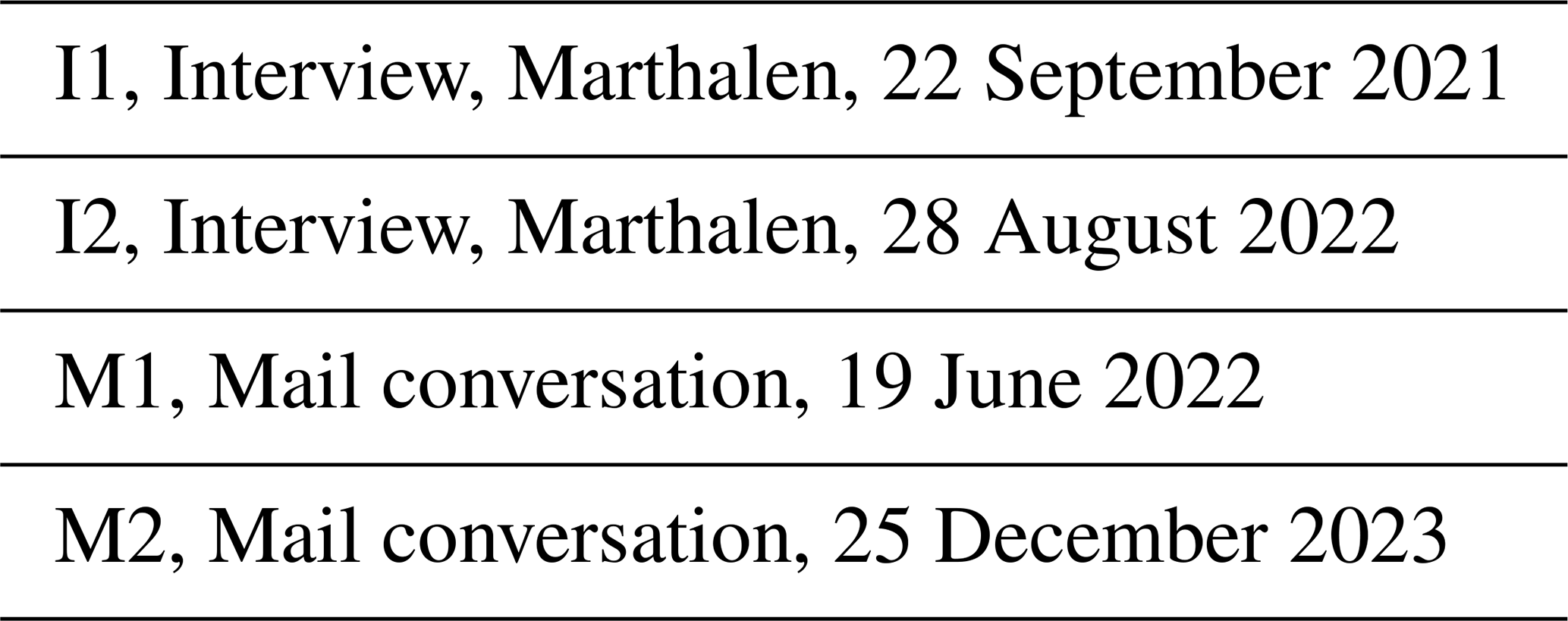
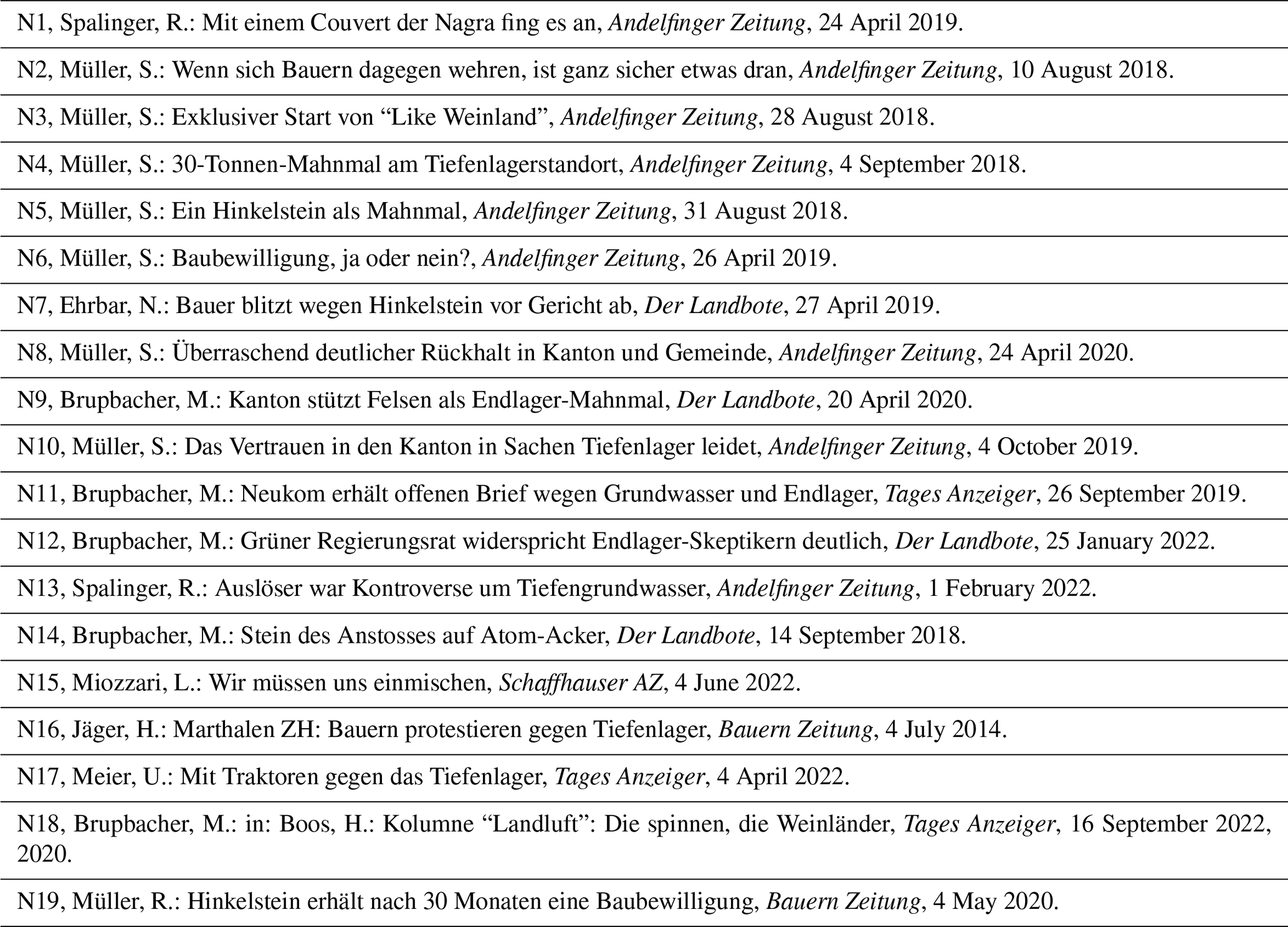

The data used for this article (see Appendix A) are publicly accessible in institutional and media archives – except data collected in informal conversations or interviews.
Both authors contributed to the conceptualization of the paper. RE conducted the fieldwork and collected the empirical material on which this article is based, wrote the article outline and approximately 90 % of the text, coordinated the writing process, and carried out the final editing. FL provided regular feedback on article drafts and the empirical case and contributed to the development and writing of the analytical argument.
The contact author has declared that neither of the authors has any competing interests.
Publisher's note: Copernicus Publications remains neutral with regard to jurisdictional claims made in the text, published maps, institutional affiliations, or any other geographical representation in this paper. The authors bear the ultimate responsibility for providing appropriate place names. Views expressed in the text are those of the authors and do not necessarily reflect the views of the publisher.
We are grateful to LiKE Weinland and KLAR! Schweiz for their positive response to this article, particularly Jürg Rasi, without whose support our analysis would not have been possible. Special thanks also go to the artist Marcel Rickli, whose collaboration around the menhir has been formative for our analysis (see the AEON project: https://marcelrickli.com/AEON, last access: 1 February 2026). We also thank the two anonymous referees and the journal editor for their support throughout the publication process.
This research has been supported by the Schweizerischer Nationalfonds zur Förderung der Wissenschaftlichen Forschung within the framework of the Nuclear Strata: The Political Geology of Nuclear Waste Governance project (grant no. 220005).
This paper was edited by René Véron and reviewed by two anonymous referees.
Adler, P.: Swiss Nuclear Waste Governance: Political Processes, Constructive Opposition, and the Role of Affectedness, Unruly Natures, https://unrulynatures.ch/Swiss-Nuclear-Waste-Governance (last access: 10 February 2026), 2023.
Aschwanden, R.: Strahlende Berge: Urner Opposition gegen ein Endlager für radioaktive Abfälle in den 1980er-Jahren, Traverse, 27, 53–70, 2020.
Bassett, K.: Rancière, Politics, and the Occupy Movement, Environment and Planning D: Society and Space, 32, 886–901, https://doi.org/10.1068/d5013, 2014.
Benediktsson, K.: “Scenophobia”, Geography and the Aesthetic Politics of Landscape, Geografiska Annaler, Series B: Human Geography, 89, 203–217, https://doi.org/10.1111/j.1468-0467.2007.00249.x, 2007.
Bennett, J.: Vibrant Matter: A Political Ecology of Things, Durham and London, Duke University Press, https://doi.org/10.1215/9780822391623, 2010.
Bergmans, A., Sundqvist, G., Kos, D., and Simmons, P.: The Participatory Turn in Radioactive Waste Management: Deliberation and the Social-technical Divide, Journal of Risk Research, 18, 347–363, https://doi.org/10.1080/13669877.2014.971335, 2015.
Bickerstaff, K. and Agyeman, J.: Assembling Justice Spaces: The Scalar Politics of Environmental Justice in North-east England, Antipode, 41, 781–806, https://doi.org/10.1111/j.1467-8330.2009.00697.x, 2009.
Blakey, J.: Accounting for Elephants: The (Post)politics of Carbon Omissions, Geoforum, 121, 1–11, https://doi.org/10.1016/j.geoforum.2021.02.006, 2021a.
Blakey, J.: The Politics of Scale through Rancière, Progress in Human Geography, 45, 623–640, https://doi.org/10.1177/0309132520944487, 2021b.
Cosgrove, D.: Prospect, Perspective and the Evolution of the Landscape Idea, Transactions of the Institute of British Geographers, 10, 45–62, 1985.
De la Cadena, M.: Earth Beings: Ecologies of Practice across Andean Worlds, Durham, NC, Duke University Press, https://doi.org/10.1215/9780822375265, 2015.
Di Stefano, E., Friberg, C., and Ryynänen, M.: Aesthetic Perspectives on Culture, Politics, and Landscape: Appearances of the Political, Cham, Springer, https://doi.org/10.1007/978-3-030-77830-9, 2022.
Dikeç, M.: Space, Politics and the Political, Environment and Planning D: Society and Space, 23, 171–188, https://doi.org/10.1068/d364t, 2005.
Duineveld, M., Van Assche, K., and Beunen, R.: Re-conceptualising Political Landscapes after the Material Turn: A Typology of Material Events, Landscape Research, 42, 375–384, https://doi.org/10.1080/01426397.2017.1290791, 2017.
Emmenegger, R.: Nuclear Strata: Enacting Clay for the Deep Geological Disposal of Nuclear Waste in Switzerland, Environment and Planning E: Nature and Space, 8, 978–1001, https://doi.org/10.1177/25148486251324935, 2025.
Emmenegger, R.: Safety and Participation: Citizens Challenging the Socio-Technical Divide in Nuclear Waste Governance in Switzerland, Safety Science, accepted, 2026a.
Emmenegger, R.: Out of Sight, out of Mind: Activism and the Scalar Politics of Nuclear Waste Governance in Switzerland, Journal of Political Ecology in review, 2026b.
Grayson, K.: Capturing the Multiplicities of Resilience through Popular Geopolitics: Aesthetics and homo resilio in Breaking Bad, Political Geography, 57, 24–33, https://doi.org/10.1016/j.polgeo.2016.11.013, 2017.
Gregson, N.: Projected Futures: The Political Matter of UK Higher Activity Radioactive Waste, Environment and Planning A, 44, 2006–2022, https://doi.org/10.1068/a44600, 2012.
Hadermann, J., Issler, H., and Zurkinden, A.: Die nukleare Entsorgung in der Schweiz 1945–2006, Verlag Neue Zürcher Zeitung, ISBN 9783038238904, 2014.
Haraway, D.: When Species Meet, University of Minnesota Press, ISBN 9780816650460, 2008.
Hietala, M. and Geysmans, R.: Social Sciences and Radioactive Waste Management: Acceptance, Acceptability, and a Persisting Socio-technical Divide, Journal of Risk Research, 25, 423–438, https://doi.org/10.1080/13669877.2020.1864010, 2022.
Ialenti, V.: Deep Time Reckoning: How Future Thinking Can Help Earth Now, MIT Press, ISBN 9780262539265, 2020.
Imoberdorf, I. and Emmenegger, R.: Diverging Worlds of Biodiversity and Biosecurity: The Presence of Wolves in a Swiss Alpine Territory, in: Managing the Return of the Wild: Human Encounters with Wolves in Europe, edited by: Fenske, M. and Tschofen, B., Routledge, 118–141, https://doi.org/10.4324/9781351127783, 2020.
Jones, R. M., Instone, L., and Mee, K. J.: Making Risk Real: Urban Trees and the Ontological Politics of Risk, Geoforum, 56, 211–225, https://doi.org/10.1016/j.geoforum.2014.07.009, 2014.
Kearnes, M. and Rickards, L.: Earthly Graves for Environmental Futures: Techno-burial Practices, Futures, 92, 48–58, https://doi.org/10.1016/j.futures.2016.12.003, 2017.
Keating, T. P. and Storm, A.: Nuclear Memory: Archival, Aesthetic, Speculative, Progress in Environmental Geography, 2, 97–117, https://doi.org/10.1177/27539687231174242, 2023.
Kirchhof, A. M. and Meyer, J. H.: Global Protest Against Nuclear Power. Transfer and Transnational Exchange in the 1970s and 1980s, Historical Social Research, 39, 165–190, https://doi.org/10.12759/hsr.39.2014.1.165-190, 2014.
Krütli, P., Flüeler, T., Stauffacher, M., Wiek, A., and Scholz, R. W.: Technical Safety vs. Public Involvement? A Case Study on the Unrealized Project for the Disposal of Nuclear Waste at Wellenberg (Switzerland), Journal of Integrative Environmental Sciences, 7, 229–244, https://doi.org/10.1080/1943815X.2010.506879, 2010.
Kuppler, S.: From Government to Governance? (Non-) Effects of Deliberation on Decision-making Structures for Nuclear Waste Management in Germany and Switzerland, Journal of Integrative Environmental Sciences, 9, 103–122, https://doi.org/10.1080/1943815X.2012.688752, 2012.
Kuppler, S.: Effekte deliberativer Ereignisse in der Endlagerpolitik: Deutschland und die Schweiz im Vergleich 2010 bis 2010, Cham, Springer, ISBN 978-3-658-18359-2, 2017.
Latour, B.: We Have Never Been Modern, Cambridge: Harvard University Press, ISBN 978-0-674-94839-6, 1993.
Luisetti, F.: Nonhuman Subjects: An Ecology of Earth-beings, Cambridge, Cambridge University Press, ISBN 978-1009442787, 2023.
Marila, M. M.: Rocky Legacies of Finnish Anti-Uranium Mining Social Movements: The Rock Art of Pessi Manner, Lähihistoria, 3, 32–61, https://doi.org/10.61559/lh.145345, 2024.
Moore, D. S.: Suffering for Territory: Race, Place, and Power in Zimbabwe, Durham, Duke University Press, https://doi.org/10.2307/j.ctv1168czt, 2005.
Mouffe, C.: On the Political, London: Routledge, ISBN 978-0415305211, 2005.
Moze, F. and Spiegel, S. J.: The Aesthetic Turn in Border Studies: Visual Geographies of Power, Contestation and Subversion, Geography Compass, 16, 1–17, https://doi.org/10.1111/gec3.12618, 2022.
Nagra (Nationale Genossenschaft für die Lagerung radioaktiver Abfälle): Sachplan geologische Tiefenlager Etappe 2: Vorschläge zur Platzierung der Standortareale für die Oberflächenanlage der geologischen Tiefenlager sowie zu deren Erschliessung (Genereller Bericht), Nagra technical report NTB 11-01, Dezember, 2011.
Nagra (Nationale Genossenschaft für die Lagerung radioaktiver Abfälle): Grundwasseruntersuchungen am möglichen Standortareal ZNO-6b für eine Oberflächenanlage. Nagra working report NAB 17-28, Dezember, 2017.
Nagra (Nationale Genossenschaft für die Lagerung radioaktiver Abfälle): Project Opalinus Clay Safety Report: Demonstration of Disposal Feasibility for SpentFuel, Vitrified High-level Waste and Long-lived Intermediate-Level Waste (Entsorgungsnachweis), Nagra technical report NTB 02-05, Dezember, 2002.
NEA (Nuclear Energy Act): Nuclear Energy Act, 732.1, Bern: The Federal Assembly of the Swiss Confederation, https://www.fedlex.admin.ch/eli/cc/2004/723/en (last access: 10 February 2026), 21 March 2003.
Pinkus, K.: Subsurface, University of Minnesota Press, ISBN 978-1517914790, 2023.
Quintana, L.: The Politics of Bodies: Philosophical Emancipation with and beyond Rancière, Washington, DC, Rowman & Littlefield, ISBN 978-1-5381-4357-5, 2020.
Rancière, J.: Disagreement: Politics and Philosophy, translated by: Rose, J., Minneapolis, University of Minnesota Press, ISBN 9780816628452, 1999.
Rancière, J.: The Politics of Aesthetics: The Distribution of the Sensible, edited and translated by: Rockhill, G., London, Bloomsbury, ISBN 978-0826470676, 2004.
Rancière, J.: The Aesthetic Dimension: Aesthetics, Politics, Knowledge, Critical Inquiry, 36, 1–19, 2009.
Rancière, J.: Dissensus: On Politics and Aesthetics, edited and translated by Steven Corcoran, New York, Continuum, ISBN 9781441119414, 2010.
Rancière, J.: Aisthesis: Scenes from the Aesthetic Regime of Art, London, Verso, ISBN 9781781683088, 2013.
Rancière, J.: The Time of the Landscape: On the Origins of the Aesthetic Revolution, Hoboken, NJ, Polity Press, ISBN 978-1509548156, 2023.
Salwa, M.: Landscape Aesthetics and Politics, in Aesthetic Perspectives on Culture, Politics, and Landscape: Appearances of the Political, edited by: Di Stefano, E., Friberg, C., and Ryynänen, M., Cham, Springer, 83–100, ISBN 978-3030778293, 2022.
Schröder, J.: Geological Disposal of Radioactive Waste: A Long-Term Socio-Technical Experiment, Science and Engineering Ethics, 22, 687–705, https://doi.org/10.1007/s11948-015-9650-4, 2016.
SFOE (Swiss Federal Office of Energy): Sectoral Plan for Deep Geological Repositories, Conceptual Part, https://pubdb.bfe.admin.ch/en/publication/download/3437 (last access: 3 April 2024), 2008.
Uggla, Y.: Risk and Safety Analysis in Long-term Perspective, Futures, 36, 549–564, https://doi.org/10.1016/j.futures.2003.10.020, 2004.
Wilson, J. and Swyngedouw, E.: The Post-political and its Discontents: Spaces of Depoliticisation, Spectres of Radical Politics, Edinburgh: Edinburgh University Press, ISBN 9781474403061, 2014.
Žižek, S.: The Ticklish Subject: The Absent Centre of Political Ontology, London, Verso, ISBN 978-8190583220, 1999.
For Rancière (2013:ix), to be precise, aesthetics has two related but distinct meanings: either as a historical “regime of art” or as “ways of perceiving and being affected” beyond the realm of art – what he captures as “the sensible”.
The Atomic Women (Kernfrauen) also organized their protest beyond the institutional participatory framework – most prominently through weekly vigils opposite the location where Rasi later placed the menhir (see https://www.kernfrauen.ch, last access: 1 October 2025).
As previously acknowledged, Rasi borrowed the idea from an exhibition at Museum Allerheiligen in 2013–2014 (see https://allerheiligen.ch/ausstellungen/ausstellung/langzeit-und-endlager/, last access: 1 October 2025), as did KLAR! on its homepage (see https://www.klar-schweiz.com, last access: 1 October 2025).