
the Creative Commons Attribution 4.0 License.
the Creative Commons Attribution 4.0 License.
 | 20 Mar 2026
Festivalisation in a new light: characteristics and objectives of light art festivals in Germany
Jochen Burger
As a nocturnal phenomenon in urban public space at the interface between the festivalisation of the city and the defamiliarisation of space at night through light art, light art festivals offer fruitful reference points for geographical perspectives. Although the night has become a research interest, light art festivals remain under-researched, despite the growing number of such festivals. This study is part of ongoing qualitative research and uses data from 25 light art festivals in Germany based on their spatial characteristics, implementation reasons and overall objectives. Furthermore, the article discusses the phenomenon of light art festivals in Germany within the international debate on the festivalisation and defamiliarisation of urban space. The findings indicate that the phenomenon is part of an ongoing process of festivalisation within urban marketing and policy strategies. This process is primarily being driven by small- and medium-sized towns with a spatial-structure growth tendency. Simultaneously, light art festivals in Germany are utilised as a medium for defamiliarising the perception of space, enhancing the image of the city through social media and addressing multiple challenges within the city centre.
- Article
(1632 KB) - Full-text XML
- BibTeX
- EndNote


Light art festivals, representing a dynamic field of temporary lighting with artistic aspirations in urban spaces, have developed in many cities worldwide over the last 2 decades. This newer type of event and festival, based on establishing light installations in public spaces and large-scale video projections on façades, is popular with visitors and numerous local stakeholders. Like other art festivals, light art festivals can be perceived as part of a broader trend towards the festivalisation of urban space and the implementation of urban policy tools to attract visitors and tourists (Quinn, 2005; Cudny, 2019; Mercer and Mayfield, 2015). Simultaneously, light art festivals introduce new elements to the geography debate on festivalisation, as Quinn (2019:11) writes in a commentary on her influential article from 2013 on art festivals: “technologically inspired festivals like light festivals … throw cities into new and different perspectives and encourage citizens to rethink the familiar in ways that require creativity and can be challenging, thought provoking and arresting”. Light art festivals are distinguished by their nocturnal occurrence, a characteristic that differentiates them from other festival formats. Darkness thus creates a “second city” at night that can be transformed with light art into what Edensor calls a “defamiliarised city”, where familiar space is examined for new experiences and possibilities (Edensor, 2015b; Lovell and Griffin, 2022). In this sense, the debate on festivalisation through light art festivals is expanded to include new facets. The central questions of this article concern what these facets are and whether and why organisers use these specific facets of light art festivals to establish festivals in urban space.
The Fête des Lumières in Lyon, founded in 1999 by local authorities to improve the city's image and tourism appeal, was the first festival to combine culture-oriented urban development and light art in a festival format. It is now regarded worldwide as a blueprint for implementing light art festivals in the context of urban development for many other cities and municipalities (Giordano and Ong, 2017). In Germany, the first light art festival to adopt a comparable approach to Lyon was founded in Braunschweig in 2000. Based on the findings of the present study, the number of light art festivals in urban areas in Germany had increased to 25 by 2024. While there appears to be a trend of intertwining urban development and festivalisation in Germany, no research has been conducted to investigate the spatial characteristics of light art festivals and objectives of the organisers.
While a rising number of light art festivals have been implemented in German cities, particularly in smaller towns, a literature review on light art festivals in the context of spatial science and urban geography reveals two distinctive characteristics of this special festival format, which have received less attention to date. Firstly, a lack of comprehensive and comparative analysis of both larger and smaller cities was identified by research focused on the international debate on large light art festivals in major cities or metropolises (Quinn, 2019; Skelly and Edensor, 2020). However, these are all generally single-case studies (Freire-Gibb and Lorentzen, 2011; Edensor, 2012, 2014; Estrada Grajales et al., 2015; Winton, 2016; Zielinska-Dabkowska, 2016; Miśkowiec, 2017; Camprubí and Lluis, 2019; Dell'Aria, 2021; Wenying and Hengton, 2022; Yin et al., 2023) or comparative analyses of various larger metropolises (Edensor, 2015b, 2021; Giordano and Ong, 2017; Edensor and Sumartojo, 2018; Lovell and Griffin, 2018; Bhatia, 2022; Lovell and Griffin, 2022). However, especially in these comparative analyses, there are no overviews of the characteristics (space, size, content, time) of this new format. Secondly, Foster (2022) notes that existing studies on the festivalisation of urban space generally refer to the economic or receptive effect, while the planning process and intentions are less considered. Despite the growing empirical relevance of this phenomenon and the increasing focus on light art festivals within the scientific debate, large-scale geographical studies on the intentions and reasons for implementation within a definable space, including smaller light art festivals, have been absent from international and German debates.
By analysing 25 light art festivals in Germany considered under the definition developed in Sect. 2, this article aims to consider the perspective of intentions to a greater extent and to shed light on the phenomenon in smaller- and medium-sized cities as well. The overarching objective is to facilitate a comprehensive understanding of a growing phenomenon within the context of German urban development and international literature. The article explores the following research questions:
- a.
What are the characteristics of light art festivals regarding space, size, content and time?
- b.
Who establishes light festivals, for what reasons and with what objectives?
- c.
What new insights do light art festivals bring to the urban geography debate on festivalisation?
Questions (a) and (b) address the characteristics and intentions of light art festivals and show that they can be classified as a phenomenon of festivalisation in the context of urban development. Thus, this has considerable relevance to urban geographical research, and question (c) analyses the new facets this festival format brings to the debate. This article proceeds as follows: after developing a definition and presenting the current state of research (Sect. 2), the methodology (Sect. 3) follows. Section 4 presents the study's results based on the above-mentioned questions, categorising and discussing the phenomenon within the existing academic debate. Section 5 concludes the article with the key findings and an outlook.
After providing a definition of light art festivals (Sect. 2.1), a brief analysis of the evolution of the debate on festivalisation over the past few decades is presented (Sect. 2.2). In the following step, existing studies on light art festivals are classified into two strands: one concerning the presented debate on festivalisation in urban spaces (Sect. 2.3) and the other based on the question of what new aspects light art festivals can add to the debate (Sect. 2.4).
2.1 Definition of light art festivals
Although the phenomenon of urban festivals has been defined by several geographers (Cudny, 2016), most authors studying light art festivals do not offer a precise and unambiguous definition of the term in their research. In his study on light art festivals in Portugal, Garcia-Ruiz (2019) criticises a discrepancy between what local stakeholders, authorities and the public understand by light art festivals. However, since the phenomenon of light art festivals can be flexible in terms of content and spatial design, this research requires a clear and distinct definition that classifies the phenomenon as an artistic phenomenon of festivalisation in the context of urban development. Finally, it is notable that light festivals were held even prior to the Fête des Lumières in Lyon, while most authors agree that Lyon was the first light art festival of its type (Zielinska-Dabkowska, 2016; Giordano and Ong, 2017; Camprubí and Lluis, 2019). However, these prior festivals did not generally adopt an urban development policy approach.
While Cudny (2014:643) defines urban festivals as “an organised socio-spatial phenomenon, taking place at a specially designated time, outside the everyday routine, shaping the social capital and celebrating selected elements of human tangible and intangible culture”, modifying the social structures of cities and transforming urban space and the city's image (Cudny, 2016), Dell'Aria describes the phenomenon of light art festivals more concisely as a
Mixture of light installation, interactive artworks, and moving images projected onto buildings. They occur at a variety of scales and temporalities – some sprawl across entire cities, while others occupy a single part; festivals can run nightly for a month or only for one night from dusk to dawn”. (Dell'Aria, 2021:150)
Dell'Aria's (2021) definition includes various artistic aspects, such as light installations and interactive artworks, to distinguish light art festivals from light festivals comprising only illuminations; however, urban development, as posited by Cudny (2016), remains unaddressed. Zielenska-Dabkowska (2016:64) describes light art festivals as “an artistic, thematic, live and cultural event, open to the general public (usually at no charge), repeated regularly, which uses artificial light as a medium and is part of Cultural Tourism”. Three further aspects are crucial to this definition: the festival is a live event with a thematic character accessible to the public, working primarily with artificial light as a medium for the promotion of cultural tourism. Garcia-Ruiz (2019) introduces yet another new aspect that distinguishes light art festivals from other festival formats:
Light festivals epitomize this by offering immersive sensory experiences that combine cultural engagement with entertainment. They transform urban spaces into interactive art installations, inviting visitors to experience cities in new and dynamic ways”. (Garcia-Ruiz, 2019:1)
Garcia-Ruiz's (2019) view of the nocturnal city expands Dell'Aria (2021) and Zielenska-Dabkowska's (2016) definitions, emphasising the sensory defamiliarisation and new experience of nocturnal urban space facilitated by light art at night. Subsequently, this paper proposes the following definition of light art festivals based on the mentioned quotations.
Light art festivals are regularly recurring artistic and socio-spatial events in urban spaces with different spatial and temporal extensions. The utilisation of artificially generated light (usually in the form of light installations or projections) serves to stage and affect the perception of nocturnal public spaces and generally accessible façades. These artistic productions, which are usually freely accessible, are carefully curated and spatially arranged by a curatorial or organisational director. The festival is purposefully marketed as a cultural and/or arts festival with a focus on light, promoting a positive image of its host city and fostering a sense of community.
This definition synthesises all the aforementioned aspects, facilitating the categorisation of the phenomenon as a festival in urban space following Cudny (2016) while mentioning nocturnal public spaces defamiliarised by light art to promote a positive image of the host city.
2.2 The festivalisation debate in the context of urban space
The academic debate surrounding the festivalisation of urban spaces has become increasingly diverse in recent decades. The debate was initially shaped by the influential text Festivalisation of Urban Policy (1993) by Häußermann and Siebel (1993), which linked two empirical observations: an increase in festivals in many European and North American cities since the 1980s and their deliberate integration in urban development strategies. In this early phase, festivals and major events, such as Fête des Lumières in Lyon, were primarily used as strategic instruments of urban development policy. The overarching objectives of the initiative encompassed promoting of economic development, augmenting tourism, enhancing the city's image and revitalising post-industrial areas. Festivals were regarded as a “driving force” for urban restructuring and revitalisation in shrinking city centres and abandoned industrial areas close to the city centre. This “politics of festivalisation” (Häußermann and Siebel, 1993) aimed to position cities in global competition and improve their image. However, Häußermann and Siebel (1993) emphasise that larger festivals are less likely to reverse urban decline and more likely to reinforce existing economic and spatial restructuring. Cities already on the path to successful restructuring are therefore much better placed to reap the benefits of festivalisation. Critics such as Harvey (1989), Zukin (1995) and Reckwitz (2010) have expressed concern that the post-Fordist, entrepreneurial city has been exploiting cultural activities such as festivals for economic and symbolic capital and culture-oriented urban development. This economic and material perspective on festivalisation has historically placed significant emphasis on large-scale events.
During the late 1990s and 2000s, a range of more nuanced and critical views emerged regarding the social and cultural impacts of large-scale festivals on urban settings (Quinn, 2005, 2010). Critical authors have identified this instrumentalisation and proliferation of festivals as a factor contributing to increasing homogenisation and serial reproduction of cultural festivals (Richards and Wilson, 2006; Finkel, 2009), which limits rather than stimulates creativity as a driver of urban development (Waitt, 2008). Nevertheless, from the mid-2000s to the present, interdisciplinary approaches, from geography, sociology, anthropology, event studies and urban studies, have become increasingly important, providing a more nuanced and comprehensive picture of larger and smaller festivals and their impact on urban space and people's relationship with it (Quinn, 2010; Page and Connell, 2012; Cudny, 2016; Smith, 2012). The establishment of critical perspectives on the contested nature and complexities of urban events is indicative of this development, as it involves the interrogation of power structures, the examination of the implications for place branding, and the discussion of the contradictions between inclusive experiences and commercialisation and exclusion (Cudny, 2019; Quinn, 2019; Finkel and Platt, 2020; Smith et al., 2022).
The contemporary discourse encompasses the relationship between festivals and the uniqueness of places, exploring not only the influence of festivals on the shaping of places and identity but also the reciprocal impact of places on artistic production and festival design (Foster, 2022; Lynch and Quinn, 2022; Smith et al., 2022). Digitalisation in the broader sense and social media in the context of festivalisation have so far had minor roles in the research literature, although festivals are increasingly using digital formats and social media to establish direct contact with their visitors (Yin et al., 2023; Chen and Yu, 2025). As Chen and Yu (2025) and Yin et al. (2023) observe in their literature reviews, the use of social media at festivals offers numerous opportunities, encompassing the effective promotion of the festival, alongside the augmentation of participation and interaction with visitors, enhancing the “festival experience”. Concurrently, the authors emphasise that this phenomenon predominantly impacts younger age groups. In summary, social media has a multifaceted and increasingly integrated role in the domain of light art festivals and the nocturnal city. Following Chen and Yu (2025) and Yin et al. (2023), this technology has proven to be a potent instrument of marketing, communication and audience interaction. Moreover, it has been established as a mechanism that can be regulated by individual stakeholders to align with specific image and advertising objectives.
2.3 Literature review: light art festivals in the context of festivalisation
The first strand of literature presented here links light art festivals to the summarised debate on urban festivals regarding festivalisation, thus understanding light art festivals as an event type like other urban festivals.
Geographical and urban studies on light art festivals show that many perspectives on and insights into light art festivals address their positive impact in the context of urban development: light art festivals can contribute to a city's positive reputation and image, sharpen its distinct character, and facilitate its image and profile dissemination within the urban population and beyond to attract tourists (Estrada Grajales et al., 2015; Giordano and Ong, 2017; Dell'Aria, 2021; Wenying and Hengtong, 2022). In that sense, light art festivals can be understood as a product to promote cities within the urban competition on a global market, “which can not only help to build a distinctive brand of a city, but will also provide added value for the night-time economy” (Zielinska-Dabkowska, 2016:84). Moreover, the occurrence of light art festivals has been shown to positively impact the local economy, revitalise the city centre and create seasonal employment opportunities (Freire-Gibb and Lorentzen, 2011; Miśkowiec, 2017, Bhatia, 2022; Wenying and Hengtong, 2022). Also notable is the increasing role of self-representation by festivals and local authorities on social media to convey a consistent image of the city and emphasise its status as an innovative and creative festival (Estrada Grajales et al., 2015; Yin et al., 2023). Finally, testing new digital innovations at the interface between art, interactivity and technology also has a role in realising light art festivals (Schulte-Römer, 2013, 2018; Haeusler, 2014).
In the context of light art festivals, the literature on social media and its role is limited. Estrada Grajales et al. (2015) observe that the call to make intensive use of social media during festivals led to a strong reproduction of the given narrative of the Colour Me Brisbane light art festival. Yin et al. (2023) and Quinn (2019) highlight that festival organisers tend to prioritise social media as a primary platform for promotion and advertising, overlooking its potential as a digital arena facilitating high levels of interactivity. Dell'Aria (2021) emphasises that social media adds a participatory level to the festival space through hashtags and selfies but can also serve as ready-made publicity. The review indicates that research into the role of social media at light art festivals has thus far been limited.
Some authors critically note that the production of content and images in the context of light art festivals is intentionally and specifically controlled by individual, exclusive stakeholders through a strong top-down approach (Estrada Grajales et al., 2015; Giordano and Ong, 2017). In his study of light art festivals in Portugal, Garcia-Ruiz (2019) demonstrates that, despite the positive outcomes associated with light art festivals, the proliferation of this type of festival often encounters obstacles. These include the historical occurrence of many art events in numerous urban centres, coupled with minimal awareness of this festival format among municipal stakeholders (Garcia-Ruiz, 2019). Except for one study focusing on the Luminale in Frankfurt (Zielinska-Dabkowska, 2016), empirical research regarding light art festivals in Germany is lacking in the urban studies debate. Although a few studies mention German light art festivals from a social or art science perspective (Schulte-Römer, 2013; Wolf and Jackson, 2015; Tritthart, 2021), they do not contribute to the urban studies debate due to different disciplinary lenses and perspectives.
2.4 The discovery and defamiliarisation of the urban night
The literature presented in this strand follows the discovery of the urban night by urban studies, which has emerged particularly in the last decade, focusing on darkness in urban spaces and the nocturnal specificity for spatial and planning perspectives. Although the urban night has become a research interest (van Liempt et al., 2015), light art festivals remain under-researched, although the number of such festivals is growing.
In this regard, Edensor conceptualises light art festivals as a manifestation of defamiliarisation of the urban night (Edensor, 2014, 2015b, 2017, 2021; Edensor and Sumartojo, 2018). Referring to a missing conceptualisation of the nocturnal city and its various qualities and potentialities, Edensor introduces the term “second city” to describe how the perception and management of urban darkness are embedded in powerful social structures and values. To “critically evaluate contemporary nocturnal practices” (Edensor, 2015a:423), the “second city” assumes that certain social arrangements are inscribed in the relationship between nocturnal darkness and illumination. These arrangements and settings “that are usually habitually and unreflexively encountered” (Edensor, 2015b:91) can be reopened by light art festivals with the power to disrupt the unreflected daily routine and repetitive rhythm of space use and help viewers reflect anew on this (Edensor, 2014). Edensor describes this disruption and the reconfiguration of familiar worlds as an alienation through which the viewer can imagine a new space of possibility as “defamiliarisation” (Edensor, 2015b:89). On discovering the city at night in the context of light art festivals, people's sensory starting point changes, and “a variety of practices and emotions gain traction within a particular space-time which generate a special atmosphere associated with particular activities, experiences and possibilities” (van Liempt et al., 2015:408). Urban spaces and architecture that conceal their materiality in the dark or are familiarised by stationary lighting can be given “enchantment” (Lovell and Griffin, 2022:2) through temporary illuminations and projections.
Geographical studies analyse light art festivals from the perspective of defamiliarisation, offering visitors unexpected and engaging experiences. The defamiliarisation and enchantment of urban space can be achieved through light art festivals as an overwhelming and immersive experience in large spatial contexts (Edensor, 2012, 2014, 2015b, 2021) and by selected light art installations presented within light art festival contexts (Edensor, 2015c, 2017; Winton, 2016; Edensor and Sumartojo, 2018; Lovell and Griffin, 2018, 2022). The experience of alienation through light art at night offers the ability “to produce sensory experiences of defamiliarisation that leads to a new relationship to form and place” (Winton, 2016:41). In this sense, light art festivals influence the individual place identity and place making by deepening the sense of place (Edensor, 2014; Edensor and Sumartojo, 2018). Light art festivals, which are mainly organised by local initiatives with local agendas, lead to strong community-based engagement and a new sense of place identity for citizens in their hometown (Skelly and Edensor, 2020). Following Edensor (2012), this leads to a communality of an emotional and affective sense of place. Light installations as part of a light art festival also sustainably impact the activation of the public realm and the production of spatial collective memory (Erel et al., 2024).
However, referring to the question regarding what light art festivals add to the debate on festivalisation, they can be ascribed the characteristic of playing with dissonant and disruptive elements through creativity and experimentation: their strategic orientation lies in defamiliarising the city and creating a state of exception intended to provide viewers with pleasure and affective stimulation. Moreover, light art festivals enable surprisingly new perspectives on well-known spatial patterns and open spaces of possibility through the defamiliarisation of familiar worlds.
In conclusion, it can be posited that the early 1990s scientific discourse concerning festivalisation from an economic and urban development perspective is being expanded not only by interdisciplinary approaches (including sociology, management and event studies, and urban studies) but also by new levels of consideration (such as power structures, place making and inclusion). Existing studies on light art festivals have classified this newer format as part of this debate. However, as outlined in this section, light art festivals have the potential to broaden this discussion to include the issue of defamiliarisation through light art in a nocturnal city. Despite the prevalence of light art festivals using digital formats as media art and social media, this aspect appears to have received insufficient research attention. Evidence suggests that light art festivals have the capacity to enhance the conventional formats of urban festivals while aligning with economic and urban development objectives. Camprubí and Lluis (2019) note that the light art festival in Barcelona fulfilled paradoxical demands on urban space: the event attracted more tourists, while residents simultaneously rediscovered and reappropriated inner-city spaces characterised by overtourism. Similarly, Quinn (2010, 2019) advises against thinking in binary terms between festivalisation as a strategy for urban tourism and cultural policy and the defamiliarisation of urban space and encourages further research on the diversity of smaller art festivals in particular. Dell'Aria (2021) confirms that light art festivals can paradoxically serve both functions. To clarify this debate, this study surveys the organisers of light art festivals in bigger and smaller cities across Germany, asking what goals they pursue when implementing festivals in public spaces.
The objective of this study is to conduct an extensive survey about light art festivals in Germany by focusing on the festival's characteristics (space, size, content, time) and the organisers' intentions within the framework of a comprehensive study. In addition to desk research, literature research and investigation of websites, qualitative interviews (Eckardt, 2014; Flick, 2012) serve as the primary data basis for the presented results. Although light art festivals were also visited as part of ongoing research, the data collected are not included in this study.
Exhaustive desk research was conducted by using search engines and a broad spectrum of prompts in accordance with established methodological standards to deepen insights into light art festivals in Germany. The initial objective of the desk research was to gain an overview of the locations of light art festivals in Germany. Following the above-mentioned definition, initial data were collected (including year of foundation, number of visitors and years of realisation). The investigation of the websites, as communication documents in the sense of promotional self-thematisation, identified initial differences between the light art festivals (Schünzel and Traue, 2019). Qualitative interviews were conducted with all of the festival stakeholders found. A central actor was found during the interviews who could establish numerous contacts for relevant light art festivals. Simultaneously, the list of light art festivals compiled by the author was compared with the interviewees' responses as a communicative validation to include light art festivals not found via the desk research.
The qualitative data collection aimed to reconstruct the founding moment of the festivals, collect the goals and intentions for the implementation and continuation of the respective festivals, and gather qualitative and quantitative data on categorical characteristics (see below). The semi-structured guidelines for the expert interviews were created based on the desktop research and literature review. The guidelines contained definable thematic complexes about the festival's goals; the reasons for founding the festival; administrative and financial aspects; the curation of artworks; and the festival's reference to the city-specific history, population and identity. The guidelines were expanded individually for each festival to include case-related questions based on the evaluation of websites (Przyborsk and Wohlrab-Sahr, 2014).
A total of 25 festivals participated in the study. The main difficulty was that not all light art festivals have clearly defined roles: at some festivals, the organisation is divided into administrative production and artistic curation, while at others, individuals adopt both roles simultaneously. However, the artistic direction is outsourced at some festivals. This is reflected in the diversity of the interviewees' roles and in administrative directors and curators being interviewed at some festivals. To gain both perspectives (if there is a curator and administrative director), the people in these different roles were interviewed either together in group interviews or in additional individual interviews. Therefore, from the 25 festivals, a total of 35 individuals in the following roles were interviewed in 30 interviews: 11 production directors or CEOs, 15 project and department heads, and 9 curators. Interviews were conducted with an internationally known light artist and a board member of the International Light Organisation to supplement the data. All interviews were audio-recorded and transcribed. Two interviews were conducted in person, while the remainder were conducted online. A qualitative content analysis was employed as a mixed form of deductive and inductive summary coding to evaluate the data, as outlined by Mayring (2022). Some conceptual main categories had already been developed from the literature for certain thematic complexes (e.g. city marketing goals or artistic goals), which served as main codes. Subcodes were then inductively developed through evaluation, from which main codes emerged that were not previously foreseeable (Mayring and Fenzl, 2019).
As previously stated, the present study aims to facilitate a comprehensive understanding regarding characteristics, objectives and new facets of a growing phenomenon within the context of German urban development and the discourse on festivalisation. Section 4.1 and 4.2 address these aims in accordance with research questions (a) and (b). In Sect. 4.3, the discussion focuses on identifying significant new aspects in the context of the festivalisation debate.
4.1 Spatial, content, and temporal characteristics
Table 1 gives an overview of light art festivals in Germany regarding their drivers and spatial and temporal characteristics.
Table 1Overview of light art festivals in Germany (2024). Sourced from qualitative interviews, desk research, emails and telephonic conversations.
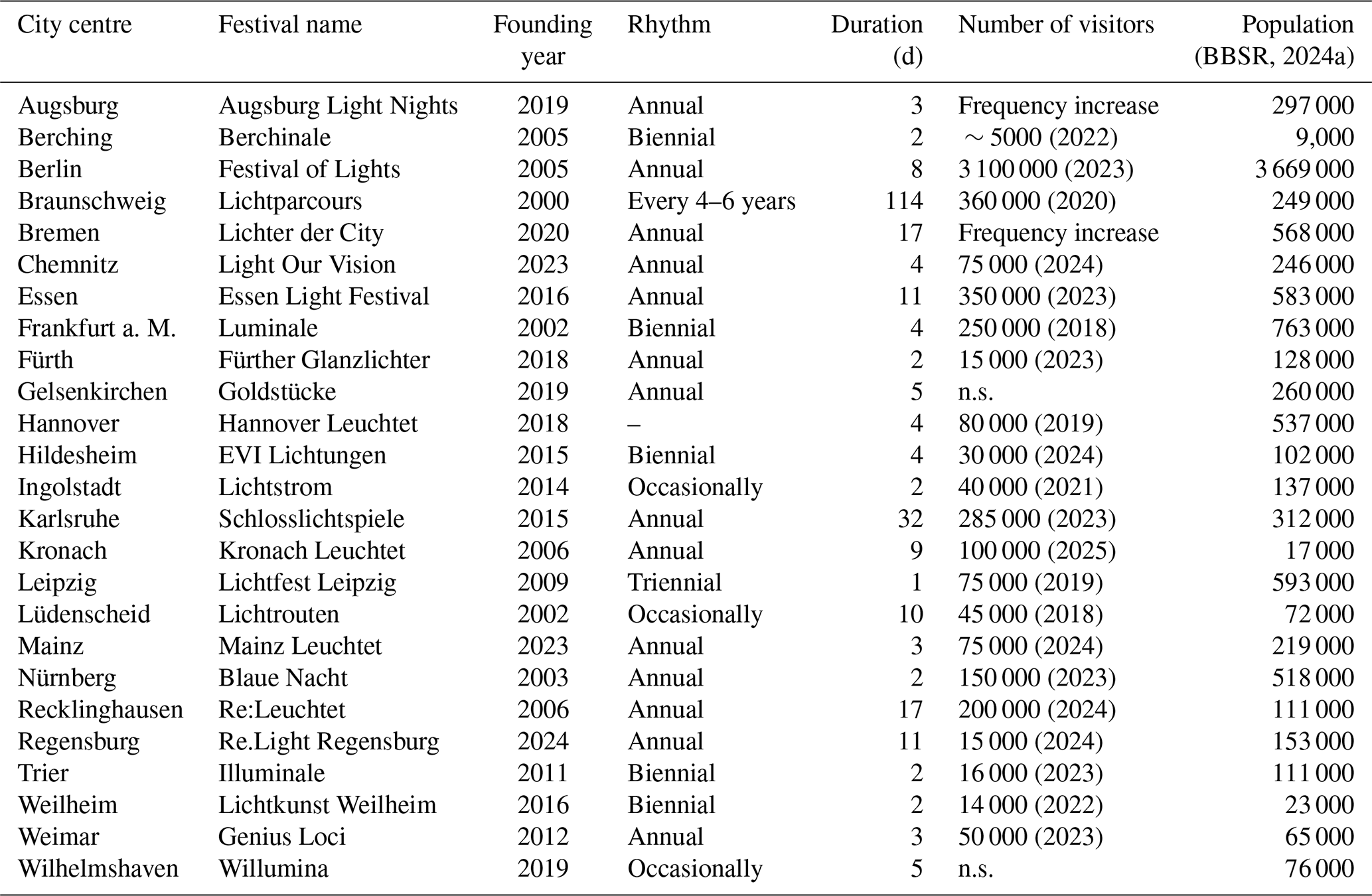
n.s. means not specified.
4.1.1 Spatial and size characteristics
Table 1 shows that the phenomenon is most common in small towns and medium to large cities with populations of 5000–480 000 (18 out of 25; typification according to BBSR, 2024b), while seven light art festivals occur in large cities with more than 480 000 inhabitants. Apart from Berlin, none of the other German metropoles (Hamburg, Munich and Cologne) has implemented light art festivals in public spaces.
The predominant spatial-structure type shown in Fig. 1 is also striking: 22 of the 25 light art festivals occur in growing or above-average growing cities. Four of the remaining six occur in areas with no recognisable growth trend, and only one occurs in a shrinking area. In this sense, the phenomenon of light art festivals appears to be primarily a phenomenon of medium-sized German cities with a growing spatial structure. In this sense, even 30 years later, Häußermann and Siebel's (1993) finding that cities that successfully adapt to structural change and can be described as growing implement and use festivals has been confirmed. While Häußermann and Siebel (1993) referred primarily to larger cities such as Barcelona and Munich, this now also applies to smaller cities such as Mainz and Hildesheim.
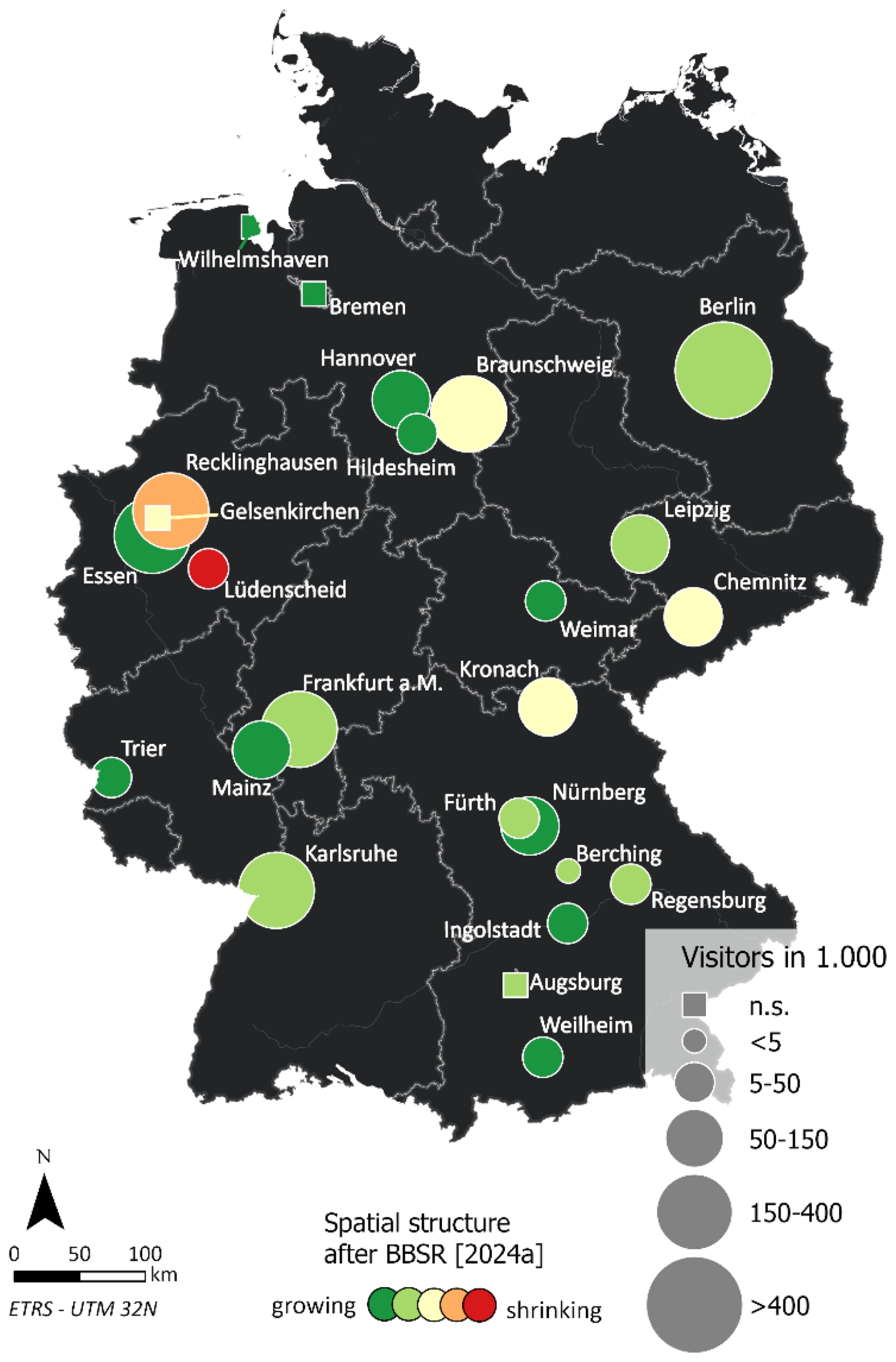
Figure 1Light art festivals in Germany.
Table 1 and Fig. 1 also illustrate the large differences in the number of visitors and thus also the range of sizes of the light art festivals: while the Berchinale attracted approximately 5000 visitors in 2022, the Festival of Lights attracted 3.1 million people in 2023. Notably, three festivals – Lichtparcours (Braunschweig), Kronach Leuchtet (Kronach) and Re:Leuchtet (Recklinghausen) – attract significantly more visitors than their own population. Recklinghausen, a shrinking city, has demonstrated the capacity to temporarily attract significant numbers of people to its city centre through this festival format. The existence of many small- and medium-sized local light art festivals is highlighted by at least 9 of the 25 festivals having fewer than 50 000 visitors and 6 festivals having 50 000–150 000 visitors.
The analysis of the specific urban spaces used for staging indicates that the city centre is the predominant location. The focus on city centres is also linked to the organisational form of many light art festivals: Stadtmarketing GmbH, for example, is usually linked to the city centre as a venue. However, other forms of organisation (public offices, associations and private limited companies) also adhere to the inner-city area. Most of the festivals are free of charge and open to everyone in public spaces, while only two festivals occur in temporarily enclosed public spaces and charge admission – Illuminale (Frankfurt) and Kronach Leuchtet (Kronach). Respondents highlighted that accessibility for all without admission fees is an essential feature of this type of festival. The city centre is therefore the spatial focus of organisers, marked as the urban space and a venue for city staging through light art festivals.
It is evident that light art festivals have been implemented in cities of all sizes throughout Germany. However, the number of attendees varies significantly between festivals, depending on their spatial and size characteristics. As demonstrated in Fig. 1, small- to medium-sized festivals are particularly prevalent in Germany and are distributed throughout the entire country. The preponderance of these festivals in areas of growth indicates that the phenomenon of festivalisation through light art festivals is attributable to spatial disparities, with the phenomenon being exclusive to such growth areas. In contrast, shrinking cities appear to be unresponsive to, or unable to utilise, this instrument. To conclude, light art festivals are a widespread phenomenon in Germany, and only Berlin, with 3.1 million visitors, can be classified as a city with a very large festival.
4.1.2 Content characteristics
In Germany, three types of festivals are identified based on their programmatic and artistic orientation. Two light art festivals feature colourful building illuminations and a select number of video mappings, accompanied by a broad cultural programme which is free of charge – Re:Leuchtet (Recklinghausen) and Blaue Nacht (Nürnberg). Five festivals almost exclusively present video mappings: Augsburg Light Nights (Augsburg), the Festival of Lights (Berlin), Hannover Leuchtet (Hannover), Lichter der City (Bremen) and Schlosslichtspiele (Karlsruhe), while 16 light art festivals develop site-specific light installations (containing video mapping and light installations) with internationally recognised light artists, namely Lichtparcours (Braunschweig), Essen Light Festival, EVI Lichtungen (Hildesheim), Lichtrouten (Lüdenscheid), Light Our Vision (Chemnitz), Goldstücke (Gelsenkirchen), and Re.Light Regensburg, or with a clear focus on local artists, such as Berchinale (Berchingen), Fürther Glanzlichter, Lichtstrom (Ingolstadt), Kronach Leuchtet, Mainz Leuchtet, Illuminale (Frankfurt), Lichtkunst Weilheim, and Willumina (Wilhelmshaven). These aspects indicate a vast and diverse range of light artworks in urban spaces in the festival context. The interviewees stated that this variety is a special feature of the format, intended to actively distinguish it from the monotony of “classic” city festivals:
It was something completely new for the city, something that hadn't happened before. And people didn't even think about whether they needed a carousel or a bratwurst stand. None of that was necessary because they just walked through the city, strolling and marvelling at the spots [Hannover Leuchtet].
Organisers can therefore use this variation in content and programme design to highlight local architectural conditions, local actors and site-specific historical aspects, creating an individual event- and place-related atmosphere and programme. Surprisingly, this site-specific design represents an argument against the mentioned “serial reproduction” (Richards and Wilson, 2006:1210) and “homogenisation” (Quinn, 2010:271), as a significant number of light art festivals request that artists develop site-specific artworks not intended for transfer between festivals. It is evident that, due to prevailing local conditions, serial production is not a viable option.
4.1.3 Temporal characteristics
Table 1 shows two trends in terms of temporal characteristics: firstly, the constant growth in the total number of festivals over the last 24 years as an indicator of an ongoing festivalisation process. While the first light art festival following the aforementioned definition was founded in Braunschweig in 2000, on average, more than one festival per year has been newly implemented since then. Only Hannover Leuchtet has been officially discontinued. Most festivals occur regularly (annually or biennially) and are so firmly anchored in local authority planning that they are organised despite the current (2024) limited financial resources of the municipalities. The COVID-19 pandemic does not appear to have slowed growth, with three additional festivals founded since 2023. The constant growth and regularity of most festivals clearly demonstrate the relevance of festivalisation regarding urban planning and tourism policy (Häußermann and Siebel, 1993).
Secondly, they can vary greatly in terms of duration and rhythm: more than half of the 25 light art festivals occur annually, while five occur every 2 years and five every 3 years or less, depending on the organisers' financial and human resources. An analysis of the duration of the individual light art festivals reveals noteworthy distinctions. Lichtparcours (Braunschweig) boasts an impressive 114 d duration, despite its irregular scheduling. Conversely, the Schlosslichtspiele (Karlsruhe) maintains an annual schedule spanning 32 d. The remaining festivals last 1–17 d, with most lasting a long weekend. In conjunction with Table 1, it becomes evident that the Festival of Lights (Berlin) has the highest daily attendance, with 385 000 visitors daily. However, it is notable that the Festival of Lights (Berlin) is not confined to a single location; instead, it is conducted at over 50 locations simultaneously. In comparison, the Schlosslichtspiele (Karlsruhe), held over 32 d, attracts an average of nearly 9000 visitors at a single location. This is unsurprising, as the Schlosslichtspiele also revitalises the square in front of Karlsruhe Palace, based on the length of time and daily visitor numbers. The broad spectrum of these figures indicates the format's adaptability to diverse local conditions.
Regarding the first research question, the data show that light art festivals in Germany represent a highly varied phenomenon, offering the opportunity for individualisation through local specifics and creating singular atmospheres due to content flexibility. In summary, the data indicate that the phenomenon is part of a general process of festivalisation occurring in cities of all sizes throughout Germany. However, unlike when the festivalisation process began, this format is being implemented less in shrinking cities and old industrial areas and more in the centres of growing cities.
4.2 Organisers, implementation reasons and goals of light art festivals
Table 2 shows the organisers and the reasons for implementing a festival in their city. In the following sections, organisers and their forms, the initial reason for implementation, and the overall objectives are analysed.
Table 2Organisers and reasons for implementation. Source: own survey (2024).

4.2.1 Organisers and forms of organisation
As shown in Table 2, 17 of the 25 light art festivals surveyed are organised directly or indirectly by the city (city departments, PCMO); light art festivals are primarily implemented by public authorities. Six of these festivals are organised by non-profit legal forms. Only one private limited company and one private association organise the light art festival; however, based on their statements, they are actively supported by the local authorities (Berlin, Bremen). Eleven light art festivals are arranged by organisations with a genuine marketing interest due to their organisational forms (private marketing companies in municipal ownership, marketing departments of the city, private associations of the local retail trade or private limited companies). Clear demarcation of city marketing exists where the cultural office organises it:
And let me put it this way, as long as it has this artistic claim, it is clearly our responsibility. … But if it were purely a light festival … to generate more shoppers or to revitalise shopping streets, then that's a city marketing matter [Goldstücke, Gelsenkirchen].
Overall, city-owned limited liability companies offer the advantage of legal protection and professional implementation regarding finances, personnel resources and political will, while public authorities and non-profit forms of organisation primarily acquire funding from the public sector or private foundations. Nearly half of the festivals are arranged by organisations with a genuine marketing interest. The organisational form of many light art festivals is linked to their spatial characteristics: PCMOs are usually linked to the city centre as a venue. However, the other forms of organisation (public offices, associations and private companies) also adhere to the inner-city area.
4.2.2 Initial reasons for implementation
Table 2 also shows that in 9 of the 25 light art festivals interviewed, the motivation of individuals formed the basis for the decision in favour of a light art festival. This indicates that the respective subjects had an existing personal interest in light art or were inspired by it through a corresponding network and staged the event in the urban space using their own energy with corresponding creative power qua their function, with no other reason (e.g. city anniversary), as in Augsburg:
Well, I saw it for the first time in Augsburg. It was a project at the university in Augsburg. The students … did their first façade illumination. … And through a friend of mine … he had contact with the people in Berlin, Festival of Lights, and said, “you, I'll get you together there” [Night Light Augsburg].
A further 10 of the organisers surveyed provided specific reasons and local circumstances for founding the event: for example, the Lichtparcours in Braunschweig was founded due to Expo 2000 in Hannover, as the city had received many hotel guests who spent the day in Hannover. The city was staged at night with light art so that Braunschweig had something to offer these guests at night. Similarly, the exceptional situation of Chemnitz being named the European Capital of Culture 2025 led to the founding of the festival there. In Frankfurt, Messe GmbH wanted to fulfil the exhibitors' need to see technical innovations in action during Light & Building, and in Leipzig, the aim was to translate the historic moment of the peaceful revolution into a modern format that reflected remembrance culture. Five of the 25 light art festivals implemented were planned as one-time events for the city's birthday but were so well received by the public and organisers that they were repeated on a rotational basis. The initial reason for three other light art festivals was to promote the revitalisation of city centres.
4.2.3 Objective of the organisation of light art festivals
Based on the data collected, five main objectives for implementing light art festivals were identified: (i) artistic and media staging of the city; (ii) tourism, city image and marketing; (iii) place making, city identity and participation of the local population; (iv) revitalisation of the city centre; and (v) shaping urban planning and lighting concepts. The objective of a festival is evidently not a singular entity. Instead, light art festivals are a multifaceted phenomenon serving various purposes.
The most frequently cited goal is to offer new perspectives on urban space through artistic and media staging of the city (i). As one of the curators said, artistic staging “can question habits, it can open up spaces of possibility and it is simply the openness to treat the city as a kind of material and to say, `how could I see my city differently?”' (Lichtrouten Lüdenscheid). This category was identified as the main objective at 19 light art festivals and refers clearly to the goal of defamiliarising nocturnal urban space with light art. Additionally, digital media staging has a significant role: three-quarters of respondents rated the role of social media as very important, not only for reaching a new (mostly younger) target group but also for presenting the city's image internationally. Light art is described as highly “Instagrammable” (board member of the International Light Organisation), reinforcing its impact beyond physical space.
The second-most frequent goal concerns strengthening tourism, extending the season and the number of overnight stays, and positive projection of the city's image externally (ii). Eleven organisers highlighted this purpose, often linking festivals to off-season events to stimulate overnight stays and long-term tourist flows. Light art festivals are used to “draw attention to ourselves from the outside, to the city's history and to the charm we have to offer” (Mainz Leuchtet).
The third-most frequent goal emphasises local engagement and strengthening identification with urban society (iii). Festivals foster pride and belonging by strengthening the identification with one's Heimat:
So, it's always a bit about giving the people who live here, and we are at home in a structurally weak region … the feeling that “hey, look, that's us too, it's so beautiful here” [Re:Leuchtet, Recklinghausen].
Curators often involve schools and universities in realising their own light artworks. Examples include participatory formats in Trier and Kronach and installations by local disability art studios in Hildesheim, highlighting the inclusive and community-based character of the festival format.
Five festivals pursued urban revitalisation of the inner-city centre by attracting residents, supporting local retail, and diversifying use and target groups (iv). The objective is then countering urban decline: “We were also simply concerned with the frequency of visits to the old town …. Keywords: urban decline, urbanisation, rural exodus, shops dying out” (Re.Light Regensburg). In some cases, public funding was directly linked to this aim.
A smaller number of festivals seek lasting urban design effects (v). In Berching and Kronach, this involved focusing on architectural lighting concepts; in Chemnitz, where the festival is organised by the Chemnitz Association for Building Culture, light art is used to present a very concrete vision of what a different type of urban development could look like: “So it was always the visualisation, the vision of how our city should develop, that was the core of the whole thing” (Light Our Vision, Chemnitz).
Referring to the second research question, the data show that nearly three-quarters of German light art festivals are municipally organised, underlining their role in city marketing and urban transformation. While initial reasons vary – ranging from anniversaries only planned to be one-off to individual commitment – city centres are the primary stage. Festivals thus target local populations and regional/national visitors, combining artistic, economic and social objectives. Particularly, organisers emphasise the role of light art at night as a means of defamiliarising spatiality and the easy dissemination of powerful images via social media.
As the data presented show, the format of light art festivals is extremely flexible and heterogeneous, serving several objectives simultaneously. Light art festivals in Germany exemplify the growing trend of festivalisation in urban development. Firstly, the number of light art festivals in city centres of all sizes is increasing significantly all over Germany. They are often organised by municipalities with limited revenues but strategic objectives such as tourism, image building and city centre revitalisation. Moreover, it is notable that almost half of these light art festivals are organised by city-owned and private organisations with genuine marketing interests, potentially indicating a trend towards the festivalisation of urban space, aiming to build an image and attract tourists (Häußermann and Siebel, 1993). In this sense, light art festivals continue to catalyse culturally led urban regeneration in city centres. But, unlike the 1990s, when festivals were used to counteract post-industrial decline and structural transformation to foster growth, current festival organisers address multiple challenges in city centres, such as online retail and monofunctional and daytime-dependent use of space. However, it is primarily growing cities that are able to join the trend of light art festivals in the context of festivalisation. In this changed context, the phenomenon tends to reinforce disparities, since primarily growing cities can leverage festivals to enhance their night-time economy and attract visitors. These observations suggest that although the festivalisation of German cities through light art festivals is an ongoing process within urban marketing and policy strategies, the reasons to implement such a festival are in transformation due to new challenges and thus changing intentions.
Nevertheless, many light art festivals in Germany seek to defamiliarise the perception of space (Edensor, 2015a) using light art. Light art is presented to the public at a low threshold in urban spaces at night, reconfiguring familiar patterns of space use and entangling architecture, enchantment and lighting within new spaces of possibilities (Edensor, 2014, 2015b, 2017, 2021). By implementing light art festivals, some organisers aim to enhance community building and populations' identities with the city and its image, particularly with social media (Skelly and Edensor, 2020; Dell'Aria, 2021; Yin et al., 2023), demonstrating the significant role of discovering the “second city” at night through light art, not only by tourists but more by local stakeholders and citizens. Particularly, the production of intense and impressive images of the city at night and their dissemination via social media have a major role in the implementation. The manner in which these images and narratives are perceived by the audience, the press and social media users is a topic that merits further research.
Light art festivals in Germany can therefore be viewed as a sign of the ongoing trend towards festivalisation, which is primarily being driven by small- and medium-sized towns with a spatial-structure growth tendency. Interestingly, the analysis shows that light art festivals have the capacity to broaden the scope of festivalisation, as explained in Sect. 2.2 and 2.3, through several key points. As cultural production, affective atmospheres (Reckwitz, 2017) and the presentation of the city's image on social media (Huang et al., 2021) become increasingly significant components of urban development, it can be hypothesised that the field of light art festivals will consequently emerge. This development aligns with the broader trend of incorporating art festivals into urban governance as a catalyst for “public engagement and as platforms for artistic experimentation” (Lynch and Quinn, 2022:258). In this sense, light art festivals can be understood as a multifaceted phenomenon of urban development situated within a differentiating geographical science of festivalisation: light art festivals offer the opportunity to simultaneously use and transform digital, affective, productive, social, public and discursive spaces.
This paper aimed to (1) generate new insights into the debate on festivalisation by illuminating unexplored facets of the phenomenon of light art festivals and (2) facilitate a comprehensive analysis regarding characteristics and objectives of a growing phenomenon in larger and smaller cities in Germany by collecting spatial and qualitative data from a geographical perspective. Moreover, this paper elucidates the phenomenon of light art festivals in Germany by further defining them.
However, limitations exist regarding the results. This paper examines the production aspect of light art festivals in Germany. Thus, the extent to which the identified goals are implemented in practice and the desired effects for visitors and the urban fabric must be objects of further investigation. Furthermore, the role of social media in this study is only one aspect among many; future research could examine the role of social media more closely, especially at festivals in small- and medium-sized towns. Future research is also required regarding the extent to which the reasons for the implementation and goals can be classified under general social change characterised by a constant process of aestheticisation, culturalisation and attention orientation within society and urban policy (Reckwitz, 2017). In order to gain a more comprehensive understanding of light art festivals in urban spaces, urban geography offers a particularly useful perspective as it allows us to understand light art festivals as a socio-spatial phenomenon that is shaped by social processes, policy strategies and spatial disparities.
The data are not publicly available.
The author has declared that there are no competing interests.
Publisher's note: Copernicus Publications remains neutral with regard to jurisdictional claims made in the text, published maps, institutional affiliations, or any other geographical representation in this paper. The authors bear the ultimate responsibility for providing appropriate place names. Views expressed in the text are those of the authors and do not necessarily reflect the views of the publisher.
This paper was edited by Hanna Hilbrandt and reviewed by two anonymous referees.
BBSR: Wachsende und schrumpfende Städte und Gemeinden, Interaktive Web-App, https://gis.uba.de/maps/resources/apps/bbsr/index.html?lang=de (last access: 29 January 2025), 2024a.
BBSR: Stadt- und Gemeindetypen in Deutschland, https://www.bbsr.bund.de/BBSR/DE/forschung/raumbeobachtung/Raumabgrenzungen/deutschland/gemeinden/StadtGemeindetyp/StadtGemeindetyp.html (last access: 3 February 2025), 2024b.
Bhatia, M.: Light festivals: Entertainment or urban renewal tool?, IOP C. Ser. Earth Env., 1099, 012009, https://doi.org/10.1088/1755-1315/1099/1/012009, 2022.
Camprubí, R. and Lluis, C.: Residents versus visitors at light festivals in cities: The case of Barcelona, Journal of Policy Research in Tourism, Leisure Events, 113, 455–468, 2019.
Chen, Z. and Yu, T.: Festivals and digitalisation: a critique of the literature, Tourism Crit.: Pract. Theory, 6, 2–17, https://doi.org/10.1108/TRC-05-2024-0022, 2025.
Cudny, W: The phenomenon of festivals – their origins, evolution and classifications, Anthropos, 109, 640–656, 2014.
Cudny, W.: Festivalisation of Urban Spaces, Springer, Cham, https://doi.org/10.1007/978-3-319-31997-1, 2016.
Cudny, W. (Ed.): Urban Events, Place Branding and Promotion: Place Event Marketing, Routledge, London, ISBN 9780429756214, 2019.
Dell'Aria, A.: The Moving Image as Public Art: Sidewalk Spectators and Modes of Enchantment, Palgrave Macmillan, Cham, ISBN 9783030659042, 2021.
Eckardt, F.: Stadtforschung: Gegenstand und Methoden, Springer, Wiesbaden, ISBN 9783658008246, 2014.
Edensor, T.: Illuminated atmospheres: Anticipating and reproducing the flow of affective experience in Blackpool, Environ. Plan. D, 30, 1103–1122, https://doi.org/10.1068/d12211, 2012.
Edensor, T.: The potentialities of light festivals, Durham University's Institute for Advanced Studies' Insights, 2–12, https://www.iasdurham.org/wp-content/uploads/2021/03/edensor_the-potentialities-of-light-festivals.pdf (last access: 19 February 2026), 2014.
Edensor, T.: The gloomy city: Rethinking the relationship between light and dark, Urban Stud., 52, 422–438, https://doi.org/10.1177/0042098013504009, 2015a.
Edensor, T.: The rich potentialities of light festivals: Defamiliarisation, a sense of place and convivial atmospheres, in: Urban Lighting, Light Pollution and Society, edited by: Meier, J., Hasenöhrl, U., Krause, K., and Pottharst, M., Routledge, New York, 85–98, ISBN 9781317602477, 2015b.
Edensor, T.: Light design and atmosphere, Vis. Commun., 14, 331–350, https://doi.org/10.1177/1470357215579975, 2015c.
Edensor, T.: Lights, city, action …, in: The SAGE Handbook of New Urban Studies, edited by: Hannigan, J. and Greg, R., Sage, Los Angeles, 217–231, https://doi.org/10.4135/9781473982604, 2017.
Edensor, T.: Illuminating identity: The capacity of light festivals to enhance place? in: A Research Agenda for Place Branding, edited by: Medway, D., Warnaby, G., and Byrom, J., Elgar, Cheltenham, 267–282, ISBN 978839102844, 2021.
Edensor, T. and Sumartojo, S.: Reconfiguring familiar worlds with light projection: The Gertrude Street Projection Festival, 2017, GeoHumanities, 4, 112–131, 2018.
Erel, Y., Kyriakidou, F., and Avendano, R. E. M.: Urban illuminations – Light art activating the public realm, IOP C. Ser. Earth Environ., 1320, 012012, https://doi.org/10.1088/1755-1315/1320/1/012012, 2024.
Estrada Grajales, C., Mitchell, P., Caldwell, G., Yang, R., and Johnstone, S.: Projecting the new world city: The city as spectacle in an urban light festival, in: Proceedings of the 5th MEDIACITY International Conference and Exhibition, edited by: Willis, K., Aurigi, A., Corino, G., and Phillips, M., QUT, Plymouth, 244–261, https://eprints.qut.edu.au/84572/34/Mediacity5_ProjectingtheNewWorldCity_final.pdf (last access: 19 March 2026), 2015.
Finkel, R.: A picture of the contemporary combined arts festival landscape, Cult. Trends, 18, 3–21, 2009.
Finkel, R. and Platt, L.: Cultural festivals and the city, Geogr. Compass, 14, https://doi.org/10.1111/gec3.12498, 2020.
Flick, U.: Qualitative Sozialforschung. Eine Einführung, Rowohlt, Reinbek, ISBN 9783499556944, 2012.
Foster, N.: From urban consumption to production: Rethinking the role of festivals in urban development through co-creation, Urban Plan., 7, 379–393, https://doi.org/10.17645/up.v7i3.5371, 2022.
Freire-Gibb, L. and Lorentzen, A.: A platform for local entrepreneurship: The case of the lighting festival of Frederikshavn, Local Econ., 26, 157–169, https://doi.org/10.1177/0269094211404124, 2011.
Garcia-Ruiz, M.: Festivales de luz y eventos de luz en Portugal. Entre cultura y promoción turística del territorio, Forum Sociolog., 35, 41–50, 2019.
Giordano, E. and Ong, C.: Light festivals, policy mobilities and urban tourism, Tourism Geogr., 19, 699–716, https://doi.org/10.1080/14616688.2017.1300936, 2017.
bibitem1 Haeusler, M. H.: Sydney: The Sydney Vivid Festival: From Place Branding to Smart Cities, in: Cities of Light, edited by: Isenstadt, S., Petty, M., and Neumann, D., Routledge, New York, 144–147, https://doi.org/10.4324/9781315747835, 2014.
Harvey, D.: From managerialism to entrepreneurialism: the transformation in urban governance in late capitalism. Geograf. Ann. B, 71, 3–17, https://doi.org/10.1080/04353684.1989.11879583, 1989.
Häußermann, H. and Siebel, W. (Eds.): Die Politik der Festivalisierung und die Festivalisierung der Politik: Große Ereignisse, Springer, Wiesbaden, https://doi.org/10.1007/978-3-663-10065-2, 1993.
Huang, J., Obracht-Prondzynska, H., Kamrowska-Zaluska, D., Sun, Y., and Li, L.: The image of the City on social media: A comparative study using “Big Data” and “Small Data” methods in the Tri-City Region in Poland, Landsc. Urban Plan., 206, https://doi.org/10.1016/j.landurbplan.2020.103977, 2021.
Lovell, J. and Griffin, H.: Fairy tale tourism: The architectural projection mapping of magically real and irreal festival lightscapes, J. Policy Res. Tourism Leis. Events, 11, 469–483, https://doi.org/10.1080/19407963.2018.1556674, 2018.
Lovell, J. and Griffin, H.: Unfamiliar light: The production of enchantment, Ann. Tourism Res., 92, 103328, https://doi.org/10.1016/j.annals.2021.103328, 2022.
Lynch, D. and Quinn, B.: Understanding the influence of place on festival making and artistic production in the local urban festival context, J. Policy Res. Tourism Leis. Events, 14, 242–261, https://doi.org/10.1080/19407963.2022.2033250, 2022.
Mayring, P.: Qualitative Inhaltsanalyse: Grundlagen und Techniken, Beltz, Weinheim, ISBN 9783407258991, 2022.
Mayring, P. and Fenzl, T.: Qualitative Inhaltsanalyse, in: Handbuch Methoden der empirischen Sozialforschung, edited by: Baur, N. and Blasius, J., Springer, Wiesbaden, 633–648, ISBN 9783658213077, 2019.
Mercer, D. and Mayfield, P.: City of the spectacle: White Night Melbourne and the politics of public space, Aust. Geogr., 46, 507–534, https://doi.org/10.1080/00049182.2015.1058796, 2015.
Miśkowiec, M.: The role of an urban festival in public space: Case study of the Light Move Festival in Łódź, Acta Universitatis Lodziensis, Folia Geogr. Socio-Oeconom., 29, 107–119, 2017.
Page, S. J. and Connell, J.: The Routledge Handbook of Events, Routledge, London, https://doi.org/10.4324/9780203803936, 2012.
Przyborski, A. and Wohlrab-Sahr, M.: Qualitative Sozialforschung: Ein Arbeitsbuch, De Gruyter, Oldenbourg, Munich, ISBN 9783486708929, 2014.
Quinn, B.: Arts festivals and the city, Urban Stud., 42, 927–943, 2005.
Quinn, B.: Arts festivals, urban tourism and cultural policy, J. Policy Res. Tourism Leis. Events, 2, 264–279, https://doi.org/10.1080/19407963.2010.512207, 2010.
Quinn, B.: A comment on: Arts festivals, urban tourism and cultural policy, J. Policy Res. Tourism Leis. Events, 11, 8–12, https://doi.org/10.1080/19407963.2018.1556855, 2019.
Reckwitz, A.: The Self-Culturalisation of the City: On the Transformation of Modern Urbanity in the `Creative City', in: ESA Research Network Sociology of Culture Midterm Conference: Culture and the Makings of Worlds, https://ssrn.com/abstract=1699808 (last access: 20 March 2026), 2010.
Reckwitz, A.: Die Gesellschaft der Singularitäten: Zum Strukturwandel der Moderne, Suhrkamp, Berlin, ISBN 978351858706, 2017.
Richards, G. and Wilson, J.: Developing creativity in tourist experiences: A solution to the serial reproduction of culture?, Tourism Manage., 27, 1209–1223, https://doi.org/10.1016/j.tourman.2005.06.002, 2006.
Schulte-Römer, N.: Fair framings arts and culture festivals as sites for technical innovation, Mind Soc., 12, 151–165, 2013.
Schulte-Römer, N.: Extraordinary LED installations: events for user – innovation interaction, Indust. Innov., 25, 699–727, https://doi.org/10.1080/13662716.2017.1345678, 2018.
Schünzel, A. and Traue, B.: Websites, in: Handbuch Methoden der empirischen Sozialforschung, edited by: Baur, N. and Blasius, J., Springer, Wiesbaden, 1001–1013, https://doi.org/10.1007/978-3-658-21308-4_71, 2019.
Skelly, G. and Edensor, T.: Routing out place identity through the vernacular production practices of a community light festival, in: The Routledge Handbook of Placemaking, edited by: Courage, C., Borrup, T., Jackson, M., Legge, K., McKeown, A., Platt, L., and Schupbach, J., Routledge, London, 258–268, ISBN 978-0-367-22051-8, 2020.
Smith, A.: Events and Urban Regeneration: The Strategic Use of Events to Revitalise Cities, Routledge, London, ISBN 978-0-415-58147-9, 2012.
Smith, A., Osborn, G., and Quinn, B. (Eds.): Festivals and the City: The Contested Geographies of Urban Events, University of Westminster Press, London, ISBN 9781915445018, 2022.
Tritthart, M.: Medienkritik auf urbanen Flächen. Spatial Augmented Reality im öffentlichen Diskurs, in: In Wirklichkeit Animation …, edited by: Bruckner, F., Hagler, J., Lang, H., and Reinerth, M,. Springer, Wiesbaden, 123–144, https://doi.org/10.1007/978-3-658-33287-7_8, 2021.
van Liempt, I., van Aalst, I., and Schwanen, T.: Introduction: Geographies of the urban night, Urban Stud., 52, 407–421, https://doi.org/10.1177/0042098014552933, 2015.
Waitt, G.: Urban festivals: Geographies of hype, hopelessness and hope, Geogr. Compass, 2, 513–537, 2008.
Wenying, F. and Hengtong, Z.: Research on the display of city image in Macau Light and Shadow Festival, Int. J. Arts Human. Stud., 2, 17–21, https://doi.org/10.32996/bjahs.2022.2.1.3, 2022.
Winton, E.: Light and the manifestation of performance place: The experience of spaces and places through a different light, Spaces Flows, 8, 31–43, https://doi.org/10.18848/2154-8676/CGP/v08i02/31-43, 2016.
Wolf, A. and Jackson, U.: Von der Gruppe zur Masse – Wirkung und Nutzen kollektiver Emotionen im Eventkontext, in: Events und Emotionen: Stand und Perspektiven der Eventforschung, edited by: Zanger, C., Springer Gabler, Wiesbaden, 43–58, https://doi.org/10.1007/978-3-658-10303-3_3, 2015.
Yin, S., Fu, C., and Dai, G.: Exploring the festival attendees' experiences on social media: A study on the Guangzhou International Light Festival, SAGE Open, 13, 1, https://doi.org/10.1177/21582440221145154, 2023.
Zielinska-Dabkowska, K.: Night in a big city. Light festivals as a creative medium used at night and their impact on the authority, significance and prestige of a city, in: The Role of Cultural Institutions and Events in Marketing of Cities and Region, edited by: Domanski, R., Wydawnictwo Uniwersytetu Łódzkiego, Lodz, 63–90, https://doi.org/10.18778/8088-149-5.04, 2016.
Zukin,S.: The Culture of Cities, Blackwell, Oxford, ISBN 1557864365, 1995.