
the Creative Commons Attribution 4.0 License.
the Creative Commons Attribution 4.0 License.
 | 25 Jun 2026
From destabilisation to disruption: deactivation network dynamics in an Italian fossil infrastructure conflict
Daniel Delatin Rodrigues
Giuseppe Calignano
Marco Grasso
This article introduces the deactivation network approach (DNA) to analyse conflicts in fossil fuel infrastructures as relational struggles between practices of continuity/legitimation and practices of destabilisation/disruption. The DNA is applied to Enel's power plants in Civitavecchia (Italy) across two contentious conversion cycles: an oil-to-coal project (2000–2010, realised) and a proposed coal-to-gas project (2018–2023, halted). Using an intentionally asymmetrical design, the study maps only the deactivation network and treats the fossil-support network as a structuring context shaping political opportunity structures. Event-based social network analysis, triangulated with interviews, documentary sources, and digital ethnography, compares changes in network composition, connectivity, and tie intensity across the two periods. Results show that mobilisation and activist cohesion alone did not produce disruption. Deactivation became effective when activists' destabilisation was brokered into institutional and labour arenas, enabling administrative and political interference with infrastructural continuity.
- Article
(584 KB) - Full-text XML
- BibTeX
- EndNote


UN Secretary-General António Guterres stated in a speech delivered on 15 June 2023 that “for every dollar [the fossil fuel industry] spends on oil and gas drilling and exploration, only 4 cents went to clean energy and carbon capture”. He further stressed that “the fossil fuel industry and its enablers have a special responsibility” and should “drive, not obstruct, the global move from fossil fuels to renewables” (UN, 2023). In fact, while global carbon emissions from fossil fuels reached record highs in 2024 (Hausfather and Friedlingstein, 2024), the industry continues to invest hundreds of billions of dollars in 425 so-called “carbon bombs” (Kühne et al., 2022), while its “enablers”, such as the financial system (Goldhaber, 2025), support with even greater vigour the ongoing fossil fuel expansion, thereby inevitably worsening the climate crisis, with catastrophic consequences expected for humanity and the planet (IPCC, 2023).
Efforts to dismantle the existing fossil fuel infrastructure remain inadequate: scientific evidence, protests, campaigns, and mass mobilisation have not yet sufficed to generate new sustainable socio-political trajectories (UNEP, 2024; Bevacqua et al., 2025; Cannon, 2025).
Therefore, based on the evidence that technical feasibility and economic efficiency, although necessary, are not sufficient to block the ongoing expansion of fossil and extractivist infrastructure, this work, aligned with a growing multidisciplinary and interdisciplinary scholarly tradition, assumes that the fossil fuel industry and its enablers act as a “fossil network” that protects its vested interest in continuing and expanding the use of fossil fuels (Grasso and Delatin Rodrigues, 2024; Kaufman, 2025). As defined in this article, a fossil network is generated around a fossil fuel infrastructure and acts to ensure the continuity of fossil fuels through support for it. By “fossil fuel infrastructure”, we mean a material-technical object with a finite operational life cycle – an extractive or production site, refinery, regasification or fossil power station, pipeline, terminal, or offsetting site. However, such objects are never merely material: they exist only through the relations they support and are defined by what they enable and connect (Star, 1999; Larkin, 2013; Appel et al., 2018). It is because the infrastructure is at once a durable, territorially fixed artefact and a dense knot of relations that it anchors the networks sustaining or contesting it, and can be said to produce political space (Mitchell, 2011). We accordingly reserve “infrastructure” for this relational-material object, and “infrastructural” or “governance arrangements” for the specific configurations assembled around it. At the same time, we posit that an antagonistic, asymmetrical, and counter-hegemonic “deactivation network” attempts to deactivate the fossil infrastructure. In this article, we then refer to fossil networks as the collective agents who mobilise to preserve fossil fuel infrastructures, and to deactivation networks as the heterogeneous groups who mobilise to challenge and dismantle them. The analytical features of these two networks are developed in detail in Sect. 4.
Building on these assumptions, we address contentious dynamics of fossil fuel infrastructures by focusing empirically on the relational organisation of deactivation efforts. We propose the deactivation network approach (DNA) as an interpretative framework. The DNA does not rely on the symmetrical empirical reconstruction of two networks (fossil and deactivation). Instead, it rests on an analytical distinction between two antagonistic logics of action that coalesce around fossil fuel infrastructures. Empirically, we analyse the internal relational dynamics of the deactivation network. The fossil network is not reconstructed as a network in our data; rather, it is treated as a structural and contextual force shaping the terrain of contestation (Mitchell, 2011; Malm, 2016) by producing specific political opportunity structures (Tilly, 2008).
The DNA is structured around two core dimensions. The first concerns its focus on conflictual and collaborative interactions within deactivation networks, i.e. the relational dynamics through which heterogeneous actors coordinate (or fail to coordinate) deactivation efforts over time. The second dimension pertains to its processual character: the DNA constructs a temporal scale and analyses key events across levels and phases of the infrastructure. In this article, the empirical focus is on the local-scale evolution of the deactivation network, while fossil network practices are treated as a structuring context rather than reconstructed through network mapping.
In what follows, we first situate the DNA within the relevant scholarly literature, then clarify its objectives, analytical categories, and methodology, and finally apply it to investigate the interactions that developed within the deactivation network targeting a fossil fuel plant in Italy over two periods. The case study concerns the dynamics of the antagonistic deactivation networks that first failed to prevent an oil-to-coal conversion and later contributed to successfully stopping the proposed coal-to-gas conversion of the same group of coal-fired power plants in Civitavecchia, a long-standing fossil energy hub near Rome, Italy. Both conversions were advocated by Enel, an Italian multi-national electricity and gas producer and distributor, and owner of the plants, supported by an articulated group of agents forming a fossil network.
The deactivation network approach (DNA) draws on strands of scholarship that address (i) the persistence of fossil fuel infrastructures, (ii) the mobilisation that contests them, and (iii) the political and institutional conditions under which phase-out becomes possible. Rather than offering a comprehensive synthesis of these literatures, the DNA uses them to specify an interpretative distinction between two antagonistic logics of action that crystallise around fossil infrastructures: practices oriented to continuity and legitimation, and practices oriented to destabilisation and disruption.
Research on fossil incumbency and climate obstruction emphasises how entrenched power, institutional inertia, financial dependence, and lobbying sustain fossil trajectories (e.g. Grasso, 2022; Hess, 2023a; Brulle et al., 2024). Relatedly, the concept of carbon lock-in highlights the technological, political, and behavioural mechanisms through which fossil infrastructures become durable and difficult to reverse (Unruh, 2000; Lamb et al., 2020). These perspectives inform the DNA's treatment of fossil power as a structuring condition: fossil infrastructures are embedded in institutional arrangements and economic dependencies that shape what is politically feasible and which forms of contestation are likely to succeed.
At the same time, scholarship on climate activism, divestment campaigns, and anti-fossil mobilisation documents how social movements challenge fossil legitimacy and build opposition capacities through symbolic, legal, and political strategies (Blondeel, 2019; Hielscher et al., 2022; Thiri et al., 2022; Hess, 2023b; Delatin Rodrigues, 2025). In the DNA, these efforts are approached not only as repertoires of contention but also as relational work: they require coalition building, coordination, and sustained alignment among heterogeneous actors. This emphasis connects with contentious politics research that foregrounds shifting alliances and the importance of organisational and institutional linkages for mobilisation outcomes (Tilly, 2008).
Recent work in transition studies has also increasingly stressed that decarbonisation is not only a matter of technological substitution and renewable “phase-in” but also of deliberate phase-out and dismantling of fossil infrastructures (David, 2017; Rinscheid et al., 2021; Grasso and Delatin Rodrigues, 2022), making infrastructure an explicitly geographic object of contention. This literature supports the DNA's focus on deactivation as an object of analysis in its own right. It also resonates with multi-scalar accounts showing that local conflicts are shaped by national policy frameworks and global economic dynamics (Levy and Newell, 2002; Geels et al., 2016). In the DNA, these broader forces are treated as conditions that shape the terrain of contestation rather than as variables to be exhaustively modelled.
Methodologically, the DNA takes inspiration from research using social network analysis (SNA) to examine climate governance and mobilisation networks (Jasny and Fisher, 2023), while recognising what structural metrics can and cannot do. Network measures describe relational configurations – who coordinates with whom, how cohesive a set of actors is, and how these patterns change – but they do not, on their own, register the meaning or strategic intent of the practices that travel through ties, nor asymmetries of power; tie frequency is not equivalent to influence (Sovacool et al., 2022; Kammerer and Ingold, 2023). The DNA therefore treats SNA not as a self-sufficient method but as one of two complementary operations: SNA maps the relational structure of the deactivation network and its change over time, while qualitative materials interpret what those configurations contained and enabled – the orientation of the practices, the reasons actors converged and the mechanisms translating proximity into interference with fossil continuity. The DNA's analytical categories (Sect. 4) bind the two together. The fossil network is not reconstructed empirically as a second network; instead, it is treated as a structural and contextual force shaping political opportunity structures (Malm, 2016; Tilly, 2008). The duality of the DNA is therefore analytical rather than cartographic. The methodological implication is developed in Sect. 3.2 and 5: SNA and qualitative analysis address different objects – relational structure versus meaning and mechanism – and their combination, rather than either alone, constitutes the DNA's analytical contribution.
3.1 Objective
The general objective of the DNA is to analyse the deactivation of fossil fuel infrastructures over the long term of contentious dynamics; in this article, the analysis follows the evolution of the deactivation network across two periods. The contribution is, in the first instance, framework developing: the aim is to elaborate and demonstrate the DNA, with Civitavecchia as an exemplary case rather than a self-contained explanation of a single conflict. The case nonetheless surfaces a substantive finding – that mobilisation and activist cohesion were not, by themselves, sufficient to deactivate the infrastructure, and that deactivation became plausible only when destabilisation was relationally articulated with actors able to disrupt institutional and operational continuity.
3.2 Structure
Drawing on social science concepts of network (Law, 1992; Barry, 2006; Mitchell, 2011), web (Marriott and Minio-Paluello, 2013), assemblage (Stewart, 2012; Watts, 2012), infrastructural ecologies (Banoub and Martin, 2020), regime complex (Keohane and Victor, 2011), and oil complex (Watts, 2005), the DNA examines the relational spaces – otherwise unobservable and extending well beyond the places where fossil fuels are materially handled – within which the deactivation of an infrastructure is pursued. These spaces should not be conflated with the infrastructure itself: the infrastructure is the material object, and it is precisely its durability, capital intensity, and territorial fixity that organise the heterogeneous relations and the social environment (Simondon, 2016), continuously re-modulated to perpetuate or challenge fossil longevity. The DNA thus offers a unified perspective on this large-scale functional articulation, taking the material infrastructure as the anchor around which fossil and deactivation networks crystallise.
The DNA is an analytical tool for examining conflicts in fossil fuel infrastructures by distinguishing two antagonistic logics of action at the meso level of socio-technical systems (Geels et al., 2016). In this respect, the DNA differs from approaches centred on “fossil capitalism” (Malm, 2016), which primarily operate at the macro level of nature–society relations. The DNA instead focuses on the infrastructure as a site where incumbent capacities and oppositional efforts confront one another over time.
Conceptually, the DNA recognises that infrastructures are surrounded by heterogeneous constellations of actors whose alignments may vary across phases of the infrastructure's life cycle. Certain components may be more visible at particular moments and less so at others: for example, investors and financial intermediaries are often central during planning and financing phases, while operational phases may foreground regulators, labour arrangements, and routine institutional procedures; conversely, carbon markets or offsetting schemes may become salient in later phases. This implies that the stabilisation of fossil infrastructures does not rest on a single actor type but on shifting configurations of practices and capacities that can become more or less visible depending on the conjuncture (Macdonald, 2017; Byrne and Callaghan, 2014).
The DNA also treats alignments as fluid and context dependent. Actors may adopt hybrid positions, shift their stance over time, or participate in arenas with only partially overlapping interests. This is particularly relevant for financial institutions, local authorities, and trade unions, whose positions may alternate between reinforcing and contesting fossil infrastructures under changing political and economic conditions. The case of Civitavecchia illustrates this ambiguity: unions, for example, may face the health–jobs conundrum and reconfigure their alignments accordingly (Delatin Rodrigues and Grasso, 2024).
Methodologically, this article does not reconstruct two networks symmetrically. The empirical analysis maps and examines only the deactivation network, focusing on its internal relational dynamics across time periods. The fossil network functions as a structural and contextual force shaping political opportunity structures (Malm, 2016; Tilly, 2008). This asymmetry follows from the DNA's two-step methodological logic: event-based SNA establishes how the deactivation network was configured and how that configuration changed; qualitative analysis of interviews, documents, and archival materials then interprets what circulated through those ties – the practices, rationales, and mechanisms through which relational proximity was converted into political and institutional effect. The analytical categories in Sect. 4 bind these two operations together; Sect. 5 specifies how each was implemented in practice.
By analytical categories, we refer to the foundational theoretical dimensions of the DNA that orient, shape, and ground its methodology and empirical application. The analytical categories presented in this section provide a theoretical grammar for interpreting conflicts in fossil fuel infrastructures. In this article, they are not treated as directly operationalised variables but as interpretative lenses guiding the reading of relational patterns identified through network analysis.
Practices of deactivation
This article classifies deactivation network practices into two (ideal) types: destabilisation and disruption. Although current literature on fossil fuel phase-out often uses these terms interchangeably and without detailed specifications (Turnheim and Geels, 2012, 2013; Rinscheid et al., 2021; van Oers et al., 2021; Frank and Schanz, 2022), treating them as actions required to shift socio-economic systems towards a low-carbon future, this article distinguishes them based on the effects they have on the continuity of fossil infrastructure. Destabilisation engages parts of the social environment – including communities not directly or closely affected by a fossil network – and aims to generate, foster, and maintain social and moral norms, values, principles, perceptions, imaginaries, and actions that denaturalise the use of fossil fuels (Jamieson, 2017; Wilson et al., 2017). It seeks to deconstruct the normative foundations of the “hegemonic ideas” of fossil continuity and endless growth that sustain the fossil network, and to shape behaviours in favour of a safer low-carbon world.
Disruption practices, by contrast, target the fossil infrastructure supported by a fossil network in order to constrain or halt the reproduction of its fossil model and its overall functioning, operation, and longevity. These practices include lawsuits, policy and administrative provisions, divestment initiatives, shareholder resolutions, strikes, blockades, and investments in alternative non-fossil options. By intervening in fossil infrastructure, disruption opens up new opportunities to experiment with forms of political action against the continuation of fossil fuels (and extractivism).
The DNA rests on theoretically grounded analysis of the deactivation network over a prolonged period and is therefore situated within a “network dynamics” approach that studies how interconnected agents and their relationships form, dissolve, and restructure over time – through internal shifts (changing alliances, strategic adjustments, power reconfigurations) and external interactions between networks (competition, conflict, cooperation) across scales. Concretely, the analysis proceeds in two interlocking steps, and it is their articulation – rather than either alone – that constitutes the methodological contribution of the DNA. In the first step, event-based SNA builds and compares the relational structure of the deactivation network across the two periods: ties are defined by co-participation in deactivation events (meetings, demonstrations, strikes, joint communiqués, public initiatives), and the resulting binary and valued matrices are analysed through the structural measures reported in Sect. 6. This step asks how the network was configured and how that configuration changed. In the second step, this relational evidence is read through the analytical categories of the DNA: each event and actor is qualitatively characterised – from interviews and documents to digital ethnography and archival materials – in terms of the practices mobilised (destabilisation or disruption) and the actors' rationales. This step asks what circulated through the ties, why particular alignments formed, and how relational proximity became political and administrative effect – questions the network measures cannot resolve alone. It is this combination that lets the DNA move beyond a protest-event count or a stand-alone ethnography, linking changes in relational configuration to changes in the repertoire of practices and thereby to the divergent outcomes of the two conflicts (illustrated in Sect. 6.3.3).
We conducted an SNA covering two distinct periods (2000–2010 and 2018–2023) in relation to the oil-to-coal and coal-to-gas transition of Enel's power plant in Civitavecchia, Italy, mentioned in the Introduction. Specifically, we focused exclusively on the deactivation network and its components, showing how the evolution of their relations contributed to halting the coal-to-gas transition of the power plant under scrutiny and, ultimately, to its envisaged 2025 closure. That closure has since been postponed under the combined pressure of the energy-security concerns raised by the Russia–Ukraine war and the broader European rollback on climate ambition that has gathered momentum since 2023 (Bocquillon, 2024). SNA reveals the relational proximities that may enable coordination among agents, but influence – the capacity to shape outcomes – cannot be read directly from tie counts (as elaborated on in Sect. 2). For this reason, interview data, digital ethnography, and documentary sources were used to triangulate and contextualise the relational patterns identified through SNA. This integrated approach allows us to distinguish relational significance from mere interaction frequency while remaining consistent with network dynamics theory.
Focusing exclusively on the deactivation network in this initial attempt is undoubtedly one of the main limitations of the present empirical analysis. A further limitation is that, for the sake of simplicity, we considered the same components (nodes) in both periods, even though some were not present in the second period and others, absent in the first period, emerged later. In addition, we acknowledge that extra-local ties must be incorporated in future empirical analyses in order to adequately account for multi-scalar interactions and events.
We acknowledge that the number of interviews conducted – eight in total, as specified below – does not allow an exhaustive reconstruction of all possible agent perspectives. However, interviews were not the primary source for defining relational structures; rather, they served a triangulation purpose alongside extensive documentary analysis, digital ethnography, and archival materials.
6.1 The case study
The exemplary case study under scrutiny represents an excellent starting point for designing future, more ambitious, and comprehensive DNA-based empirical investigations. It has provided rich and informative results on the relational dynamics within the deactivation network examined.
Data were collected through document analysis to reconstruct the two matrices necessary to conduct our network study. The two periods were chosen based on a crucial similarity: both involved contested fossil-to-fossil conversions of the power plants, yet with opposite outcomes. The first period saw a successful oil-to-coal conversion; the second, an unsuccessful coal-to-gas conversion. Their durations reflect the temporal extension of the actions and reactions – the practices of deactivation – triggered by these conversions that we were able to trace. We identified the components of the deactivation networks in the two periods by examining media coverage of those practices, by gathering information provided by an activist from Civitavecchia, and through two structured interviews with components of both deactivation networks who had the most comprehensive knowledge of the issues at stake and of the roles of the various agents involved. For the first period, we collected data through documentary analysis and online searches (using the keywords “Civitavecchia”, “protest”, “demonstration”, “meetings”, and “Enel”). In the second period, we gathered data through eight semi-structured and structured interviews with the identified components of the deactivation network; we also collected information via digital media on Civitavecchia's fossil network, the components of the deactivation network, and other stakeholders, in order to broaden the information obtained through interviews.
To complement these approaches, we used digital ethnography for both periods to follow the components and their connections in online spaces (social networks, news portals, etc.). Naturally, the availability of information was far greater for the second period. Nevertheless, the digital infrastructure enabled access to diverse sources of information – articles published in magazines and online newspapers, discussion forums, corporate advertising, archives, blogs, posts, and more – in different formats and languages. We further expanded our perspective by incorporating insights from various other stakeholders in the local context, gathered through publicly available documents in digital form from public institutions and through materials found in activists' personal archives. Enel itself, however, declined to be interviewed for this research or to otherwise collaborate.
Based on the data gathered, we used a case-by-case matrix, in which the deactivation network components represent cases, to map the ties between them that potentially influenced the conversion process. Two components were considered connected when they jointly participated in at least one event (e.g. meeting, demonstration, protest, i.e. practices of deactivation they organised or took part in) in each of the two reference periods. In addition to these binary networks, which reveal the existence (or absence) of a relationship between pairs of components, we calculated how many times the components participated in the various events organised in each period. We hypothesised that stronger ties (i.e. the intensity of ties captured by the number of joint participations) could positively affect the impact of the deactivation practices undertaken. In other words, we used binary and valued networks to determine the network dynamics that eventually created favourable conditions for halting the coal-to-gas conversion of the Civitavecchia power plant and ultimately led to its projected shutdown in 2025.
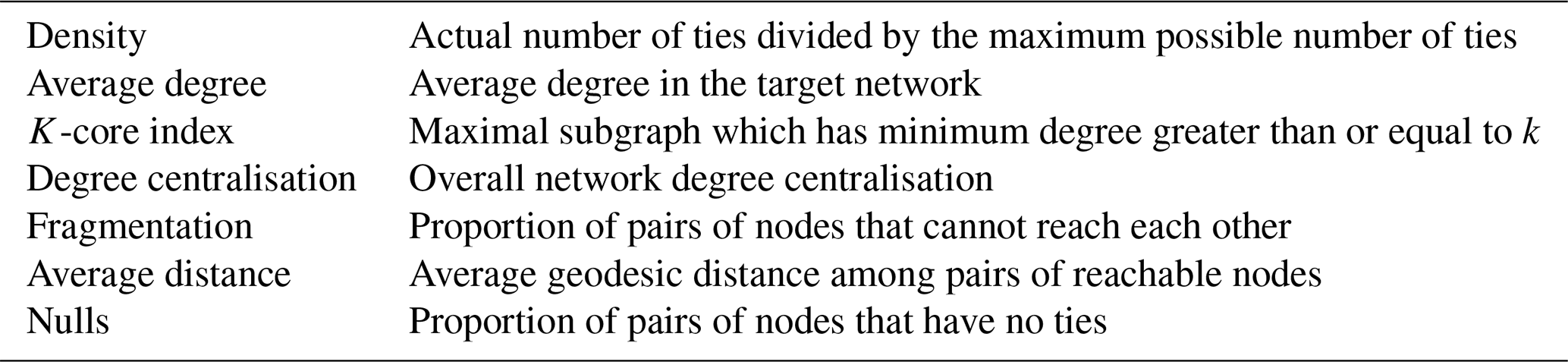
We used several SNA measures to compare the structural characteristics of the reconstructed networks. Specifically, we adopted density, average degree, K-core index, degree centralisation, fragmentation, transitivity/closure, average distance, and nulls for this purpose (see Table 1 for the definition of these network measures).
Table 1Multiple network measures adopted and their definition (Borgatti et al., 2002).
In addition, we employed a “density by groups” approach to determine whether relational changes occurred within and between different categories of components in the periods considered. We also examined node positions using two widely used centrality measures. Specifically, we employed degree (i.e. the total number of ties) and eigenvector centrality (i.e. node centrality determined by the centrality of the nodes to which it is connected), together with graph visualisation, to observe any differences in the “weight” of each category and individual component across the two periods. Finally, we used graph visualisation based on valued networks to highlight changes in tie intensity, with thicker lines graphically representing stronger links between pairs of components. We recognise that the non-homogeneity of the data prevents us from presenting the results as definitive. We decided to continue with the case study because what we retain as robust is the hypothesis that the framework offers: if fossil continuity is guaranteed through its reticular articulation, retracing components, interactions, and conflicts between networks can help to understand why deactivation may or may not occur.
6.2 The empirical analysis
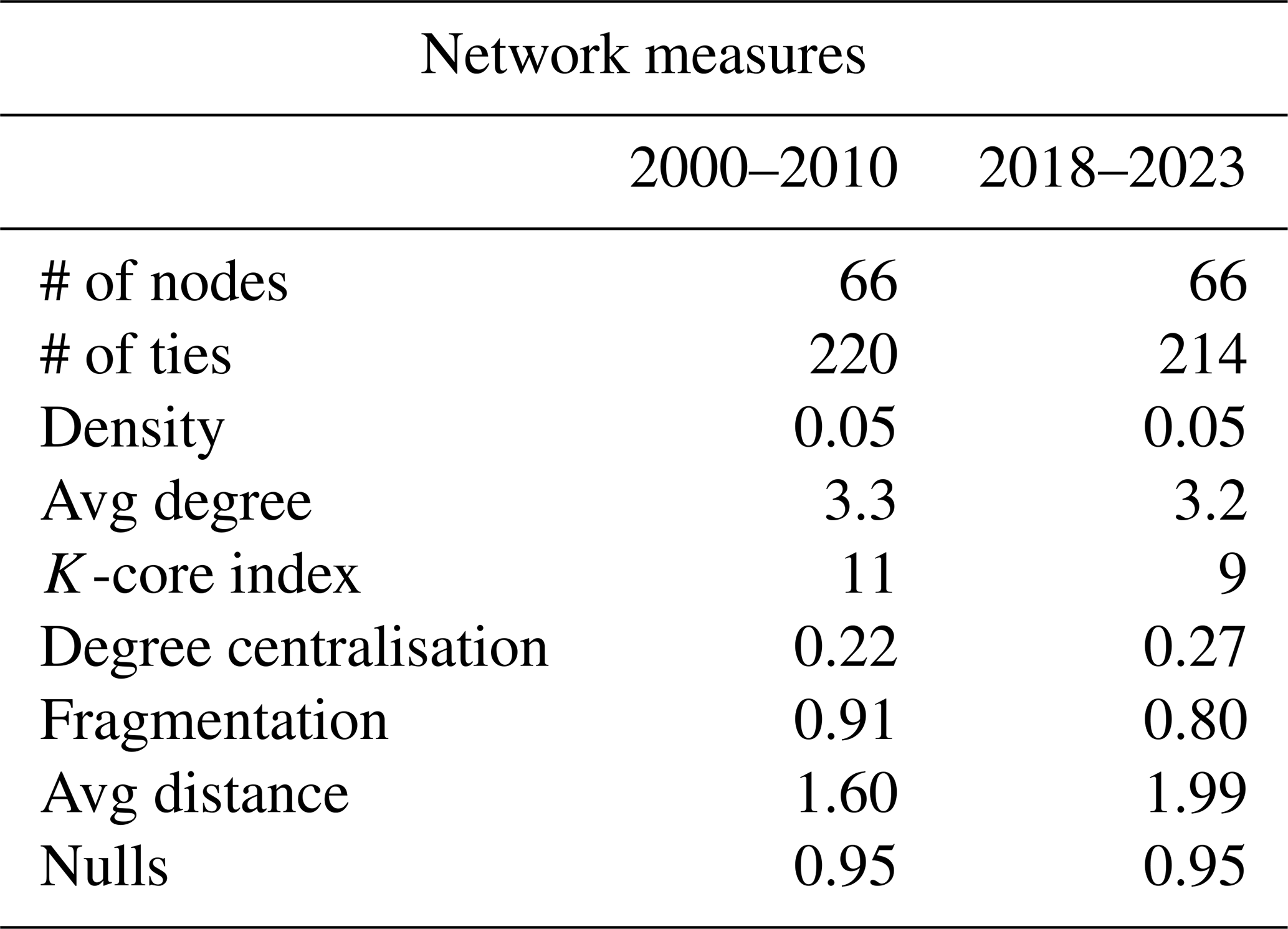
The structural part of our analysis, based on multiple measures (see Table 2), shows that the deactivation network remained almost unchanged across the two periods. We observed 220 ties in 2000–2010 and 216 ties in 2018–2023, with a very similar average degree (i.e. total number of ties) and only 5 % of connected ties. This low density is also reflected in the high percentage of nulls (95 % of dyads have no ties). Despite some negligible variations in degree centralisation, average distance, k cores, and fragmentation (with the older network being slightly more fragmented than the newer one), the two networks can be safely considered to be structurally equivalent.
Table 2Multiple measures at the network level (2000–2010 and 2018–2023).
What significantly differentiates the deactivation network in the two periods considered is the number and types of component involved. As Table 3 shows, the 2000–2010 deactivation network displays a clear predominance of activists (the top four nodes in terms of degree centrality and more than 50 % of the total number of components involved). Institutions (four participating components, two of which occupy positions just below the top four activists), political parties (two), scientific and health organisations (two), and trade associations (one) played a more marginal role in the relational dynamics that unfolded during 2000–2010. The eigenvector scores do not differ substantially from degree centrality.
Table 3Components of the deactivation network, type, degree, and eigenvector in 2000–2010 and 2018–2023.
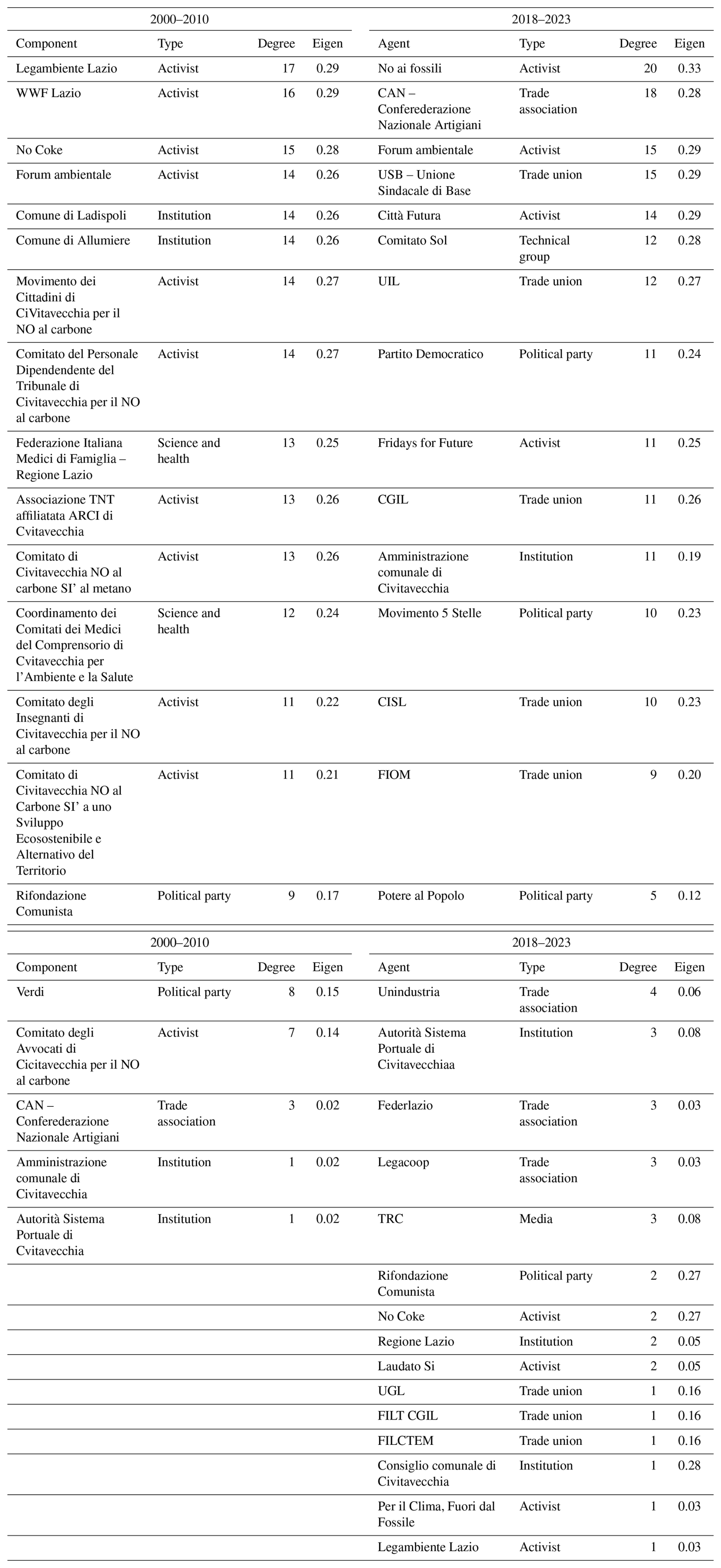
The radically different situation observed in the 2018–2023 period results from the increased participation of a more diverse set of components in the deactivation network. These include political parties (four participating components), institutions (four), trade associations (four), technical groups (one), and media companies (one). Above all, a significant increase in trade union participation emerges, with seven components participating in events organised against the power plant in the Civitavecchia area, whereas they were entirely absent in the previous period. In the 2018–2023 period, there are only eight activists in the reconstructed network (i.e. three fewer than in the previous period). Some components with very few ties display higher eigenvector scores than others who score higher in terms of degree centrality. This illustrates the ability of certain political parties, activists, and trade unions to connect to parts of the network with higher overall connectivity, thereby exerting a form of indirect influence within the network in the 2018–2023 period.
Another interesting insight emerges from the investigation of the “density by groups of components”, which allows us to understand how cohesive a group is (density within groups) and how connected it is to other groups that make up a given network (density between groups). Although these measures are often reported as scores ranging from 0 to 1 or as relative percentages (i.e. the share of nodes connected within and between groups; see Hanneman and Riddle, 2005), we chose to use absolute values because the different sizes of each group strongly influence the interpretation of this type of network statistic.
That said, it is evident that the main difference lies in the higher level of interactions among trade unions, both within their own group and with other groups such as trade associations, politicians, political parties, institutions, and activists. Activists, by contrast, display a significantly lower level of interaction, mainly within their own group (see Tables 4 and 5 for details on the number of ties within each category and all possible combinations between groups). Trade associations also show a general increase in connectivity in the second period, whereas science and health entities, which exhibited a good number of connections within their group and with other categories in 2000–2010, display no connections at all in 2018–2023. Finally, the technical group shows a moderate increase in connectivity in the 2018–2023 period, while media has a low level of connectivity and industry remains completely irrelevant, with no ties in either period.
Table 4Density by groups. Period: 2000–2010. Groups: political party, institution, trade union, activist, science and health, technical group, media.
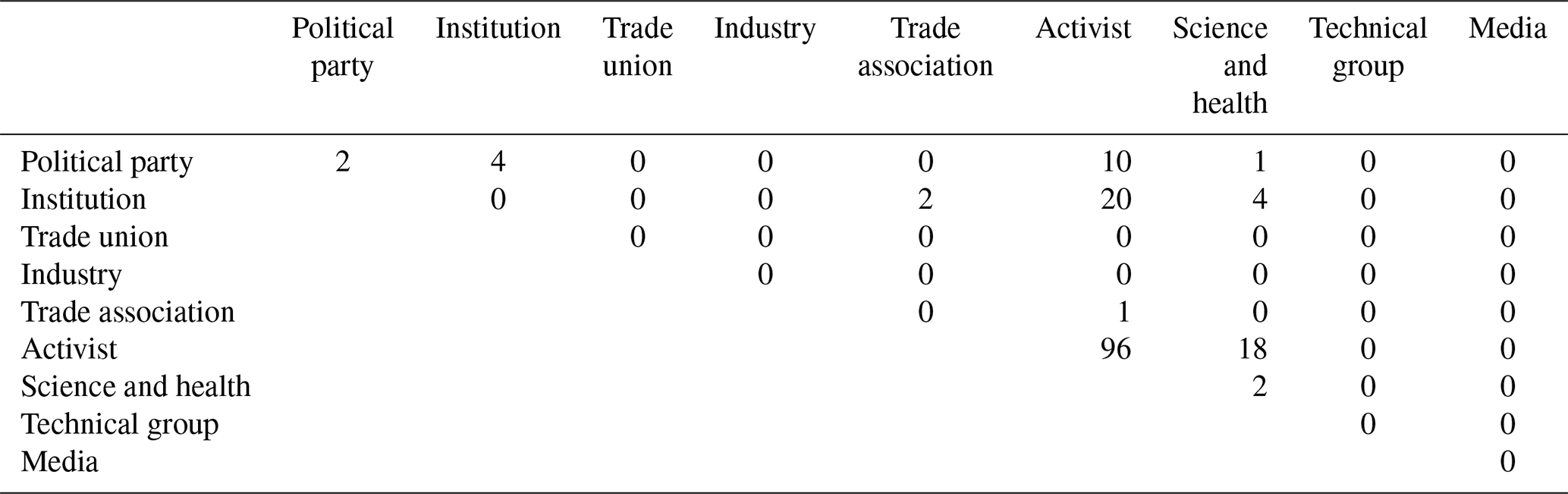
Table 5Density by groups. Period: 2018–2023. Groups: political party, institution, trade union, activist, science and health, technical group, media.
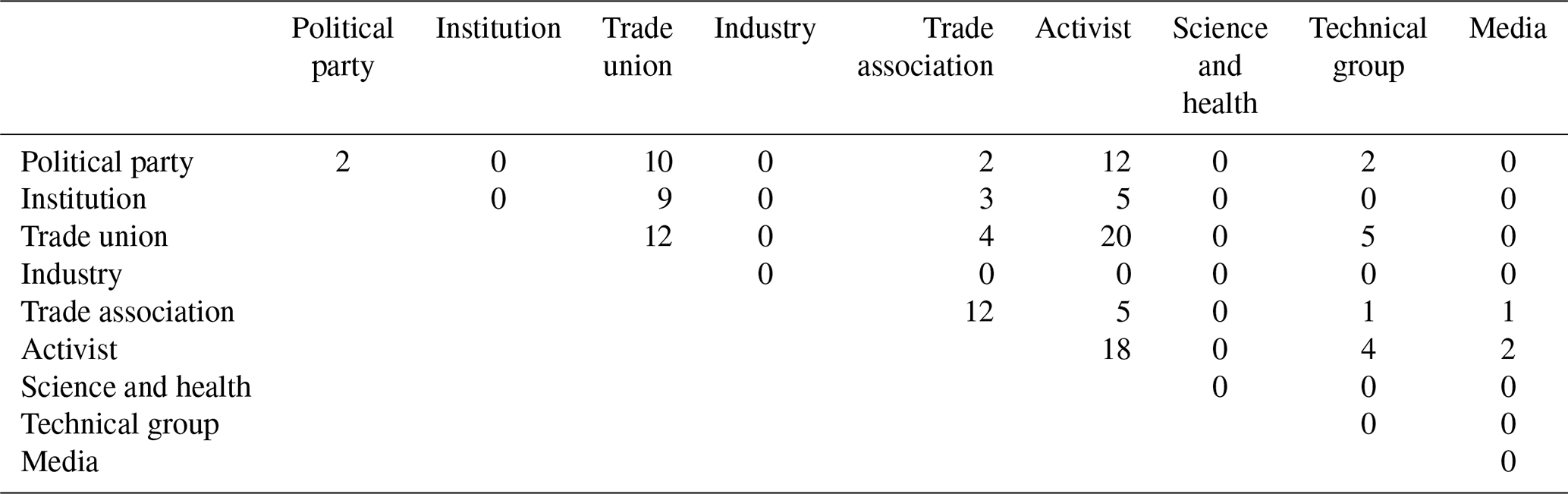
Table 6Density by groups. Difference between 2000–2010 and 2018–2023. Groups: political party, institution, trade union, activist, science and health, technical group, media. Legend: +: positive balance; =: no change; −: negative balance.
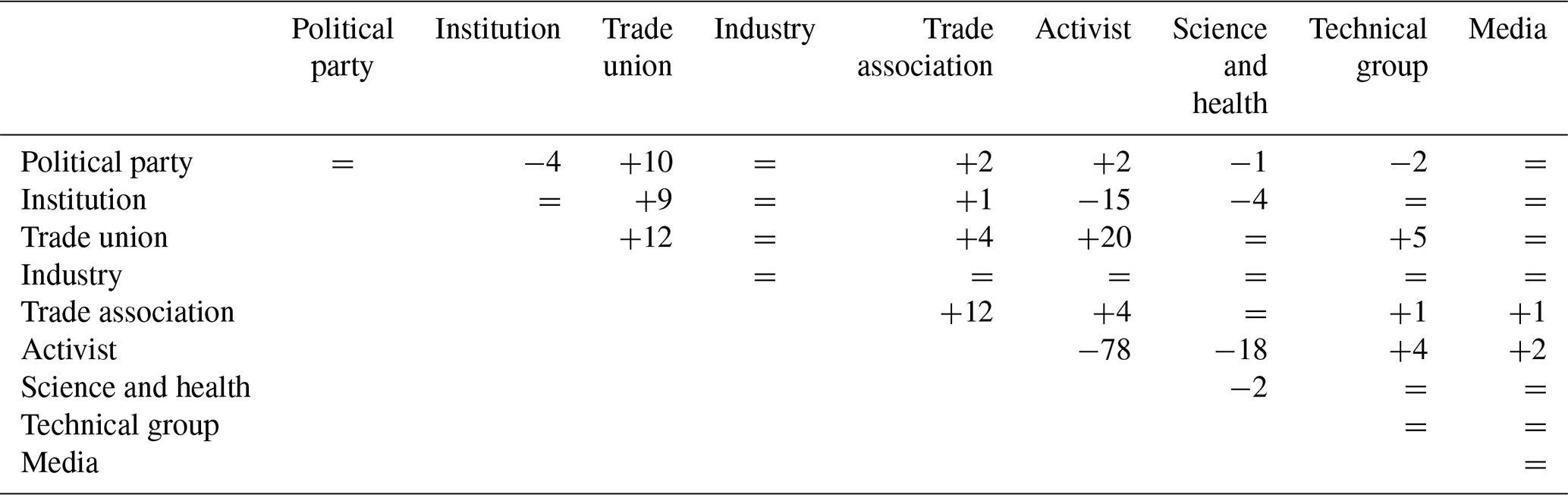
The above data and the related considerations on the role of each component, and on their interactions with other components in contributing to stopping the coal-to-gas conversion of the Civitavecchia power plants, lead us to several reflections on the roles played by the different components of the deactivation network in the two target periods. Table 6 illustrates the changes in network connectivity that occurred within and between groups in the two periods considered.
It is worth noting the significant loss of connectivity among a particular group of components, namely activists. Although they remained among the most important components in 2018–2023, activists' lower centrality is demonstrated by the substantially reduced number of ties established with scientific and health organisations (−18) and institutions (−15). Perhaps more importantly, the density within the activist group decreased dramatically from 96 ties in 2000–2010 to 18 ties in 2018–2023 (−78). This notable decrease was partially, and apparently successfully, offset by a higher number of ties with all other components and, above all, with trade unions (+20 ties).
These results suggest that, at least in the case of Civitavecchia, the combined actions implemented by different types of component – such as political parties, trade associations, and, above all, trade unions – working in support of activists led to more effective outcomes. In other words, only the political and institutional support received by activists – who were undoubtedly central and played a predominant role but were somewhat disconnected from the rest of the components in the previous period – contributed to a reconfiguration of political and institutional alignments that preceded the decision to stop the Civitavecchia power plant conversion in October 2022.
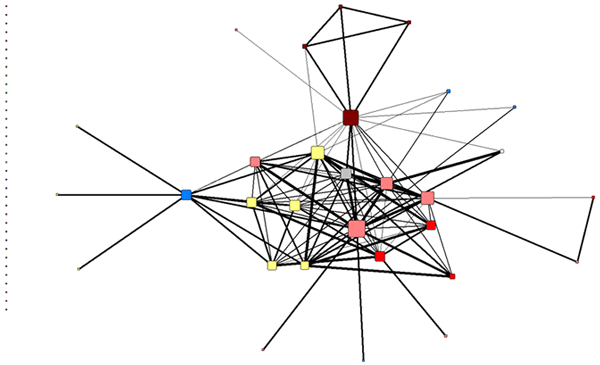
Another valuable insight emerges from examining the intensity of ties. In addition to evaluating the mere existence of a relationship (binary network) between components, we also calculated the strength of ties by observing the number of times two components participated in the same event (meeting, demonstration, protest, etc.) in the two reference periods, and we illustrated these results graphically in Figs. 1 and 2 (i.e. thicker lines correspond to stronger ties, while different colours refer to different groups of components; see the figures for details). The two graphs unequivocally show that, beyond the relatively stable network properties (such as density, other structural measures, and broader participation of more agents in 2018–2023), groups of components established more intense relationships. This element, together with the entry of political and institutional organisations into the relational dynamics observed in Civitavecchia, may represent a key factor that contributed to halting the plant's coal-to-gas conversion.
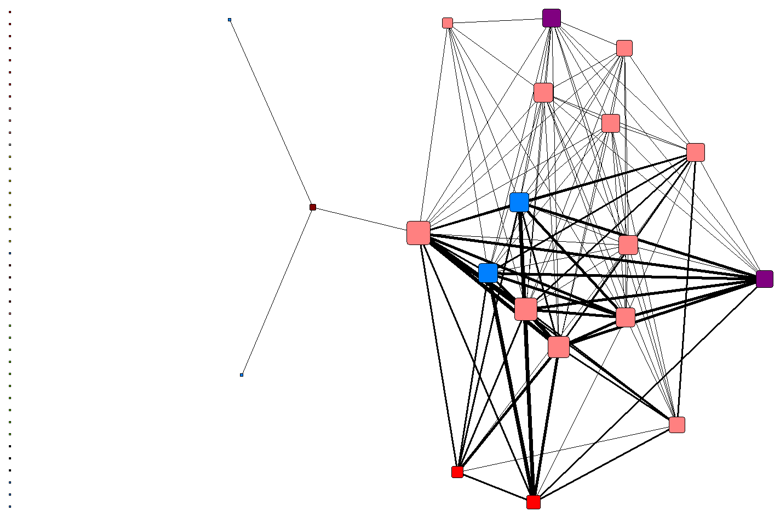
Figure 1Network visualisation. Period: 2000–2010. Legend: political party – 1 (red); institution – 2 (light blue); trade union – 3 (yellow); industry – 4 (green); trade association – 5 (brown); activist – 6 (pink); science and health – 7 (purple); technical group – 8 (grey); media – 9 (white).
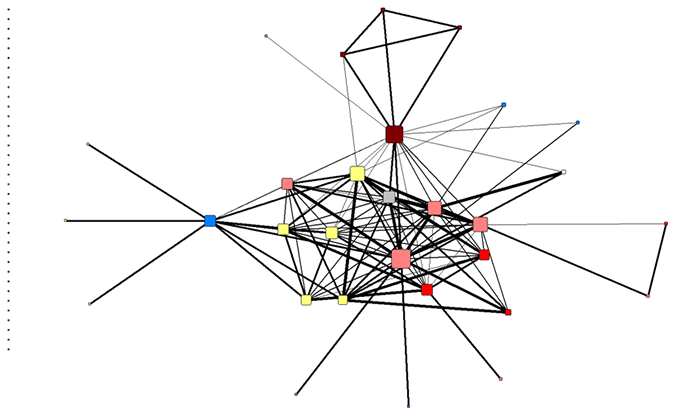
Figure 2Network visualisation. Period: 2018–2023. Legend: political party – 1 (red); institution – 2 (light blue); trade union – 3 (yellow); industry – 4 (green); trade association – 5 (brown); activist – 6 (pink); science and health – 7 (purple); technical group – 8 (grey); media – 9 (white).
6.3 Interpreting network reconfigurations through the analytical categories of the deactivation network approach
While Sect. 6.2 reconstructs and compares the relational configurations of the deactivation network across the two periods under investigation, this section advances a second-order analytical step. It interprets the observed network dynamics through the analytical categories defined by the deactivation network approach (DNA), namely the practices of legitimation and continuity on the side of the fossil network, and destabilisation and disruption on the side of the deactivation network. In doing so, this section addresses a key analytical challenge: moving from a structural description of relational change to an interpretation of how different configurations enable or constrain specific repertoires of action in conflicts relating to fossil fuel infrastructures.
6.3.1 Fossil network practices as a structuring condition of contestation
Although the fossil network is not empirically reconstructed through social network analysis in this article, its practices constitute a fundamental structuring condition for the conflicts analysed. In the case of Civitavecchia, both the oil-to-coal conversion in the first period and the coal-to-gas proposal in the second can be interpreted as instances of fossil network practices aimed at ensuring infrastructural continuity through legitimation.
These practices include the framing of conversion projects as technological upgrading, environmental improvement, or pragmatic responses to regulatory and climatic pressures, thereby shifting the terrain of contestation from whether fossil fuels should be phased out to which fossil configuration should be retained. At the same time, continuity practices operate through administrative procedures, regulatory authorisations, labour arrangements, and territorial anchoring strategies that preserve the operational viability of the infrastructure. Together, these practices produce a political space in which fossil continuity appears both necessary and reasonable, setting the parameters within which deactivation efforts must operate.
6.3.2 The 2000–2010 period: destabilisation without disruption
The relational configuration observed in the 2000–2010 period corresponds to a deactivation network whose practices were predominantly oriented towards destabilisation. As shown in Sect. 6.2, this phase is characterised by a strong centrality of activist components; the high density of ties within the activist group; and comparatively weak connections with institutional, political, economic, and labour actors.
Interpreted through the DNA, this configuration reflects a repertoire of action focused on the denaturalisation of fossil fuel use and the public articulation of its harmful effects, particularly regarding health and environmental risks. Destabilisation practices were effective in producing controversy, mobilising moral and scientific arguments, and challenging the legitimacy of the oil-to-coal conversion at the level of public discourse. However, they remained largely disconnected from the institutional and organisational arenas in which continuity practices were enacted.
As a result, destabilisation was not translated into disruption. The deactivation network lacked the relational channels required to interfere with the administrative, political, and economic mechanisms sustaining infrastructural continuity. The failure to prevent the oil-to-coal conversion thus does not indicate the weakness of mobilisation per se but rather the structural mismatch between a repertoire centred on destabilisation and a fossil network capable of maintaining continuity through deeply embedded institutional arrangements. This helps to understand why large demonstrations do not necessarily translate into substantial changes.
6.3.3 The 2018–2023 period: articulating destabilisation and disruption
The second period displays a markedly different configuration. While activists remain central, the deactivation network expands and diversifies through the entry of trade unions, political parties, institutional actors, trade associations, and technical groups. As shown by the density-by-groups analysis and centrality measures presented in Sect. 6.2, this diversification is accompanied by increased inter-group connectivity and stronger ties between activists and actors positioned closer to decision-making arenas.
From the perspective of the DNA, this reconfiguration signals a qualitative shift in the repertoire of practices deployed by the deactivation network. Destabilisation practices continue to play a crucial role by maintaining public visibility, moral pressure, and a normative critique of fossil fuel use. However, they are now coupled with disruption practices that directly target the operational and institutional conditions of the infrastructure.
The entry of trade unions best illustrates how the two steps work together and what the qualitative material adds. Structurally, SNA registers the unions as absent in 2000–2010 and prominent in 2018–2023, entering with high inter-group connectivity and a bridging position: the density-by-groups analysis records a marked rise in activist–union ties (+20) precisely as intra-activist density collapses (−78). The network shows that a cross-cutting actor entered as the outcome changed; it cannot show why – and the question matters, since unions have historically defended jobs against environmental closure (“jobs versus environment”). The answer lies in the qualitative record. Our interviews and documents, corroborated by recent work on the Civitavecchia mobilisations (Caligari and Asara, 2024; Grasso and Delatin Rodrigues, 2024), show that the unions did not merely join an existing coalition: they rearticulated health, labour, and territorial futures as a single just-transition problem and co-produced, with technicians and ecological committees, a concrete industrial alternative to the gas conversion – notably offshore wind tied to local shipyard and port employment. It was this discursive and projectual work, legible only qualitatively, that converted relational proximity into disruptive capacity, dissolving the very opposition on which the fossil network's legitimation rested. The network locates the hinge; the qualitative analysis explains why it held.
As the union case demonstrates, this interpretation clarifies the analytical role of social network analysis within the DNA. Network measures do not capture power or influence directly; rather, they render visible the relational conditions under which specific practices can circulate, combine, and acquire effectiveness. Changes in centrality, density, and tie intensity reflect shifts in the deactivation network's capacity to align destabilisation with disruption and to counter fossil network practices of legitimation and continuity. The emergence of a relational configuration enables the translation of contestation into institutional interference (at a local, regional, and national scale). The halting of the coal-to-gas conversion thus appears as the outcome of a temporary but consequential rebalancing between practices of continuity and practices of disruption, mediated by network reconfiguration.
By interpreting the empirical results through the analytical categories of the DNA, this section demonstrates how network reconfigurations correspond to shifts in the repertoire of practices deployed in conflicts in fossil fuel infrastructures. The case of Civitavecchia shows that deactivation becomes plausible not when destabilisation intensifies in isolation but when it is relationally articulated with disruptive capacities capable of constraining fossil continuity. In this sense, the DNA provides not only a conceptual vocabulary but an interpretative framework for understanding how infrastructural conflicts evolve through the interaction of practices embedded in changing network configurations.
This article has proposed and analytically mobilised the deactivation network approach (DNA) to examine conflicts surrounding fossil fuel infrastructures. Rather than treating fossil fuel phase-out as a primarily technological or policy-driven process, the DNA conceptualises infrastructural contestation as a relational and practice-based struggle between antagonistic logics of continuity and deactivation.
Empirically, the article focused on the deactivation network opposing successive fossil-to-fossil conversion projects at the Civitavecchia power plants. While only one network was reconstructed through social network analysis, the analytical contribution of the DNA does not rest on the symmetrical mapping of two networks. Instead, fossil networks were approached as structurally embedded constellations of legitimation and continuity practices that define the political and institutional conditions under which deactivation efforts unfold. This asymmetry is not a limitation of the analysis but a constitutive feature of fossil power, which tends to operate by stabilising infrastructures while keeping the governance arrangements built around them partially opaque.
The comparative analysis of the two periods demonstrates that the effectiveness of deactivation cannot be explained by activist mobilisation or network cohesion alone. In the first period, a repertoire dominated by destabilisation practices proved insufficient to constrain fossil continuity. In the second period, deactivation became plausible when destabilisation was relationally articulated with disruptive practices capable of interfering with the infrastructure's operational and institutional viability. Network reconfigurations, in this sense, functioned as mediators, enabling the translation of normative contestation into material and political constraints. Crucially, this mediating role of networks must be understood as intrinsically shaped by the infrastructural nature of fossil power. Fossil fuel infrastructures do not merely constitute the object of contention; they actively organise asymmetrical conditions of visibility, access, and intervention (Mitchell, 2011). Through their material embeddedness in territories, regulatory regimes, labour relations, and energy systems, infrastructures stabilise practices of legitimation and continuity while rendering fossil networks partially opaque and institutionally sedimented. Deactivation networks, by contrast, remain relationally exposed and politically contingent. The asymmetry observed in this article is therefore not only relational but infra-structural: it is produced by the capacity of infrastructures to concentrate power while dispersing responsibility and to normalise continuity as a taken-for-granted background condition of socio-economic and political life.
By foregrounding the interplay between practices and relational configurations, the DNA contributes to ongoing debates on supply-side climate politics, fossil fuel phase-out, and infrastructural power. It offers an interpretative framework for analysing why some deactivation efforts succeed while others fail, without presupposing empirical symmetry between opposing forces. More broadly, the approach highlights how asymmetrical power relations are produced and contested through infrastructures, and why understanding these asymmetries is crucial for the politics of decarbonisation.
Future research may build on this framework by exploring other infrastructural sites and by combining different empirical strategies to trace fossil and deactivation network practices across scales. However, the central contribution of this article lies in demonstrating how a practice-oriented and relational perspective can render visible the conditions under which fossil continuity is disrupted and infrastructural deactivation becomes politically achievable.
No original software code was developed for this study. Data analyses were conducted using UCINET (version 6.800), a proprietary software package for social network analysis. Therefore, there is no underlying source code generated by the authors to deposit in a public repository. The software is commercially distributed and can be accessed through the developer's website.
The data can be accessed by request.
DDR and MG conceived the study, developed the theoretical framework, designed the research, conducted the fieldwork and interviews, and wrote the paper. GC contributed to the research design, performed the formal social network analysis, contributed to the theoretical elaboration, and wrote parts of the paper. All authors reviewed and approved the final article.
The contact author has declared that none of the authors has any competing interests.
Publisher's note: Copernicus Publications remains neutral with regard to jurisdictional claims made in the text, published maps, institutional affiliations, or any other geographical representation in this paper. The authors bear the ultimate responsibility for providing appropriate place names. Views expressed in the text are those of the authors and do not necessarily reflect the views of the publisher.
The authors thank Timothy Raeymaekers for editorial guidance and two anonymous reviewers for their constructive comments, which substantially improved this article.
This research has been supported by Climate Social Science Network (grant no. PSA-GR5300342) and the Ministero dell'Università e della Ricerca (grant no. 20224HPEJP – CUP H53D23004890006).
This paper was edited by Timothy Raeymaekers and reviewed by two anonymous referees.
Appel, H., Anand, N., and Gupta, A. (Eds.): Introduction: Temporality, politics, and the promise of infrastructure, in: The Promise of Infrastructure, 1–38, https://doi.org/10.1215/9781478002031-001, 2018.
Banoub, D. and Martin, S. J.: Storing value: The infrastructural ecologies of commodity storage, Environ. Plan. D, 38, 1101–1119, https://doi.org/10.1177/0263775820911942, 2020.
Barry, A.: Technological zones, Eur. J. Soc. Theory, 9, 239–253, https://doi.org/10.1177/1368431006063343, 2006.
Bevacqua, E., Schleussner, C.-F., and Zscheischler, J.: A year above 1.5 °C signals that Earth is most probably within the 20-year period that will reach the Paris Agreement limit, Nat. Clim. Change, 15, 262–265, https://doi.org/10.1038/s41558-025-02246-9, 2025.
Blondeel, M.: Taking away a “social licence”: Neo-Gramscian perspectives on an international fossil fuel divestment norm, Global Transit., 1, 200–209, https://doi.org/10.1016/j.glt.2019.10.006, 2019.
Bocquillon, P.: Climate and energy transitions in times of environmental backlash? The European Union `Green Deal' from adoption to implementation, J. Common Mark. Stud., 62, 124–134, https://doi.org/10.1111/jcms.13675, 2024.
Borgatti, S. P., Everett, M. G., and Freeman, L. C.: Ucinet 6 for Windows: Software for Social Network Analysis, Analytic Technologies, Harvard, MA, 2002.
Brulle, R., Roberts, J. T., and Spencer, M. (Eds.): Climate Obstruction across Europe, Oxford University Press, Oxford, https://doi.org/10.1093/oso/9780197762042.001.0001, 2024.
Byrne, D. and Callaghan, G.: Complexity Theory and the Social Sciences: The State of the Art, Routledge, Abingdon, https://doi.org/10.4324/9780203519585, 2014.
Caligari, M. and Asara, V.: Protagonismo sindacale verso la transizione giusta a Civitavecchia, Econ. Soc. Reg., 2, 103–118, https://doi.org/10.3280/ES2024-002008, 2024.
Cannon, A. J.: Twelve months at 1.5 °C signals earlier than expected breach of Paris Agreement threshold, Nat. Clim. Change, 15, 1–4, 2025.
David, M.: Moving beyond the heuristic of creative destruction: Targeting exnovation with policy mixes for energy transitions, Energy Res. Soc. Sci., 33, 138–146, https://doi.org/10.1016/j.erss.2017.09.023, 2017.
Delatin Rodrigues, D.: Climate Change and Political Action in Italy, Palgrave Macmillan, Cham, ISBN 978-3-031-98771-7, 2025.
Delatin Rodrigues, D. and Grasso, M.: Social tipping processes in the transformation of Civitavecchia's socio-energy system, in: Positive Tipping Points towards Sustainability, edited by: Tàbara, J. D., Flamos, A., and Mangalagiu, D., Springer, Cham, https://doi.org/10.1007/978-3-031-50762-5, 2024.
Frank, L. and Schanz, H.: Three perspectives on regime destabilisation governance: A metatheoretical analysis of German pesticide policy, Environ. Innov. Soc. Transit., 44, 245–264, https://doi.org/10.1016/j.eist.2022.07.002, 2022.
Geels, F. W., Berkhout, F., and Van Vuuren, D. P.: Bridging analytical approaches for low-carbon transitions, Nat. Clim. Change, 6, 576–583, https://doi.org/10.1038/nclimate2980, 2016.
Goldhaber, M. D.: Big banks and asset managers abandon the goal of net zero carbon emissions, https://bhr.stern.nyu.edu/quick-take/big-banks-and-asset-managers-abandon-the-goal-of-net-zero- carbon-emissions/ (last access: 15 June 2026), 2025.
Grasso, M.: From Big Oil to Big Green: Holding the Oil Industry to Account for the Climate Crisis, MIT Press, Cambridge, MA, ISBN 978-0-262-54374-3, https://doi.org/10.7551/mitpress/14293.001.0001, 2022.
Grasso, M. and Delatin Rodrigues, D.: Rage against the fossil machine: The deactivation of fossil energy production in Italy, Energy Res. Soc. Sci., 115, 103655, https://doi.org/10.1016/j.erss.2024.103655, 2024.
Grasso, M. and Delatin Rodrigues, D.: Disrupting to decarbonise socio-energy systems: The `carbon transformation axes' framework, Energy Res. Soc. Sci., 90, 102657, https://doi.org/10.1016/j.erss.2022.102657, 2022.
Hanneman, R. A. and Riddle, M.: Introduction to Social Network Methods, University of California, Riverside, CA, http://faculty.ucr.edu/~hanneman/nettext/ (last access: 24 June 2026), 2005.
Hausfather, Z. and Friedlingstein, P.: Analysis: Global CO2 emissions will reach new high in 2024 despite slower growth, https://www.carbonbrief.org/analysis-global-co2-emissions-will-reach-new-high-in-2024- despite-slower-growth/ (last access: 15 June 2026), 2024.
Hess, D. J.: Conflict and uneven development in the multidecade distributed solar energy transition in the United States, P. Natl. Acad. Sci. USA, 120, e2206200119, https://doi.org/10.1073/pnas.2206200119, 2023a.
Hess, D. J.: Pipeline conflicts, coalitions, and strategic action: A review of the literature, Extr. Ind. Soc., 16, 101339, https://doi.org/10.1016/j.exis.2023.101339, 2023b.
Hielscher, S., Wittmayer, J. M., and Dańkowska, A.: Social movements in energy transitions: The politics of fossil fuel energy pathways in the United Kingdom, the Netherlands and Poland, Extr. Ind. Soc., 10, 101073, https://doi.org/10.1016/j.exis.2022.101073, 2022.
IPCC: Summary for Policymakers, in: Climate Change 2023: Synthesis Report, Contribution of Working Groups I, II and III to the Sixth Assessment Report of the Intergovernmental Panel on Climate Change, edited by: Lee, H. and Romero, J., IPCC, Geneva, 1–34, https://doi.org/10.59327/IPCC/AR6-9789291691647.001, 2023.
Jamieson, D.: Slavery, carbon, and moral progress, Eth. Theory Moral Pract., 20, 169–183, 2017.
Jasny, L. and Fisher, D. R.: How networks of social movement issues motivate climate resistance, Soc. Netw., 75, 159–169, https://doi.org/10.1016/j.socnet.2022.02.002, 2023.
Kammerer, M. and Ingold, K.: Actors and issues in climate change policy: The maturation of a policy discourse in the national and international context, Soc. Netw., 75, 65–77, https://doi.org/10.1016/j.socnet.2021.08.005, 2023.
Kaufman, C.: Taking political power from the fossil fuel industry, Radic. Philos. Rev., 27, 1–19, https://doi.org/10.5840/radphilrev202517151, 2025.
Keohane, R. O. and Victor, D. G.: The regime complex for climate change, Perspect. Polit., 9, 7–23, https://doi.org/10.1017/S1537592710004068, 2011.
Kühne, K., Bartsch, N., Tate, R. D., Higson, J., and Habet, A.: `Carbon bombs' – Mapping key fossil fuel projects, Energy Policy, 166, 112950, https://doi.org/10.1016/j.enpol.2022.112950, 2022.
Lamb, W. F., Mattioli, G., Levi, S., Roberts, J. T., Capstick, S., Creutzig, F., and Steinberger, J. K.: Discourses of climate delay, Global Sustain., 3, e17, https://doi.org/10.1017/sus.2020.13, 2020.
Larkin, B.: The politics and poetics of infrastructure, Annu. Rev. Anthropol., 42, 327–343, 2013.
Law, J.: Notes on the theory of the actor-network: Ordering, strategy, and heterogeneity, Syst. Pract., 5, 379–393, https://doi.org/10.1007/BF01059830, 1992.
Levy, D. L. and Newell, P. J.: Business strategy and international environmental governance: Toward a neo-Gramscian synthesis, Global Environ. Polit., 2, 84–101, https://doi.org/10.1162/152638002320980632, 2002.
Macdonald, G.: Containing oil: The pipeline in petroculture, in: Petrocultures: Oil, Politics, Culture, edited by: Wilson, S., Carlson, A., and Szeman, I., McGill-Queen's University Press, Montreal, 36–77, https://doi.org/10.1515/9780773550391-005, 2017.
Malm, A.: Fossil Capital: The Rise of Steam Power and the Roots of Global Warming, Verso Books, London, ISBN 978-1-78478-129-3, 2016.
Marriott, J. and Minio-Paluello, M.: The Oil Road: Journeys from the Caspian Sea to the City of London, Verso, London, ISBN 978-1-84467-646-0, 2012.
Mitchell, T.: Carbon Democracy: Political Power in the Age of Oil, Verso, London, ISBN 978-1-84467-745-0, 2011.
Rinscheid, A., Rosenbloom, D., Markard, J., and Turnheim, B.: From terminating to transforming: The role of phase-out in sustainability transitions, Environ. Innov. Soc. Transit., 41, 27–31, https://doi.org/10.1016/j.eist.2021.10.019, 2021.
Simondon, G.: On the Mode of Existence of Technical Objects, University of Minnesota Press, Minneapolis, ISBN 978-1-5179-0487-6, 2016.
Sovacool, B. K., Hess, D. J., Cantoni, R., Lee, D., Brisbois, M. C., Walnum, H. J., Dale, R. F., Rygg, B. J., Korsnes, M., Goswami, A., Kedia, S., and Goel, S.: Conflicted transitions: Exploring the actors, tactics, and outcomes of social opposition against energy infrastructure, Global Environ. Change, 73, 102473, https://doi.org/10.1016/j.gloenvcha.2022.102473, 2022.
Star, S. L.: The ethnography of infrastructure, Am. Behav. Sci., 43, 377–391, 1999.
Stewart, J.: Making globalization visible? The oil assemblage, the work of sociology and the work of art, Cult. Sociol., 7, 368–384, https://doi.org/10.1177/1749975512453663, 2012.
Thiri, M. A., Villamayor-Tomás, S., Scheidel, A., and Demaria, F.: How social movements contribute to staying within the global carbon budget: Evidence from a qualitative meta-analysis of case studies, Ecol. Econ., 195, 107356, https://doi.org/10.1016/j.ecolecon.2022.107356, 2022.
Tilly, C.: Contentious Performances, Cambridge University Press, Cambridge, https://doi.org/10.1017/CBO9780511804366, 2008.
Turnheim, B. and Geels, F. W.: Regime destabilization as the flipside of energy transitions: Lessons from the history of the British coal industry (1913–1997), Energy Policy, 50, 35–49, https://doi.org/10.1016/j.enpol.2012.04.060, 2012.
Turnheim, B. and Geels, F. W.: The destabilization of existing regimes: Confronting a multi-dimensional framework with a case study of the British coal industry (1913–1967), Res. Policy, 42, 1749–1767, https://doi.org/10.1016/j.respol.2013.04.009, 2013.
UN: Press conference by Secretary-General António Guterres at United Nations Headquarters, https://press.un.org/en/2023/sgsm21840.doc.htm (last access: 15 June 2026), 2023.
UNEP: Emissions Gap Report 2024: No more hot air … please! With a massive gap between rhetoric and reality, countries draft new climate commitments, United Nations Environment Programme, Nairobi, https://doi.org/10.59117/20.500.11822/46404, 2024.
Unruh, G. C.: Understanding carbon lock-in, Energy Policy, 28, 817–830, https://doi.org/10.1016/S0301-4215(00)00070-7, 2000.
van Oers, L., Feola, G., Moors, E., and Runhaar, H.: The politics of deliberate destabilisation for sustainability transitions, Environ. Innov. Soc. Transit., 40, 159–171, https://doi.org/10.1016/j.eist.2021.06.003, 2021.
Watts, M. J.: Righteous oil? Human rights, the oil complex, and corporate social responsibility, Annu. Rev. Environ. Resour., 30, 373–407, https://doi.org/10.1146/annurev.energy.30.050504.144456, 2005.
Watts, M. J.: A tale of two gulfs: Life, death, and dispossession along two oil frontiers, Am. Q., 64, 437–467, 2012.
Wilson, S., Szeman, I., and Carlson, A. (Eds.): On petrocultures: Or, why we need to understand oil to understand everything else, in: Petrocultures: Oil, Politics, Culture, McGill-Queen's University Press, Montreal, 3–19, https://doi.org/10.1515/9780773550391-003, 2017.
- Abstract
- Introduction
- The deactivation network approach and the relevant literature
- The deactivation network approach: objective and structure
- Analytical categories
- Methodology
- An application of the DNA to the Civitavecchia power plants
- Conclusion
- Code availability
- Data availability
- Author contributions
- Competing interests
- Disclaimer
- Acknowledgements
- Financial support
- Review statement
- References
- Abstract
- Introduction
- The deactivation network approach and the relevant literature
- The deactivation network approach: objective and structure
- Analytical categories
- Methodology
- An application of the DNA to the Civitavecchia power plants
- Conclusion
- Code availability
- Data availability
- Author contributions
- Competing interests
- Disclaimer
- Acknowledgements
- Financial support
- Review statement
- References