
the Creative Commons Attribution 4.0 License.
the Creative Commons Attribution 4.0 License.
 | 15 Oct 2026
Visible yet unseen: unpacking the (in)visibilities of food-delivery riders in public space
Emilia M. Bruck

Katarzyna Gruszka
Food-delivery riders embody a constitutive paradox of platform-mediated labour. Although visible and physically exposed in public space, their labour is obscured, their subjectivities unacknowledged, and their presence marginalised. This article explores this visible invisibility paradox to illuminate gaps in theorising (in)visibility in platform labour. Existing scholarship conceptualises (in)visibility as disembodiment, sociocultural disguise, and economic devaluation, with spatial mechanisms primarily addressed through material presence in public or private space. Moreover, institutional invisibility has largely been theorised regarding labour regulation, overlooking how invisibility within the transportation regime compounds economic, physical, and cultural vulnerabilities. Drawing on interviews with food-delivery riders in Toronto and international studies, this article makes a theoretical contribution to platform labour studies. By illustrating how riders are at once highly visible and othered in public space, the paper provides an analytical expansion of the framework for (in)visibility in platform-mediated work that foregrounds sociospatial dynamics, including sociocultural practices and norms, and institutional regulation. Conceptualising space not as a mere backdrop but as a social product enables a more comprehensive analysis of how sociospatial arrangements (re)produce invisibility.
- Article
(668 KB) - Full-text XML
- BibTeX
- EndNote


“As humans we are invisible to the people we deliver to,” says Mohammed, a Syrian refugee who also works as a Deliveroo rider. “People don't think about our struggles and our dreams.”
“Everyone assumes all riders are working illegally, which is not the case,” adds Rayan, from Pakistan. “We are vulnerable to being attacked – I've been attacked twice by teenagers who were just doing it for fun. We are invisible and exposed at the same time” (Taylor, 2025).
This paradox, of being “visibly invisible” (Lee et al., 2016), lies at the core of food-delivery riders' everyday experiences in public space. They are highly visible and physically exposed in urban environments, yet the full scope of their labour is obscured, their subjectivities are rarely recognised or represented, and their presence is often contested. Most importantly, food delivery is largely performed by people positioned on the margins of the broader public sphere (Fraser, 1990), rendering them particularly susceptible to labour exploitation and sociocultural othering (Vaiou and Kalandides, 2009; van Doorn, 2017). Yet, the literature on (in)visibility in platform labour has hardly addressed how extended presence in public space reproduces and requires delivery riders to negotiate cultural, legal, and economic invisibilities. This paper explores the visible invisibility paradox to illuminate this gap in theorising (in)visibility in platform labour and proposes an analytical reconceptualisation to address this limitation.
In line with Hatton's (2017) notion of “sociospatial mechanisms” of invisible work, understood as the economic devaluation of labour performed in spaces physically segregated from conventional worksites, invisibility is commonly associated with two segments of the platform-based labour force. First, it is used to describe web-based labour such as content moderation, data annotation, and micro-tasking (Cherry, 2016; Woodcock and Graham, 2020), conducted via online crowdsourcing platforms “by an invisible labour force dispersed around the world” (Rodriguez, 2025:3). Second, it is employed in studies of domestic and care work mediated by platforms (Kluzik, 2022; Gruszka et al., 2024). In this context, feminist geographers have challenged the notion that all location-based work performed through digital platforms is inherently visible, highlighting the persisting invisibility and economic devaluation of platform labour carried out in the domestic sphere, such as cleaning and care tasks (Bauriedl and Strüver, 2020). Building on this critique, Ecker and Strüver (2023) contend that platform-mediated food delivery likewise resembles reproductive labour, such as grocery shopping and meal preparation, previously hidden in homes.
Contrasting work conducted in the “invisible space” of private households (Keller, 2022) or “behind the scenes” in restaurant kitchens, grocery shops, and distribution hubs (Ecker and Strüver, 2023), food-delivery riders are commonly regarded as visible due to their presence in public space (Bauriedl and Strüver, 2022). Their platform-branded clothing, boxy delivery backpacks, and electric bicycles or scooters render them highly visible in perceptible terms (Gruszka and Böhm, 2022). Unless clients opt for the COVID-19-related feature of contactless delivery, riders “are seen by their clients upon completion of the job, by the general public while passing down the city streets as well as by other workers” (Gruszka and Böhm, 2022:1859). The opportunity for riders to physically meet in public spaces, far less common among web-based labour workers, has been identified as crucial to building collective identity and improving riders' economic conditions through knowledge sharing and coordinated labour action that strengthens collective bargaining (Tassinari and Maccarrone, 2020; Woodcock, 2021). We show that these benefits can be undermined by cultural dynamics and institutional barriers, causing exposure to traffic-related hazards, policing, and involuntary scrutiny.
We argue that characterising food-delivery work as innately visible because it is physically perceptible disregards the fact that labour performed in public space can be likewise affected by cultural, legal, and spatial mechanisms of invisibility. As theorised by Hatton (2017:343), invisible work “may also take place in the public sphere but is nonetheless devalued through spatial dynamics because it occurs in non-traditional worksites”. Thus far, scholarship on platform labour (in)visibility has theorised spatial mechanisms primarily in relation to changing material conditions, highlighting the gradual erasure of interpersonal encounters and the concealment of workers and their labour behind software or in dispersed private locations (van Doorn, 2017). However, public space has not been adequately theorised as an equally non-traditional worksite. Less attention has been paid to its sociospatial dynamics, including sociocultural practices and norms. Moreover, institutional invisibility in public space concerns not only workers' lack of labour rights but also the transportation regime governing riders' status as road users and their entitlement to its use – an aspect that has received comparatively little scrutiny.
This article makes three theoretical contributions to debates on (in)visibility in digital labour and platform studies. First, it shows why food-delivery riders and their labour remain unrecognised and devalued despite being highly visible in public space. By specifying three interrelated facets of the visible invisibility paradox, the concept of “perceptible (in)visibility” (Gruszka and Böhm, 2022) is complicated: the cultural and institutional underrepresentation of minority riders within cycling communities; the gendered segmentation in the platform delivery sector; and the marginalisation of spatial practices perceived to transgress established norms. Drawing on these examples, we call for reconceptualising perceptible (in)visibility not as mere physical presence but as embedded within and produced by sociocultural and sociolegal dynamics.
Second, scrutinising the qualities and scope of perceptible (in)visibility in platform labour requires an expanded conception of spatial production. We therefore advocate for integrating insights on relational sociospatial ontologies from digital geography scholarship into the broader discourse on (in)visibility in platform labour. Conceptualising the spatial conditions of platform labour as “relational” and “relative” (Butler et al., 2024) enables the theorisation of public space as a “non-traditional workplace” (Hatton, 2017), one that is neither equally accessible nor uniformly experienced by food-delivery workers. Conversely, sociocultural, sociolegal, and sociospatial mechanisms of invisibilisation in public space can reinforce the devaluation of delivery riders and their labour.
Third, we extend the analytical framework by Gruszka and Böhm (2022) by distinguishing between two interrelated spatial dimensions that cut across perceptible, institutional, and individual (in)visibility: the material conditions of platform labour and the social-practice dynamics, ideologies, and norms shaping workers' lived experiences. Expanding the analytical lens clarifies how material conditions and social-practice dynamics of platform labour interact to produce (in)visibility, offering a more nuanced account of concurrent invisibilisation and visibilisation.
We begin with a synthesis of debates on the (in)visibility of platform labour, introducing the analytical framework by Gruszka and Böhm (2022) before exploring the visible invisibility paradox. Our account is inspired by interviews with food-delivery riders conducted by one of the authors in 2024 as part of a broader study on experiences of inclusion and exclusion in public space among delivery riders in Toronto, Canada. Selected vignettes situate the theoretical elaboration, which draws on international studies on food-delivery labour. We conclude by advancing an analytical expansion informed by literature from urban geography, sociology, and planning studies.
This article contributes to debates in platform labour studies by advancing the analytical framework for (in)visibility of platform-mediated work through an exploration of food-delivery riders' experiences. To contextualise our argumentation and to highlight the gap in the existing discourse, we first draw on (in)visibility perspectives in platform labour scholarship. These contributions explore the intersection of new technologies and work across social sciences and humanities, including sociology, political economy, heterodox economic research, critical labour studies, and media technology (Sect. 3).
Second, we develop an account of the visible invisibility paradox by expanding on three distinct facets that systematise the mechanisms of invisibility first problematised by Lee et al. (2016) (Sect. 4). Drawing on the experiences of Chinese delivery workers in New York City, Lee et al. (2016) characterise them as “visibly invisible” cyclists whose everyday realities are shaped by the dichotomy of being underrepresented and largely ignored in infrastructure planning, yet highly visible in mediatised narratives of reckless cycling. Underpinning this dichotomy are mechanisms of cultural, legal, and spatial invisibility (Hatton, 2017) that persist today, in a context where delivery work is shaped by digital platforms and algorithmic management.
Each facet is introduced by an empirical vignette that inspired the conceptual elaboration of the paradox, substantiated with insights from a scoping review of international studies on food-delivery riders. In line with ethnographic traditions, the vignettes serve as a literary tool, distilling what is important and easing the comprehension of analytical insights (Demetriou, 2023; Schöneich, 2021). They “set an emotional tone over the material that is to come” (Smartt Gullion, 2016:90) and thereby acknowledge the riders whose perspectives allowed our theoretical argument to transpire (Rose, 2016; Bissell, 2023).
The interview data informing the vignettes was collected by one of the authors in 2024 as part of a broader study comparing experiences of inclusion and exclusion in public space among delivery riders in Toronto, Canada. Twenty-two semi-structured interviews were conducted with app-based food-delivery riders (e.g. UberEats), volunteers for a local delivery non-profit, and cooperative bike messengers. Interviewees were recruited through an online call circulated through rider networks, flyers at bike shops, and snowball sampling. The vignettes were constructed by one of the authors from verbatim excerpts and selected to illustrate mechanisms of cultural, legal, and spatial (in)visibility that disproportionally affect app-based food-delivery riders relative to other groups in the sample. To ensure confidentiality, all names were replaced with pseudonyms.
Although experiences of platform work are historically and geographically specific (Ecker and Strüver, 2022), we contend that facets of visible invisibility shape the realities of food-delivery workers across diverse institutional, cultural, and spatial contexts, albeit in locally distinct forms and to varying degrees. Accordingly, we refine the existing framework on the (in)visibility of platform-mediated work by drawing on scholarship that theorises platform-mediated environments as sociospatial formations in which space is relationally and continuously produced rather than a fixed category. To this end, we place platform labour insights in dialogue with literature from urban geography, sociology, and planning studies (Sect. 5).
The lens of (in)visibility has drawn increasing attention among platform labour scholars across disciplines, with food-delivery riders receiving relatively little attention thus far (Cini, 2023; Ecker and Strüver, 2023). In what follows, we present the (in)visibility framework for platform work (Gruszka and Böhm, 2022), central to our contribution, and synthesise insights on web-based (in)visibility, value-visibility dynamics, and location-based platform-mediated care and domestic work.
Bringing together web-based and location-based platform work, Gruszka and Böhm (2022) offer a three-layered analytical framework to capture the complexity of (in)visibility dynamics and their manifestations in the daily lives and experiences of heterogeneous platform workers. Visibility and invisibility are perceived as fluid and on a spectrum, hence the parenthetical expression: (in)visibility. Drawing on Hatton (2017) and Ticona and Mateescu (2018), they distinguish between three dimensions of (in)visibility in platform labour: perceptible, institutional, and individual.
“Perceptible (in)visibility” pertains to the extent to which workers are “actually seen” while working/as a worker by other workers, clients, or the general public, reflecting sociospatial mechanisms of rendering work invisible (Hatton, 2017). “Institutional (in)visibility” refers to the formalisation and regulation of work, corresponding with Hatton's (2017) sociolegal mechanisms. It addresses perhaps the most notorious question in platform-mediated work literature and policy, namely: are platforms actually employers? It encompasses a range of labour rights issues, spanning from workers' social security, taxation, and unionisation to ensuring decent working conditions and fair pay. In the case of food-delivery riders, we stress that analyses of institutional (in)visibility must also encompass the institutions, rules, and entitlements within the transportation regime that shape riders' status as road users. Finally, “individual (in)visibility” centres on the digital infrastructures of platforms that render workers (in)visible via the design of online profiles or rating and review schemes, or other algorithmic management practices. These dimensions are intersecting and interdependent, functioning as a sense-making, heuristic tool, as shown further on.
Early work on (in)visibility and platforms focused on web-based labour, e.g. Amazon Mechanical Turk (AMT), highlighting how geographical untethering isolates workers and fosters high invisibility (Bergvall-Kåreborn and Howcroft, 2014; Irani, 2015; Cherry, 2016). As Cherry put it, “Technology may serve to disembody workers, in some instances separating workers from their work and rendering both the work and workers invisible to consumers” (2016:72). Platforms obscure human labour for instance through number-based profile names (Irani, 2015), creating an illusion of “bodilessness” – a clear expression of individual and perceptible (in)visibility dynamics (Gruszka and Böhm, 2022). Although the geographical and temporal flexibility can provide scheduling advantages that benefit work–life balance, these come with repercussions for workers' labour conditions, collective bargaining power, and individual well-being (Pulignano et al., 2023; Rodriguez, 2025). Spatial dispersion and a lack of formal worksites add to a sense of social atomisation that undermines workers' ability to both understand and challenge the algorithmic management they are subjected to (Tassinari and Maccarrone, 2020).
Discussions on (in)visibility in platform work often relate to value-visibility dynamics. In the context of capital-labour relations in contemporary capitalism, invisibilisation is integral to economic devaluation and the extraction of labour value. The term “sociotechnical obfuscation” describes how platform infrastructures render workers “largely invisible to customers, to each other, and even to themselves” (van Doorn, 2017:904). Workers' (in)visibility is operationalised through the technological and managerial practices of platform companies, such as (i) enforcing the immunity of the companies and the clients by devolving responsibility for labour protection standards, (ii) expanding algorithmic practices of labour control, and (iii) designing platform infrastructures that orchestrate worker “fungibility” and “superfluity” – creating a sense of an abundant, easily replaceable workforce of underemployed labourers (van Doorn, 2017). Moreover, platform companies only selectively formalise the labour relations with workers, for instance, by providing calendar and payment management tools or cancellation policies but avoiding formal employment (van Doorn, 2020). These practices reflect the interaction and co-shaping of institutional and individual (in)visibilities.
Extending value extraction debates, Cini (2023) argues that algorithmic control is not only an effective time-control system but also increases workers' exposure to unpaid labour time – well documented across location-based and web-based platform work (Sannon and Cosley, 2019; Pulignano et al., 2023; Toxtli et al., 2021). This capture of unpaid labour time constitutes a value extraction mechanism, driven and operationalised by algorithmic control that renders unremunerated tasks “necessary for capital to exploit labour-power in its paid labour-time” (Cini, 2023:895). Cini stresses the extensive share of unrecognised labour time in food-delivery work. Beyond task searching and waiting, invisibilised tasks include riding (to and from work, and between orders) and compulsory breaks (e.g. meals, conflict handling). To Cini (2023), capturing the value of unpaid and coerced labour is inseparable from its legal informalisation through weakened social protection standards – as a result, it reflects high institutional invisibility that drives economic devaluation.
Much of the (in)visibility literature explores the outsourcing of domestic and care work via platforms. This is unsurprising, considering the original conceptualisation of “invisible work” (Kaplan Daniels, 1987) in reference to reproductive work in private homes – overwhelmingly feminised, economically and culturally devalued, and predominantly informal. In platform and invisible labour scholarship, Ticona and Mateescu's (2018) study of babysitters on Care.com, introducing the terms “institutional invisibility” and “individual visibility”, is a milestone among feminist studies of value-visibility dynamics (see e.g. Kluzik, 2022; Rodríguez-Modroño et al., 2022). Here, individual visibility captures the efforts that care workers must put into crafting narratives and building their “online” selves on platform infrastructures to enhance trustworthiness (Ticona and Mateescu, 2018). Pressuring workers towards such crafting efforts, individual (in)visibility simultaneously has a “catalogue effect” (Pignolo, 2025) that benefits the clients by enabling them to browse a wide range of profiles and deal with work arrangements on a single interface.
Recent studies of platform-mediated home cleaning (Gerold et al., 2025, Gruszka et al., 2024) further expose how individual and perceptible (in)visibility intersect. Personal encounters both create space for clients to express expectations regarding job performance and demand emotional labour from workers, such as friendliness and a service-oriented demeanour. Such amicable in-person relations between clients and workers have been shown to influence the sincerity of rating practices. In effect, these dynamics blur the boundaries between visibility and invisibility across the three dimensions, shaping workers' economic realities and vulnerabilities. Consequently, domestic workers on platforms engage heavily in visibility-management practices, and platforms operate as “techno-capitalist assemblages that govern invisibility and ultimately produce feminised and racialised precarity” (Kluzik, 2022:2).
Overall, multiple studies show that (in)visibility dynamics permeate platform-mediated work – from labour management, value creation, and extraction to technology and digital infrastructure tools. (In)visibility is conceived as a sociotechnical disguise of both workers and their labour – an uncanny “disembodiment” behind digital interfaces. (In)visibility also stands for multifaceted informalisation practices and notorious accounts of unpaid work experienced by platform workers, along with extensive visibility management of their online profiles. Against this background, the three layers of (in)visibility in platform-mediated work (Gruszka and Böhm, 2022) – perceptible, institutional, and individual – offer an analytical framework that caters for the heterogeneity of (in)visibility dynamics and manifestations. In this article, we think through the dimension of perceptible (in)visibility and explore its intersections with institutional and individual (in)visibility by centring on the lived experiences of food-delivery riders.
In contrast to the above-mentioned location-based platform workers in private homes, food-delivery riders are highly visible in perceptible terms. Access to physical meeting spots provides occasions to engage in acts of mutual support and build worker solidarity, supplementing equally important virtual channels. This begs the question of whether high perceptible visibility translates into greater institutional visibility in the form of better labour protections and sociocultural valuation. The following section critically engages with such stipulations and unpacks the intricacies of delivery riders' perceptible (in)visibility by examining its different facets. We reveal how the realities of delivery riders are shaped by a multiplicity of cultural, legal, and spatial mechanisms, which render riders at once visible or exposed and invisible in public space.
4.1 Cultural and institutional underrepresentation
The first vignette draws on an interview with Drew, a volunteer rider for a local delivery non-profit. An avid cyclist, Drew previously worked as a delivery rider for UberEats, participated in cycling education, and was employed by an e-bike rental company. Their multifaceted perspective was critical in deepening my understanding of Toronto's cycling ecosystem and the forces shaping riders' working experiences in public space.
Drew is careful to acknowledge how their positionality shapes their experience as a delivery rider. Reflecting on their time at an e-bike rental company, Drew does not feel they face the same challenges as someone who has newly arrived in Canada, trying to pay off student loans and send money back home.
When they come to speak of the public sentiment towards delivery riders, I can sense how they are conflicted. For Drew, there is a stark contrast between their own interactions with riders and other people's perceptions: “I hear so many people saying, `Oh, these food-delivery riders on e-bikes. They're illegal. They shouldn't be on the roads. They're riding on the sidewalks'.”
Drew is frustrated because, to them, the core problem lies elsewhere – namely in road space being unequally distributed, privileging cars over other modes. Polarisation makes people overlook this shared concern: “Even among people who are regular `cyclists', they're quick to make [the] distinction that, you know, somebody doing food delivery, gig work, especially if they're on an e-bike, are a different category. They don't count. That's something else. I find that fascinating but sad that, you know, people can't see outside of their own perspective and see that we're not at odds with each other.”
Drew's account highlights a cultural segmentation within the cycling community, a phenomenon not unique to Toronto but widely discussed in North American mobility scholarship. In the US context particularly, mobility scholars have brought attention to the fact that the mainstream urban bicycle culture has been dominated by white middle-class bike riders (Hoffmann and Lugo, 2014; Lee, 2018). People of colour, women, immigrants, low-income cyclists, and delivery riders, who are disproportionately recent immigrants and racial minorities, are in turn marginalised and often deemed “invisible riders” in cycling debates (Koeppel, 20006; Agyeman and Zavestoski, 2012).
Many minority riders experience a sense of collective invisibility, despite the overall growth of ridership supported by bike infrastructure investments in North American cities (Pucher and Buehler, 2016; Lubitow, 2017). They face persisting barriers, including feelings of unsafety, economic constraints, and cultural norms around embodied identity (Lubitow, 2017; Ravensbergen, 2022). This sense of collective invisibility is heightened by institutional mechanisms when cycling campaigns and infrastructure fail to care for these groups. In this context, some are deterred from cycling altogether, and those who do ride bicycles report feelings of hypervisibility, as encounters with equals are rare (Lubitow, 2017; Pedroso and Aldred, 2023). Hypervisibility here conveys the discomfort of involuntarily standing out in public and the associated exposure to the scrutiny and judgement of the public (Madanipour, 2023).
Lee et al. (2016:117) show how delivery cyclists in New York City are affected by the dichotomy of collective invisibility and personal hypervisibility, owing to their “perceived identities as low-income, undocumented immigrants, male, and Chinese or Latino”. Their perceptible presence in public space exposes them to recurring judgement, discrimination, and policing, amplified by media coverage that frames delivery riders as disruptors of social order (Lee, 2018). The riders' voices, however, are often unrepresented. Here, perceptibility operates both materially and at the level of public imagination. Media depictions of food-delivery riders as reckless and rule breaking reinforce broader social stereotypes that overgeneralise a diverse group, rendering them highly present in one's mind even when physically absent.
Sociocultural mechanisms of invisibilisation are compounded by delivery riders' institutional invisibility in the transport regime, resulting in a lack of safe infrastructure, the absence of safety training, and an ambiguous status as e-bike users. In the US context, research shows that, despite their growing numbers, delivery riders have long been excluded from transportation planning and bicycle advocacy (Lee et al., 2016). Their categorisation as a minority user group has led municipal cycling counts to undercount commercial cyclists (Stehlin, 2014). The discrepancy between riders’ substantial presence on urban streets and their limited visibility in planning debates is particularly evident in New York City. In 2021, an estimated 56,168 delivery workers used e-bikes for work (NYC Department of Consumer and Worker Protection, 2022) compared with 54,966 residents recorded as bicycle commuters (NYC Department of Transportation, 2025). Nevertheless, past transportation plans have failed to recognise delivery riders as a distinct user group, leaving their specific infrastructure and safety needs unaddressed (Lee et al., 2016). As a result, riders navigate car-dominated streets and constrained cycling spaces, increasing their exposure and vulnerability to traffic-related hazards (Popan and Anaya-Boig, 2021).
Importantly, food-delivery riders' institutional invisibility within cycling and transportation regimes contrasts with prevailing notions in platform labour scholarship, which suggest that workers' use of public space puts them at a relative advantage in collective organising and gaining political representation. Although food-delivery riders have led some of the most visible and effective platform labour protests (Cant, 2018; Gray, 2022), these efforts have primarily resulted in union representation and somewhat strengthened negotiating power over labour conditions. However, they had little impact on the infrastructural and traffic-related challenges riders face (Gray, 2022). Issues such as access to toilets and spaces for rest, typically covered by employers' health and safety obligations, remain unresolved in many contexts as platforms classify workers as “independent contractors” rather than employees (Wells and Stratta, 2023). Meanwhile, urban bicycle infrastructure, including kerb access and parking, falls under municipal jurisdiction and thus lies beyond the scope of labour negotiations with individual companies. Thus, although delivery riders' political visibility may have increased, this has not necessarily translated into safer working conditions as road users. Institutional visibility in one policy arena has not extended to others.
Echoing Drew's account of food-delivery riders being cast as a separate category “outside” mainstream cycling culture, the documented dynamics point to the material consequences of their marginalisation for both riders and the broader public. Exclusion from institutional arrangements such as cycling advocacy and transportation planning not only disadvantages delivery riders and heightens the physical precarity of their labour but also reinforces perceptions of competition over public space, thereby fuelling tensions between different user groups and sociocultural fragmentation (Madanipour, 2023).
4.2 Gender segmentation
The second vignette derives from an interview with Judith, an app-based bike courier and union representative. Conducted near the end of the fieldwork, the interview intended to explore organising challenges among delivery riders and to clarify legal aspects of platform work in Ontario that emerged in earlier interviews. Yet the conversation raised a previously overlooked question: how sociocultural mechanisms of invisibility diminish female riders' presence in public space and obscure their labour contributions.
We speak about the physical dangers of the job. In Toronto, delivery workers on bicycles navigate traffic-heavy roads, peppered with potholes and bike lanes that come to a sudden end. Drawing on the many conversations Judith has had with delivery riders as an organiser, she hits a reflective tone: “There is a gendered experience, and there is a racialised experience”. She recalls riders reporting many instances of name calling, being physically targeted, or being intentionally hit by a car.
We go on speaking about the lack of social protection in platform work and about how delivery companies fail to provide riders with adequate safety training and information on filing grievances. She shares an instance of sexual harassment involving a client, who was repeatedly flagged by delivery riders, mostly women, for exposing himself upon delivery, but to no avail. It took multiple years and complaints by several dozens of riders before the delivery platform banned the user from its app.
The account leaves me speechless. To Judith, it is but one example of how female delivery riders in particular struggle to create safety for themselves and claim space. She points to women not feeling safe to hang out in public and build connections with other riders. To contradict the common image of young men doing food delivery on bikes, she adds that “there are more women that do that work than it seems”.
It is then that I realise the importance of her main message to me. Female delivery workers and their labour contributions are structurally obscured under algorithmic management conditions. They are more likely to be the supporting worker when delivery riders pair up, to be sanctioned or deactivated for bringing children along on delivery, and to miss out on peak payments during lunch and dinner rush hour when childcare requires them to stay home.
Judith's account is mirrored in findings from international studies on women in delivery work. Drawing from these, three aspects emerge as being critical for understanding the mechanisms that render female delivery riders invisible at the collective level while simultaneously making their bodies hypervisible when they are individually present in public space (Pedroso and Aldred, 2023).
First, entrenched cultural gender ideologies legitimise a gender-skewed division in platform labour. Sun (2024) shows that gender stereotypes in China render female riders as “physically weak” and having “poor driving skills”, reinforcing a gendered allocation of tasks. Among couples partnering as food-delivery workers using a shared account, the husband rides the motorbike, whereas the wife handles the navigation, order pickups and drop-offs, and customer interaction (Sun, 2024). As with other tactics such as working on multiple delivery apps (Cini, 2025), pairing up maximises hourly gigs and income, while reducing the strains of the physical labour. However, opposed to other strategies, pairing up to work via one platform account conceals the labour contribution of the supporting worker. Attributes such as being patient and communicative are perceived to benefit client relations (Sun, 2024), thereby naturalising these qualities as feminised skills (Hatton, 2017). Although some female riders strategically mobilise gender-based labels to their advantage (Sun, 2024), hegemonic cultural ideologies obscure the emotional and bodily labour required of them to do so (Hatton, 2017). A further example is provided by Milkman et al. (2021), who document an overrepresentation of women in the US grocery delivery sector when accounting for car use. Among those surveyed, predominantly white working-class mothers, many embrace traditional gender roles and choose grocery delivery precisely because it monetises previously unremunerated domestic skills, such as shopping efficiently and making informed grocery decisions.
Second, although female workers are drawn to platform-based delivery work for its perceived scheduling flexibility, allowing them to accommodate reproductive labour such as childcare (Kohlrausch and Weber, 2020), balancing these responsibilities also contributes to their invisibilisation. Echoing Judith's account of gendered bias in algorithmic management, Chen and Sun (2023) identify gender income disparities among Chinese platform delivery workers, attributing the pay gap to childcare responsibilities that constrain female riders' ability to increase earnings through extended working hours.
Third, female riders are less likely to be visible in public space due to gender-specific risks associated with delivery work. Reports of female riders experiencing sexual harassment, assault, and verbal abuse by clients, food providers, as well as pedestrians on the street have been documented in North American (Villegas, 2025), Latin American (Popan and Anaya-Boig, 2021), and Asian cities (Lee, 2024). However, health and safety risks extend beyond possible altercations. For women, they also include concerns about personal hygiene and reliable access to restrooms (Wells and Stratta, 2023; Le and Siddiqui, 2024). Strategies developed by women in response include concealing their femininity (Bingqian, 2024), avoiding workplace socialising (Popan and Anaya-Boig, 2021), resting in sheltered locations (Le and Siddiqui, 2024), and building women's networks and solidarity-based alternatives (Salvagni et al., 2022). Owing to the vulnerability of women's presence in public space, the use of digital communication tools has proved vital to connect with others, share grievances, and build collective agency (Tassinari and Maccarrone, 2020; Kwan, 2022).
Taken together, these accounts reveal a gendered experience of platform-mediated delivery work that defies simple dichotomies and challenges common stereotypes. Although platform work provides many women with access to the labour market, partly because it enables them to balance reproductive responsibilities, female riders face greater challenges in claiming space in physical, cultural, and economic terms. Persistent divisions between reproductive and paid labour, together with prevailing gender ideologies that manifest differently across cultural and geographic contexts, shape the type of delivery work women conduct, when and how they deliver, and how they mitigate gender-based risks. Consequently, their labour is more likely to be physically concealed, structurally disadvantaged by algorithmic management, and economically devalued. The need to manage these barriers not only deters some from performing delivery work but also obscures female workers' true number and the scale of their economic labour contributions to the platform food-delivery sector.
4.3 Perceived transgressions of norms and boundaries
The third vignette is drawn from an interview with Martin, an app-based bike courier since 2015. He started with Favor, a US delivery company that briefly expanded into the Canadian market. In the years since, Martin worked for a range of platforms, including Foodora (which exited the Canadian market in 2020), DoorDash, SkipTheDishes, and UberEats. To him, cycling is more than a mode of transportation or even a job: it is a lifestyle and a shared identity. At the time of the interview, Martin had recently taken a job in tourism due to the unreliability of gigs and payment – a move he regrets, as he would rather be on his bike delivering across the city.
Martin speaks with ease and a sense of irony about his experiences as a delivery rider in Toronto. A confident rider, he does not shy away from confrontations in traffic. To him, the job can be dangerous, if only it were paid fairly and provided consistent work. And still, his view on how delivery riders are publicly perceived is rather bleak: “Since COVID ended, everyone wants their food delivered quickly, but everyone hates it when we ride quickly, you know. … As far as I'm concerned, everyone hates us.” In his mind, this is not just irritated drivers but also pedestrians, concierges in condo buildings, and restaurant workers.
Towards the end of our conversation, I ask what role he thinks public space has played in the change of sentiment. Martin compares his experiences to those of his friends in the messenger scene: “I think people don't like seeing the help. You know? I think one of the biggest things when it comes to these apps versus, like, older world versions of the same job is [that] all these older places would have an office to go to … So, just the fact that we have literally nowhere to go, literally have no choice but to sit on the sidewalk or on a bench, I think that reduces people's perspectives of us drastically. Because we are just like seen as people sitting around not doing anything.”
Martin's account illustrates how food-delivery riders are perceived to transgress established rules and conventions, a pattern documented by scholarship regarding both their mobility practices and their use of public space while waiting or resting.
Predominantly European studies on riders' travel behaviour have shown that delivery riders swerve through traffic, exploiting physical gaps and regulatory grey areas to maximise hourly earnings and minimise unpaid gaps between gigs (Suslowicz and Brömmelstroet, 2024). Their sociolegal invisibility within the labour regime has traffic-safety effects. Per-delivery payments and algorithmic penalties pressure riders to speed and take risks, whereas surge pricing during rainfall or snow directly incentivises dangerous behaviour (Altenried et al., 2021; Christie and Ward, 2019). Platform companies thereby externalise financial risk onto workers, whose exposure to dangerous road conditions further exacerbates their economic vulnerability. Although studies indicate that delivery riders tend to regard their behaviour as calculated and learnt rather than risky (Lachapelle et al., 2021), the absence of both labour and transport protections, e.g. guaranteed pay and accident insurance, forces them to continually negotiate the tension between speed and safety (Lee, 2018). Especially in car-centric urban environments, riders may resort to riding on sidewalks – a breach of traffic laws and a safety strategy.
Beyond that, riders are also viewed as disrupting the social order by appropriating public spaces while waiting or taking breaks. Attoh et al. (2024) highlight how waiting – between gigs, at pickup and drop-off locations, and for payments – is an unpaid precondition for platform-mediated labour. In the North American context, where platform companies increasingly refrain from providing central hubs or warehouses for workers to meet, rest, or leave their gear (Orth, 2022; Wells et al., 2023), they are required to spend waiting times in public. It is not by choice but out of necessity that riders rely on public infrastructure and the goodwill of restaurant or shop owners to fulfil basic health and safety needs, such as accessing restrooms, having a meal, or charging phones and e-bikes (Wells and Stratta, 2023; Le and Siddiqui, 2024). For platform companies, riders' perceptible visibility presents a strategic business advantage. Their forced presence in public space – heightened by branded clothing and colourful backpacks – renders delivery workers “human billboards for companies competing over market share and visibility” (Widera, 2025, Conclusion, Sect. 2). By extracting this unpaid value, platform companies profit from riders' presence as advertisement for convenience and instant access, directed at potential clients, while degrading their labour value by instilling a sense of an abundant, replaceable commodity (van Doorn, 2017).
Yet as riders claim space by navigating traffic and crowding thoroughfares with their presence, they break with expectations of “proper use” of public space and thereby become “potentially more – and negatively – visible” (Stehlin, 2014:31). In such instances of hypervisibility, delivery riders are perceived as “others” who are “out of place” (Vaiou and Kalandides, 2009). Studies in New York City document how the othering of delivery riders due to their mobility practices manifests in racialised depictions, negative media coverage, and targeted policing (Lee et al., 2016; Lee and Wang, 2024). In Asian cities, riders have reported being chased away and harassed when seeking public spaces in which to wait or rest (Le and Siddiqui, 2024).
Drawing on Ecker and Strüver's (2023) framing of food delivery as reproductive labour, delivery riders may be viewed to create strangeness for introducing previously domestic and hidden activities, such as grocery shopping and meal preparation, into the public. This private connotation degrades both the service labour and the labourer, which ties back to a largely gendered and racialised history of devaluing domestic service work as subordinate (Komlosy, 2018; van Doorn, 2017).
Martin's account illustrates the interdependence of institutional invisibility across the labour and transport regimes. Riders are stigmatised not only for falling outside the mainstream cycling constituency (Stehlin, 2014) but also because their labour is strategically informalised – to the extent of lacking formal workplaces and necessitating the occupation of public space. Framing riders and their everyday practices as out of place obscures both the structural conditions that drive and profit from spatial appropriation and the socioeconomic value of gatherings. It is through in-person encounters that riders can overcome individualisation, share knowledge, and build solidarity. Finally, sentiments of not wanting to “see the help”, as Martin put it, and other forms of cultural othering reinforce the economic devaluation and marginal status of platform-mediated delivery workers and deny them the “right to the street” (Lee, 2018) and, by extension, to the city itself.
Existing studies on (in)visibility in platform labour have largely focused on the material conditions of the public or private spaces in which platform-mediated work is conducted. Be it web-based or location-based platform work, the core argument has been that workers and their labour are rendered physically and, consequently, culturally invisible through the software infrastructures and managerial rationalities embedded in digital platforms that “erase” direct physical encounters between workers and clients, between workers themselves, and between workers and corporate authorities (van Doorn, 2017). This notion is translated into the perceptible (in)visibility dimension by Gruszka and Böhm (2022), operationalised to distinguish between location-based workers such as delivery riders, whose presence in public spaces is highly visible, and domestic cleaners and care workers, who are hidden in the domestic sphere of private homes.
Drawing from the case of food-delivery riders working in public space, we propose a theoretical refinement of the (in)visibility framework. We reinforce the argument that thinking through perceptible, institutional, and individual (in)visibilities facilitates a more nuanced understanding of “who is recognised as a worker, and what is recognised as work, and how these two questions are negotiated in a platform-mediated digital space” (Gruszka and Böhm, 2022:1865). Yet we call for a reconceptualisation of perceptible visibility that treats it not as mere physical presence but as embedded within and produced by sociocultural dynamics of (de)valuation. Food-delivery riders' physical visibility does not necessarily imply that they are more likely to be culturally valued, legally recognised, or financially remunerated for their labour. On the contrary, their realities are shaped by a constitutive paradox: they are at once highly visible in public spaces and rendered invisible through sociolegal, sociospatial, and sociocultural processes. Crucially, these invisibilisation processes may work to reinforce each other.
Scrutinising the qualities and scope of perceptible (in)visibility in platform labour calls for an expanded conception of spatial production that incorporates feminist relational ontologies, which challenge bounded notions of space (Massey, 2005), and conceive of space as a dynamic constellation of material and embodied relations, ideologies, and structural processes (Elwood, 2021). We advocate for integrating notions from digital geographies that operationalise relational ontologies into the broader discourse on (in)visibility in platform labour.
Relationality is foregrounded in Richardson's (2020) framing of digital platforms as coordinating infrastructures that produce flexible spatiotemporal arrangements by connecting networked entities such as riders, restaurants, and consumers. In this sense, the spatiality of platformisation not only encompasses changes to the “absolute” qualities of urban form (Butler et al., 2024), meaning the material conditions of public spaces, restaurants, or ghost kitchens that render work more or less perceptible (Shapiro, 2023). Urban spatiality is also being restructured through changes to social relations, practice dynamics, and norms, which can (re)produce cultural and legal mechanisms of (in)visibility. Importantly, Butler et al. (2024) argue that the spatial conditions of platform labour are not only “relational” but also “relative”. The experiences and ability to claim space greatly differ between platform workers, depending on their migrant status, race, and gender. One delivery rider may be reduced to being an on-demand labourer, whereas another may be in demand and view platform labour environments as spaces of opportunity (Butler et al., 2024). As argued by Ecker and Strüver (2022:10), “platformization appears as an ambivalent strategic terrain that provides different levels of agency and access to profits”.
And yet, riders' affordances are not fixed but continuously negotiated (Zieleniec, 2018). By transgressing established norms of using roads and public spaces, delivery riders exercise their agency to claim space and to reposition themselves (Butler et al., 2024; Suslowicz and Brömmelstroet, 2024). Adopting a relational lens in analysing platform labour allows one to recognise platform workers' resistance as co-constitutive acts of spatial production (Palacios Crisóstomo and Kaufmann, 2024), contesting processes of territorialisation, extraction, and invisibilisation. Moreover, conceiving space as socially produced and lived foregrounds the possibility of remaking the conditions that govern its use (Zieleniec, 2018). In this sense, platform-mediated spaces can be theorised as open for reassembly and as potential sites of radical politics (Elwood, 2021).
To theorise platform-mediated perceptibility in public space through a relational lens, we expand the analytical framework for the (in)visibility of platform-mediated work by Gruszka and Böhm (2022) with two spatial dimensions that cut across perceptible, institutional, and individual (in)visibilities (Fig. 1): (a) the material conditions of platform labour, and (b) the social-practice dynamics, ideologies, and norms shaping platform workers' lived experiences and encounters in material as well as digital spaces. The expanded framework clarifies how perceptible, institutional, or individual (in)visibility domains shape and are shaped by interactions between material conditions and social-practice dynamics. It also enables the analysis of concurrent processes of visibility and invisibility by distinguishing mechanisms of (de)valuation operating through material infrastructures and affordances from those enacted through social-practice dynamics. Finally, the extension improves the framework's application and the comparison between cases by specifying observable indicators.
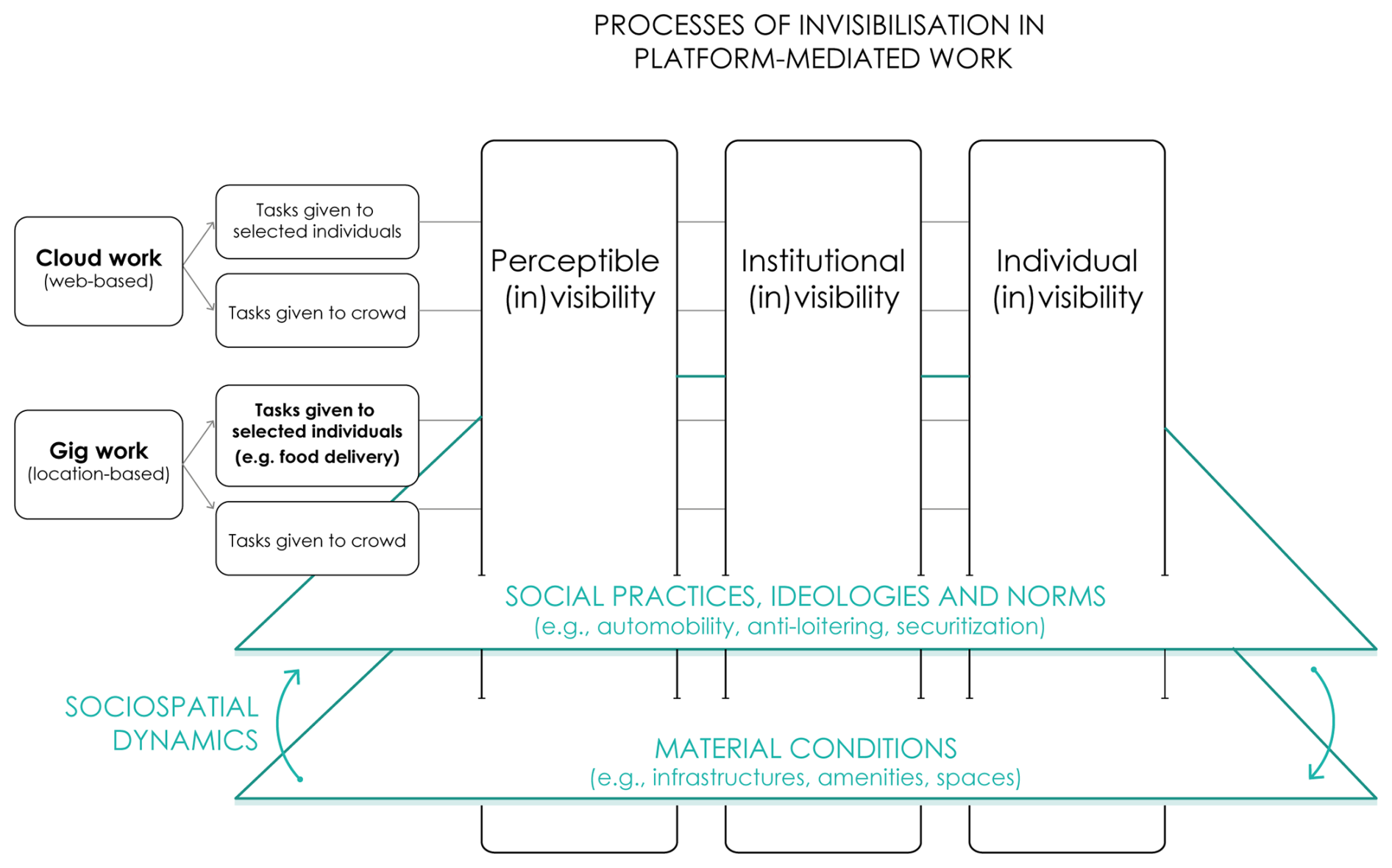
Figure 1Expanded framework for (in)visibility of platform-mediated work (based on Gruszka and Böhm, 2022), highlighting food delivery as a form of location-based gig work in which mechanisms of invisibility operate differently from those in cloud work.
Applying the expanded (in)visibility framework to the work of delivery riders exposes the contradictions of the visible invisibility paradox operating across the three domains of (in)visibility.
In perceptible terms, riders' presence in public space is often framed by stereotypes of reckless riding, which persist even in their absence. Several mechanisms contribute to this cultural devaluation and othering. First, institutional invisibility in terms of informal labour arrangements and piece wages creates time pressures with tangible traffic effects, encouraging speeding and risk taking, which transgress established rules governing public space (social-practice dynamics). Second, and paradoxically, these mobility practices increase riders' individual visibility within the platform ecosystem, as they are incentivised through higher commissions, algorithmic performance metrics, and customer ratings. Structurally enforced, these practices are constitutive of their invisible labour through self-management and “crafting the online self” (Gruszka and Böhm, 2022). Third, institutional invisibility within the transport regime leaves riders' infrastructural needs unaddressed (material conditions). Consequently, riders face both heightened physical and economic vulnerability in traffic, compounded by conflicts with pedestrians and other cyclists.
The appropriation of public space offers another example. Although delivery riders' joint presence is crucial for building connections and mutual support (social-practice dynamics), it is just as much a product of institutional invisibility in the labour regime and works to devalue their labour. On the one hand, the lack of regulation ensuring formal workplace provisions requires riders to appropriate public spaces, amenities, and infrastructure (material conditions). On the other hand, riders primarily claim space for unremunerated tasks, namely when waiting for orders, searching for destinations, and taking compulsory breaks (e.g. meals, conflict solving, moments of rest). In these moments, platform companies extract the value generated by their unpaid labour and embodied perceptibility, which functions as constant advertisement. Consequently, riders are exposed to sociocultural devaluation and othering because the informalisation of their labour compels them to perform tasks traditionally confined to the private sphere in public space.
(In)visibility is not merely a result of platform labour processes but a core component of platform-mediated labour management and value creation. Conceptions of (in)visibility in the platform economy range from notions of “disembodiment” (Cherry, 2016), and the sociotechnical disguise of workers and their labour (van Doorn, 2017) to labour informalisation practices (van Doorn, 2020) and value extraction from the enforcement of unpaid labour (Cini, 2023). Spatial considerations of (in)visibility have largely pertained to the technological erasure of personal encounters (van Doorn, 2017), and the economic devaluation of domestic and care work performed in private homes (Bauriedl and Strüver, 2020; Gruszka et al., 2024). Despite prolific scholarship on platform-based food delivery (Ecker and Strüver, 2022; Suslowicz and Brömmelstroet, 2024), it has not yet been theorised how sociocultural, socioeconomic, and sociolegal mechanisms of (in)visibility are (re)produced in public space (Hatton, 2017).
As shown through riders' lived experiences, platform work in public spaces can be just as much affected by cultural, legal, and spatial mechanisms of (in)visibility as domestic care work and click work performed via platforms. Conceiving spatial mechanisms of invisible work as pertaining to the material condition of one's presence alone misses how space as a social product can reproduce these forms of devaluation and cause cultural othering through sociocultural practice dynamics, norms, and institutional regulations or the lack thereof. Food-delivery workers face risks of income loss, policing, and marginalisation precisely because they are highly visible. Their labour informalisation and economic dependence on public space compel informal mobility and spatial practices, exposing them to traffic risks and heightened scrutiny.
The common framing of delivery riders recklessly claiming space as they transgress expectations of streets' “proper use” (Stehlin, 2014) disregards the underlying structural conditions of exploitative platform labour practices and institutional invisibility within labour and transport regimes that give rise to and partly necessitate such behaviour. Following Hatton's (2017) conception of sociospatial mechanisms of invisibility, according to which labour is economically devalued when performed in “non-traditional worksites”, we contend that public space must equally be regarded in such a way as to advance analyses of platform labour (in)visibility. While platform companies offload responsibility for workplace infrastructure and safety onto workers, cities, and the broader public, riders' precarity is compounded by sociolegal and -cultural obstacles that challenge their presence in public space.
The interplay among perceptible, institutional, and individual (in)visibility (Gruszka and Böhm, 2022) generates contingent dynamics that produce the seemingly paradoxical condition of being visibly invisible (Lee et al., 2016). To fully grasp this paradox and the complexity of platform workers' (in)visibility, we propose expanding Gruszka and Böhm's (2022) analytical framework to encompass both the material conditions and the social-practice dynamics that shape the everyday realities of platform-mediated work. The sociocultural mechanisms that devalue delivery riders' presence in public space are manifold (see Sect. 4), and include racialised and classed dynamics that lie beyond the scope of this article. Moreover, the paradox of visible invisibility is not exclusive to food-delivery riders, although it is perhaps most evident in this context. Rather, it can manifest in different spatial arrangements of platform work, which warrants further comparative analysis. Our conceptual refinements and theoretical arguments are further constrained by uneven geographical representation of the visible invisibility paradox and by the absence of systematic empirical application. Establishing their generalisability will require future research to conduct comparative analysis across locations and to examine how spatial dynamics of other location-based platform labour compare with those of food-delivery riders.
Acknowledging the spatial insights gained from the case of food-delivery riders enriches the initial definition of perceptible (in)visibility by broadening the scope of who is watching. As the experiences of delivery riders show, workers are seen in the flesh by other workers, clients, and the general public, including other cyclists or pedestrians. Considering space in both its material and social practice meaning reveals a larger set of actors who partake in the dynamics of everyday social interactions than originally conceived in relation to domestic care workers. At the same time, it reinforces the need to consider workers' positionality and affordance to negotiate their visibility – for instance, whether delivery riders are able to make use of the supposed affordances of working in public space (connections with workers, organising, gaining knowledge and therefore economic opportunities) strongly depends on their gender, class, race, and migrant status (Butler et al., 2024).
To this end, the extended framework for (in)visibility in platform-mediated work enables an exploration of contradictory dynamics. This reveals that safeguarding the interests of platform workers cannot be achieved through labour law alone. It also requires a critical scrutiny of contemporary transportation policy and prevailing cultural norms, operating across dominant notions of gendered, racialised, and class-based assumptions, cycling as non-commercial mobility, and car-centric urban infrastructure. In this regard, the issue at stake is how to protect public space as open and accessible to all under conditions of ongoing platformisation.
The article draws on a literature review of previously published work, which is fully cited in the reference list, and on qualitative interview data. The interview data are not publicly accessible due to confidentiality agreements specified in the human ethics protocol. No additional research data are available.
EB developed the article's main conceptual ideas, drawing on their empirical research. The authors jointly developed the article's outline, with EB preparing the main text and KG authoring the literature review on platform (in)visibility, shaping the article's refinement, and providing critical revisions throughout all stages of article development.
The contact author has declared that neither of the authors has any competing interests.
Publisher's note: Copernicus Publications remains neutral with regard to jurisdictional claims made in the text, published maps, institutional affiliations, or any other geographical representation in this paper. The authors bear the ultimate responsibility for providing appropriate place names. Views expressed in the text are those of the authors and do not necessarily reflect the views of the publisher.
We are deeply grateful to the interviewed delivery riders, whose insights and lived experiences informed the vignettes and guided our theoretical elaboration. We also thank the anonymous reviewers for their careful reading and poignant input on earlier versions of this paper, and the editors of this special issue for their valuable feedback.
This research was supported by a Postdoctoral Research Award Grant from the Centre for Urban Environments at the University of Toronto Mississauga. The authors acknowledge TUWien Bibliothek for the financial support through its Open Access Funding Programme.
This paper was edited by Laura Péaud and reviewed by two anonymous referees.
Agyeman, J. and Zavestoski, S.: The Invisible Cyclist: Transportation Justice. WORLD STREETS – A New Mobility Action Plan for 2022, https://worldstreets.wordpress.com/2012/02/24/the-invisible-cyclist-transportation-justice/ (last access: 7 October 2026), 2012.
Altenried, M., Animento, S., and Bojadžijev, M.: Plattform-Urbanismus: Arbeit, Migration und die Transformation des urbanen Raums, s\u, 9, 73–91, https://doi.org/10.36900/suburban.v9i1/2.605, 2021.
Attoh, K., Wells, K. J., and Cullen, D.: The work of waiting: migrant labour in the fulfillment city, J. Ethn. Migr. Stud., 50, 3839–3854, https://doi.org/10.1080/1369183X.2024.2379649, 2024.
Bauriedl, S. and Strüver, A.: Platform Urbanism: Technocapitalist Production of Private and Public Spaces, Urban Planning, 5, 267–276, https://doi.org/10.17645/up.v5i4.3414, 2020.
Bauriedl, S. and Strüver, A.: Platformized Cities and Urban Life: An Introduction, in: Platformization of Urban Life, edited by: Strüver, A., and Bauriedl, S., transcript Verlag, 11–36, https://doi.org/10.14361/9783839459645-002, 2022.
Bergvall-Kåreborn, B. and Howcroft, D.: Amazon Mechanical Turk and the commodification of labour: Amazon Mechanical Turk, New Tech. Work Employ., 29, 213–223, https://doi.org/10.1111/ntwe.12038, 2014.
Bingqian, Z.: Gender Segregation in the Labor Process: A Study on Female Food Delivery Riders, LLI, 10, 227–241, https://doi.org/10.6092/ISSN.2421-2695/20924, 2024.
Bissell, D.: Questioning quotation: Writing about interview experiences without using quotes, Area, 55, 191–196, https://doi.org/10.1111/area.12854, 2023.
Butler, O., Zampoukos, K., and Mitchell, D.: Antinomies of the gig economy: The annihilation of space by time or the annihilation of time by space?, Popul. Space Place, 30, 1–10, https://doi.org/10.1002/psp.2815, 2024.
Cant, C.: The wave of worker resistance in European food platforms 2016–17, Notes from Below, https://notesfrombelow.org/article/european-food-platform-strike-wave (last access: 7 October 2026), 2018.
Chen, Y. and Sun, P.: Digital labour platforms and national employment policies in China: Studying the case of food delivery platforms, International Labour Organization, ILO Working paper 99, https://doi.org/10.54394/KHET8772, 2023.
Cherry, M. A.: 4. Virtual work and invisible labor, in: Invisible Labor: Hidden Work in the Contemporary World, edited by: Crain, M. G., Poster, W. R., and Cherry, M. A., University of California Press, 71–86, https://doi.org/10.1525/9780520961630-006, 2016.
Christie, N. and Ward, H.: The health and safety risks for people who drive for work in the gig economy, J. Transp. Health, 13, 115–127, https://doi.org/10.1016/j.jth.2019.02.007, 2019.
Cini, L.: How algorithms are reshaping the exploitation of labour-power: Insights into the process of labour invisibilization in the platform economy, Theor. Soc., 52, 885–911, https://doi.org/10.1007/s11186-023-09520-9, 2023.
Cini, L.: Misbehaving for Deliveroo. How couriers' digital manipulation boosts the platform's business, Organization, 33, https://doi.org/10.1177/13505084251334994, 2025.
Demetriou, O.: Reconsidering the vignette as method. Art, ethnography, and refugee studies, Am. Ethnol., 50, 208–222, https://doi.org/10.1111/amet.13145, 2023.
Ecker, Y. and Strüver, A.: Towards alternative platform futures in post-pandemic cities? A case study on platformization and changing socio-spatial relations in on-demand food delivery, Digit. Geogr. Soc., 3, 100032, https://doi.org/10.1016/j.diggeo.2022.100032, 2022.
Ecker, Y. and Strüver, A.: Kommodifizierung, Fragmentierung, Auslagerung: Restrukturierung städtischer Räume und Arbeit in technologischen Experimenten mit Hausarbeit, s\u, 11, 17–45, https://doi.org/10.36900/suburban.v11i1/2.836, 2023.
Elwood, S.: Digital geographies, feminist relationality, Black and queer code studies: Thriving otherwise, Prog. Hum. Geog., 45, 209–228, https://doi.org/10.1177/0309132519899733, 2021.
Fraser, N.: Rethinking the Public Sphere: A Contribution to the Critique of Actually Existing Democracy, Social Text, 25/26, 56–80, https://doi.org/10.2307/466240, 1990.
Gerold, S., Gruszka, K., Sardadvar, K., Theine, H., and Pillinger, A.: Outsourcing Domestic Work in the Crisis of Social Reproduction: Platform-Mediated Cleaning and the Role of Clients, New Tech. Work Employ, 41, 186–197, https://doi.org/10.1111/ntwe.70015, 2025.
Gray, P. C.: “The Same Tools Work Everywhere”: Organizing Gig Workers with Foodsters United, Labour/Le Travail, 90, 41–84, https://muse.jhu.edu/pub/151/article/870057 (last access: 7 October 2026), 2022.
Gruszka, K. and Böhm, M.: Out of sight, out of mind? (In)visibility of/in platform-mediated work, New Media Soc., 24, 1852–1871, https://doi.org/10.1177/1461444820977209, 2022.
Gruszka, K., Pillinger, A., Gerold, S., and Theine, H.: (In)visible by Design: An Analysis of a Domestic Labor Platform, Crit. Sociol., 52, 903–922, https://doi.org/10.1177/08969205241276803, 2024.
Hatton, E.: Mechanisms of invisibility: Rethinking the concept of invisible work, Work Employ. Soc., 31, 336–351, https://doi.org/10.1177/0950017016674894, 2017.
Hoffmann, M. L., and Lugo, A.: Who Is “World Class”? Transportation Justice and Bicycle Policy. Urbanities, 4, 45–61, https://www.anthrojournal-urbanities.com/docs/tableofcontents_6/5-%20Hoffmann-Lugo.pdf, (last access: 7 October 2026), 2014
Irani, L.: The cultural work of microwork, New Media Soc., 17, 720–739, https://doi.org/10.1177/1461444813511926, 2015.
Kaplan Daniels, A.: Invisible work, Soc. Probl., 34, 403–415, https://doi.org/10.2307/800538, 1987.
Keller, M.: “When Clean Angels Calls, I Run”: Working Conditions of a Gigified Care-Worker, in: Platformization of Urban Life, edited by: Strüver, A. and Bauriedl, S., transcript Verlag, 135–148, https://doi.org/10.1515/9783839459645-009, 2022.
Kluzik, V.: Governing invisibility in the platform economy: Excavating the logics of platform care, Internet Policy Rev., 11, 1–21, https://doi.org/10.14763/2022.1.1636, 2022.
Koeppel, D.: Invisible Riders, UTNE, https://www.utne.com/community/invisibleriders/ (last access: 7 October 2026), 2006.
Kohlrausch, B. and Weber, L.: Gender Relations at the Digitalised Workplace: The Interrelation Between Digitalisation, Gender, and Work, Gend. Res., 21, 13–31, https://doi.org/10.13060/gav.2020.010, 2020.
Komlosy, A.: Work: The Last 1000 Years, Verso, ISBN 1786634139, 2018.
Kwan, H.: Women's Solidarity, Communicative Space, the Gig Economy's Social Reproduction and Labour Process: The Case of Female Platform Drivers in China, Crit. Sociol., 48, 1221–1236, https://doi.org/10.1177/08969205221101451, 2022.
Lachapelle, U., Carpentier-Laberge, D., Cloutier, M.-S., and Ranger, L.: A framework for analyzing collisions, near misses and injuries of commercial cyclists, J. Transp. Geogr., 90, 102937, https://doi.org/10.1016/j.jtrangeo.2020.102937, 2021.
Le, L. and Siddiqui, Z.: Catching a break: How gig workers find rest, Rest of World, https://restofworld.org/2024/gig-worker-rest-breaks/ (last access: 17 September 2026), 2024.
Lee, B.-Y.: Understanding justice in the platform economy: A qualitative case study of platform-based food delivery work, J. Ind. Relat., 66, 291–315, https://doi.org/10.1177/00221856241237032, 2024.
Lee, D. J.: Delivering Justice: Food Delivery Cyclists in New York City, Doctoral Dissertation, CUNY – City University of New York, in: Dissertations, Theses, and Capstone Projects, CUNY Academic Works, https://academicworks.cuny.edu/gc_etds/2794 (last access: 7 October 2026), 2018.
Lee, D. J. and Wang, J.: From threat to essentially sacrificial: Racial capitalism, (im)mobilities, and food delivery workers in New York City during Covid-19, Mobilities, 19, 1023–1040, https://doi.org/10.1080/17450101.2024.2337260, 2024.
Lee, D. J., Ho, H., Banks, M., Giampieri, M., Chen, X., and Le, D.: Delivering (in)justice: Food delivery cyclists in New York City, in: Bicycle Justice and Urban Transformation, Routledge, 114–129, https://doi.org/10.4324/9781315668840-8, 2016.
Lubitow, A.: Narratives of Marginalized Cyclists: Understanding Obstacles to Utilitarian Cycling Among Women and Minorities in Portland, OR, Portland State University, https://doi.org/10.15760/trec.171, 2017.
Madanipour, A.: Rethinking Public Space, Edward Elgar Publishing, https://doi.org/10.4337/9781800884588, 2023.
Massey, D. B.: For space, Sage, ISBN 978-1412903622, 2005.
Milkman, R., Elliott-Negri, L., Griesbach, K., and Reich, A.: Gender, Class, and the Gig Economy: The Case of Platform-Based Food Delivery, Crit. Sociol., 47, 357–372, https://doi.org/10.1177/0896920520949631, 2021.
NYC Department of Consumer and Worker Protection: A Minimum Pay Rate for App-Based Restaurant Delivery Workers in NYC, https://www.nyc.gov/assets/dca/downloads/pdf/workers/Delivery-Worker-Study-November-2022.pdf (last access: 7 October 2026), 2022.
NYC Department of Transportation: Bike Network and Ridership, https://www.nyc.gov/html/dot/html/bicyclists/bikestats.shtml (last access: 7 October 2026), 2025.
Orth, B.: Riders United Will Never Be Divided?: A Cautionary Tale of Disrupting the Platformization of Urban Space, in: Urban Studies, edited by: Strüver, A. and Bauriedl, S., transcript Verlag, 185–204, https://doi.org/10.14361/9783839459645-012, 2022.
Palacios Crisóstomo, N. and Kaufmann, D.: Strategies and Tactics in Platform Urbanism: Contested Spatial Production through Quick Delivery Platforms in Berlin and Barcelona, Int. J. Urban Regional, 48, 833–854, https://doi.org/10.1111/1468-2427.13269, 2024.
Pedroso, D. and Aldred, R.: In the opposite lane: How Women of Colour experience, negotiate and apply an oppositional gaze to dominant cycling discourses, Transp. Res. Interdiscip. Persp., 19, 100828, https://doi.org/10.1016/j.trip.2023.100828, 2023.
Pignolo, L.: A “catalogue” for clients: Domestic labour platforms, informality and (in)visibility, Int. J. Sociol. Soc. Policy, 1–15, https://doi.org/10.1108/IJSSP-01-2025-0079 2025.
Popan, C. and Anaya-Boig, E.: The intersectional precarity of platform cycle delivery workers, SocArXiv [preprint], https://ideas.repec.org//p/osf/socarx/tk6v8.html (last access: 7 October 2026), 2021.
Pucher, J. and Buehler, R.: Safer Cycling Through Improved Infrastructure, Am. J. Public Health, 106, 2089–2091, https://doi.org/10.2105/AJPH.2016.303507, 2016.
Pulignano, V., Marà, C., Franke, M., and Muszynski, K.: Informal employment on domestic care platforms: A study on the individualisation of risk and unpaid labour in mature market contexts, Transfer, 1–16, https://doi.org/10.1177/10242589231177353, 2023.
Ravensbergen, L.: “I wouldn't take the risk of the attention, you know? Just a lone girl biking”: examining the gendered and classed embodied experiences of cycling, Soc. Cult. Geog., 23, 678–696, https://doi.org/10.1080/14649365.2020.1806344, 2022.
Richardson, L.: Coordinating the city: Platforms as flexible spatial arrangements, Urban Geogr., 41, 458–461, https://doi.org/10.1080/02723638.2020.1717027, 2020
Rodriguez, L.: Labour law and decent work in the platform economy, Routledge, https://doi.org/10.4324/9781003491255, 2025.
Rodríguez-Modroño, P., Agenjo-Calderón, A., and López-Igual, P.: Platform work in the domestic and home care sector: New mechanisms of invisibility and exploitation of women migrant workers, Gend. Dev., 30, 619–635, https://doi.org/10.1080/13552074.2022.2121060, 2022.
Rose, M.: A Place for Other Stories: Authorship and Evidence in Experimental Times, GeoHumanities, 2, 132–148, https://doi.org/10.1080/2373566X.2016.1157031, 2016.
Salvagni, J., Grohmann, R., and Matos, É.: Gendering platform co-operativism: The rise of women-owned rider co-operatives in Brazil and Spain, Gend. Dev., 30, 707–724, https://doi.org/10.1080/13552074.2022.2131254, 2022.
Sannon, S. and Cosley, D.: Privacy, Power, and Invisible Labor on Amazon Mechanical Turk, in: Proceedings of the 2019 CHI Conference on Human Factors in Computing Systems, Association for Computing Machinery, New York, NY, USA, 1–12, https://doi.org/10.1145/3290605.3300512, 2019.
Schöneich, S.: “On a Hot Day in the Field…”: – The Art of Writing Ethnographic Vignettes, Ethnoscripts, 23, 116–124, https://doi.org/10.15460/ethnoscripts.2021.23.1.1666, 2021.
Shapiro, A.: Platform urbanism in a pandemic: Dark stores, ghost kitchens, and the logistical-urban frontier, J. Consum. Cult., 23, 168–187, https://doi.org/10.1177/14695405211069983, 2023.
Smartt Gullion, J.: Writing Ethnography, Rotterdam: Sense Publishers, https://doi.org/10.1007/978-94-6300-381-0, 2016.
Stehlin, J.: Regulating Inclusion: Spatial Form, Social Process, and the Normalization of Cycling Practice in the USA, Mobilities, 9, 21–41, https://doi.org/10.1080/17450101.2013.784527, 2014.
Sun, P.: U-Turn: Female Food Couriers Find Strength in Stereotypes, Sixth Tone, https://www.sixthtone.com/news/1016045 (last access: 7 October 2026), 2024.
Suslowicz, J. and Brömmelstroet, M. T.: Playing in Traffic? Exploring the Intersection of Platforms, Agency, and Space in Bicycle Courier Mobilities, J. Urban Technol., 31, 129–155, https://doi.org/10.1080/10630732.2024.2311636, 2024.
Tassinari, A. and Maccarrone, V.: Riders on the Storm: Workplace Solidarity among Gig Economy Couriers in Italy and the UK, Work, Work Employ. Soc., 34, 35–54, https://doi.org/10.1177/0950017019862954, 2020.
Taylor, D.: Life as a food delivery worker: “Sometimes men open the door naked.”, The Guardian, https://www.theguardian.com/business/2025/nov/16/life-food-delivery-worker-sometimes-men-open-door-naked (last access: 7 October 2026), 2025.
Ticona, J. and Mateescu, A.: Trusted strangers: Carework platforms' cultural entrepreneurship in the on-demand economy, New Media Soc., 20, 4384–4404, https://doi.org/10.1177/1461444818773727, 2018.
Toxtli, C., Suri, S., and Savage, S.: Quantifying the Invisible Labor in Crowd Work, Proc. ACM Hum. Comput. Interact., 5, 1–26, https://doi.org/10.1145/3476060, 2021.
Vaiou, D. and Kalandides, A.: Cities of “others”: public space and everyday practices, Geogr. Helv., 64, 11–20, https://doi.org/10.5194/gh-64-11-2009, 2009.
van Doorn, N.: Platform labor: On the gendered and racialized exploitation of low-income service work in the “on-demand” economy, Inform. Commun. Soc., 20, 898–914, https://doi.org/10.1080/1369118X.2017.1294194, 2017.
van Doorn, N.: Stepping stone or dead end? The ambiguities of platform-mediated domestic work under conditions of austerity urbanism, in: Working in the Context of Austerity: Challenges and Struggles, edited by: Baines, D. and Cunnningham, I., Bristol University Press, 49–69, https://doi.org/10.1332/policypress/9781529208672.003.0003, 2020.
Villegas, M. N.: The difficult balance of New York's female delivery workers in a predominantly male-dominated job, EL PAÍS English, https://english.elpais.com/usa/2025-03-16/the-difficult-balance-of-new-yorks-female-delivery-workers-in-a-predominantly-male-dominated-job.html (last access: 7 October 2026), 2025.
Wells, K. and Stratta, I.: The Instant Delivery Workplace in D.C, Georgetown University, 28 pp., 2023.
Wells, K. J., Attoh, K. A., and Cullen, D.: Disrupting D.C: The rise of Uber and the fall of the city, Princeton University Press, ISBN 9780691249759, 2023.
Widera, J.: 21st-Century Sandwichmen: How Bicycle Couriers Contribute to Urban Food Delivery Platforms, Lateral, 14, https://doi.org/10.25158/L14.2.4, 2025.
Woodcock, J.: The Fight Against Platform Capitalism: An Inquiry into the Global Struggles of the Gig Economy, University of Westminster Press, https://doi.org/10.16997/book51, 2021.
Woodcock, J. and Graham, M.: The Gig economy: A critical introduction, Polity, ISBN 9781509536351, 2020.
Zieleniec, A.: Lefebvre's Politics of Space: Planning the Urban as Oeuvre, Urban Planning, 3, 5–15, https://doi.org/10.17645/up.v3i3.1343, 2018.
- Abstract
- Introduction
- Conceptual approach and research context
- Existing perspectives on (in)visibility in platform labour
- Unpacking the (in)visibilities of food-delivery riders in public space
- An expanded perspective on (in)visibility in platform labour
- Conclusion
- Data availability
- Author contributions
- Competing interests
- Disclaimer
- Acknowledgements
- Financial support
- Review statement
- References
- Abstract
- Introduction
- Conceptual approach and research context
- Existing perspectives on (in)visibility in platform labour
- Unpacking the (in)visibilities of food-delivery riders in public space
- An expanded perspective on (in)visibility in platform labour
- Conclusion
- Data availability
- Author contributions
- Competing interests
- Disclaimer
- Acknowledgements
- Financial support
- Review statement
- References